{"title":"Retrosynthesis Zero: Self-Improving Global Synthesis Planning Using Reinforcement Learning","authors":"Jiasheng Guo, Chenning Yu, Kenan Li, Yijian Zhang, Guoqiang Wang, Shuhua Li* and Hao Dong*, ","doi":"10.1021/acs.jctc.4c00071","DOIUrl":null,"url":null,"abstract":"<p >The field of computer-aided synthesis planning (CASP) has witnessed significant growth in recent years. Still, many CASP programs rely on large data sets to train neural networks, resulting in limitations due to the data quality and prior knowledge from chemists. In response, we propose Retrosynthesis Zero (ReSynZ), a reaction template-based method that combines Monte Carlo Tree Search with reinforcement learning inspired by AlphaGo Zero. Unlike other single-step reaction template-based CASP methods, ReSynZ takes complete synthesis paths for complex molecules, determined by reaction rules, as input for training the neural network. ReSynZ enables neural networks trained with relatively small reaction data sets (tens of thousands of data) to generate multiple synthesis pathways for a target molecule and suggest possible reaction conditions. On multiple data sets of molecular retrosynthesis, ReSynZ demonstrates excellent predictive performance compared to existing algorithms. The advantages, such as self-improving model features, flexible reward settings, the potential to surpass human limitations in chemical synthesis route planning, and others, make ReSynZ a valuable tool in chemical synthesis design.</p>","PeriodicalId":45,"journal":{"name":"Journal of Chemical Theory and Computation","volume":"20 11","pages":"4921–4938"},"PeriodicalIF":5.5000,"publicationDate":"2024-05-15","publicationTypes":"Journal Article","fieldsOfStudy":null,"isOpenAccess":false,"openAccessPdf":"","citationCount":"0","resultStr":null,"platform":"Semanticscholar","paperid":null,"PeriodicalName":"Journal of Chemical Theory and Computation","FirstCategoryId":"92","ListUrlMain":"https://pubs.acs.org/doi/10.1021/acs.jctc.4c00071","RegionNum":1,"RegionCategory":"化学","ArticlePicture":[],"TitleCN":null,"AbstractTextCN":null,"PMCID":null,"EPubDate":"","PubModel":"","JCR":"Q2","JCRName":"CHEMISTRY, PHYSICAL","Score":null,"Total":0}
引用次数: 0
Abstract
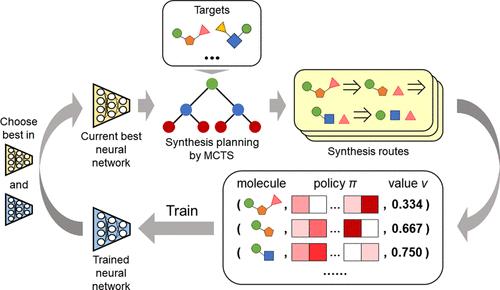
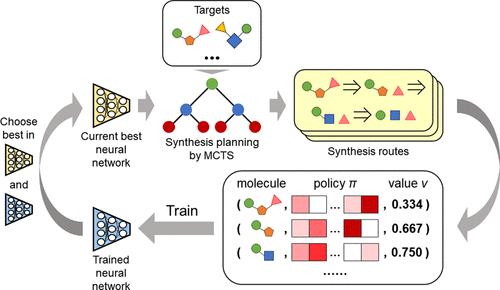
The field of computer-aided synthesis planning (CASP) has witnessed significant growth in recent years. Still, many CASP programs rely on large data sets to train neural networks, resulting in limitations due to the data quality and prior knowledge from chemists. In response, we propose Retrosynthesis Zero (ReSynZ), a reaction template-based method that combines Monte Carlo Tree Search with reinforcement learning inspired by AlphaGo Zero. Unlike other single-step reaction template-based CASP methods, ReSynZ takes complete synthesis paths for complex molecules, determined by reaction rules, as input for training the neural network. ReSynZ enables neural networks trained with relatively small reaction data sets (tens of thousands of data) to generate multiple synthesis pathways for a target molecule and suggest possible reaction conditions. On multiple data sets of molecular retrosynthesis, ReSynZ demonstrates excellent predictive performance compared to existing algorithms. The advantages, such as self-improving model features, flexible reward settings, the potential to surpass human limitations in chemical synthesis route planning, and others, make ReSynZ a valuable tool in chemical synthesis design.
期刊介绍:
The Journal of Chemical Theory and Computation invites new and original contributions with the understanding that, if accepted, they will not be published elsewhere. Papers reporting new theories, methodology, and/or important applications in quantum electronic structure, molecular dynamics, and statistical mechanics are appropriate for submission to this Journal. Specific topics include advances in or applications of ab initio quantum mechanics, density functional theory, design and properties of new materials, surface science, Monte Carlo simulations, solvation models, QM/MM calculations, biomolecular structure prediction, and molecular dynamics in the broadest sense including gas-phase dynamics, ab initio dynamics, biomolecular dynamics, and protein folding. The Journal does not consider papers that are straightforward applications of known methods including DFT and molecular dynamics. The Journal favors submissions that include advances in theory or methodology with applications to compelling problems.




 京公网安备 11010802042870号
京ICP备2023020795号-1
京公网安备 11010802042870号
京ICP备2023020795号-1

 分享
分享
 求助内容:
求助内容: 应助结果提醒方式:
 扫码关注我们
