{"title":"Combined ultra-microelectrode: Exploring new potentials for in vivo/in situ ascorbic acid electroanalysis","authors":"Samira Fathi, Amir Hatamie","doi":"10.1002/elan.202400133","DOIUrl":null,"url":null,"abstract":"<p>Miniaturized and portable analytical tools show promise for sophisticated analysis, particularly in biological systems such as fruits, and they are suitable for advanced agriculture and related food industries. In this study, we developed combined ultra-microelectrodes (UME) by modifying a microscale carbon fiber electrode (33 μm) coated with an Au nano-film in a micropipette-tip system. The proposed UME@Au exhibited a linear response to AC concentrations ranging from 30 to 1400 μM, with a 16 μM limit of detection. It demonstrated the ability to perform in vivo-in vitro AC analysis in micro-zones and volumes, such as different points of fruit tissue (Such as lemon) and within the body of a living plant (Such as Cactus arms and trunk), serving as a tiny implanted probe.</p><p>In the first part of our study, we analyzed AC levels in lemon tissue directly. Our measurements revealed that AC levels are distributed heterogeneously in a single fruit. Additionally, stored AC levels depend on the color of the lemon (yellow ones have higher levels than the green ones). Furthermore, the UME was applied to control AC levels in different storage conditions, including opened containers, airtight containers, with and without exposing daylight, etc.</p><p>In the second part, the UME@Au was utilized as an implanted sensor for in vivo analysis of AC in different parts of the cactus, recognized as a source of AC. No sample preparation is needed with minimum damage. The implanted microsensor could perform electroanalysis inside the live plant and stored parenchyma cells, etc. Notably, our results showed that AC levels are higher in the younger arms compared to the older ones, and so on.</p><p>Based on our findings, the miniaturized, small, cheap, user-friendly electrode demonstrated many capabilities, such as being implantable, having satisfactory stability, and not requiring sample preparations for analysis. It can open up a new window for micro-electroanalysis in food and analytical plant sciences. We predict that this microscale platform can be modified and used for bioanalysis of other (bio)targets, such as vitamins, ions, and even the detection of plant pathogens in plants and crops directly. This involvement in the smart and modern farming industry is anticipated in the near future.</p>","PeriodicalId":162,"journal":{"name":"Electroanalysis","volume":"37 1","pages":""},"PeriodicalIF":2.3000,"publicationDate":"2024-05-07","publicationTypes":"Journal Article","fieldsOfStudy":null,"isOpenAccess":false,"openAccessPdf":"","citationCount":"0","resultStr":null,"platform":"Semanticscholar","paperid":null,"PeriodicalName":"Electroanalysis","FirstCategoryId":"92","ListUrlMain":"https://analyticalsciencejournals.onlinelibrary.wiley.com/doi/10.1002/elan.202400133","RegionNum":3,"RegionCategory":"化学","ArticlePicture":[],"TitleCN":null,"AbstractTextCN":null,"PMCID":null,"EPubDate":"","PubModel":"","JCR":"Q2","JCRName":"CHEMISTRY, ANALYTICAL","Score":null,"Total":0}
引用次数: 0
Abstract
Miniaturized and portable analytical tools show promise for sophisticated analysis, particularly in biological systems such as fruits, and they are suitable for advanced agriculture and related food industries. In this study, we developed combined ultra-microelectrodes (UME) by modifying a microscale carbon fiber electrode (33 μm) coated with an Au nano-film in a micropipette-tip system. The proposed UME@Au exhibited a linear response to AC concentrations ranging from 30 to 1400 μM, with a 16 μM limit of detection. It demonstrated the ability to perform in vivo-in vitro AC analysis in micro-zones and volumes, such as different points of fruit tissue (Such as lemon) and within the body of a living plant (Such as Cactus arms and trunk), serving as a tiny implanted probe.
In the first part of our study, we analyzed AC levels in lemon tissue directly. Our measurements revealed that AC levels are distributed heterogeneously in a single fruit. Additionally, stored AC levels depend on the color of the lemon (yellow ones have higher levels than the green ones). Furthermore, the UME was applied to control AC levels in different storage conditions, including opened containers, airtight containers, with and without exposing daylight, etc.
In the second part, the UME@Au was utilized as an implanted sensor for in vivo analysis of AC in different parts of the cactus, recognized as a source of AC. No sample preparation is needed with minimum damage. The implanted microsensor could perform electroanalysis inside the live plant and stored parenchyma cells, etc. Notably, our results showed that AC levels are higher in the younger arms compared to the older ones, and so on.
Based on our findings, the miniaturized, small, cheap, user-friendly electrode demonstrated many capabilities, such as being implantable, having satisfactory stability, and not requiring sample preparations for analysis. It can open up a new window for micro-electroanalysis in food and analytical plant sciences. We predict that this microscale platform can be modified and used for bioanalysis of other (bio)targets, such as vitamins, ions, and even the detection of plant pathogens in plants and crops directly. This involvement in the smart and modern farming industry is anticipated in the near future.
期刊介绍:
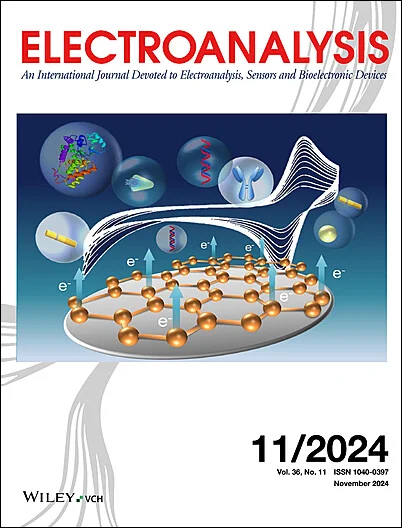
Electroanalysis is an international, peer-reviewed journal covering all branches of electroanalytical chemistry, including both fundamental and application papers as well as reviews dealing with new electrochemical sensors and biosensors, nanobioelectronics devices, analytical voltammetry, potentiometry, new electrochemical detection schemes based on novel nanomaterials, fuel cells and biofuel cells, and important practical applications.
Serving as a vital communication link between the research labs and the field, Electroanalysis helps you to quickly adapt the latest innovations into practical clinical, environmental, food analysis, industrial and energy-related applications. Electroanalysis provides the most comprehensive coverage of the field and is the number one source for information on electroanalytical chemistry, electrochemical sensors and biosensors and fuel/biofuel cells.



 京公网安备 11010802042870号
京ICP备2023020795号-1
京公网安备 11010802042870号
京ICP备2023020795号-1

 分享
分享
 求助内容:
求助内容: 应助结果提醒方式:
 扫码关注我们
