Qianming Zhao, Meng Qi, Bo Jing, Fuchun Jian, Pihong Gong, Chenyang Lu, Yaqun Yan, Zhiyang Pei, Changshen Ning
{"title":"Cryptosporidium spp. in large-scale sheep farms in China: prevalence and genetic diversity.","authors":"Qianming Zhao, Meng Qi, Bo Jing, Fuchun Jian, Pihong Gong, Chenyang Lu, Yaqun Yan, Zhiyang Pei, Changshen Ning","doi":"10.1038/s41598-024-62110-2","DOIUrl":null,"url":null,"abstract":"<p><p>Cryptosporidium spp. are significant zoonotic intestinal parasites that induce diarrhea and even death across most vertebrates, including humans. Previous studies showed that sheep are important hosts for Cryptosporidium and that its distribution in sheep is influenced by geography, feeding patterns, age, and season. Environmental factors also influence the transmission of Cryptosporidium. Molecular studies of Cryptosporidium in sheep have been conducted in only a few regions of China, and studies into the effect of sheep-housing environments on Cryptosporidium transmission are even rarer. To detect the prevalence of Cryptosporidium in large-scale sheep-housing farms, a total of 1241 fecal samples were collected from sheep, 727 environmental samples were taken from sheep housing, and 30 water samples were collected in six regions of China. To ascertain the existence of the parasite and identify the species of Cryptosporidium spp., we conducted nested PCR amplification of DNA extracted from all samples using the small-subunit (SSU) rRNA gene as a target. For a more in-depth analysis of Cryptosporidium spp. subtypes, C. xiaoi-and C. ubiquitum-positive samples underwent separate nested PCR amplification targeting the 60 kDa glycoprotein (gp60) gene. The amplification of the Cryptosporidium spp. SSU rRNA gene locus from the whole genomic DNA of all samples yielded a positive rate of 1.2% (20/1241) in fecal samples, 0.1% (1/727) in environmental samples, and no positive samples were found in water samples. The prevalence of Cryptosporidium spp. infection in large-scale housed sheep was 1.7%, which was higher than that in free-ranging sheep (0.0%). The highest prevalence of infection was found in weaning lambs (6.8%). Among the different seasons, the peaks were found in the fall and winter. The most prevalent species were C. xiaoi and C. ubiquitum, with the former accounting for the majority of infections. The distribution of C. xiaoi subtypes was diverse, with XXIIIc (n = 1), XXIIId (n = 2), XXIIIe (n = 2), and XXIIIl (n = 4) identified. In contrast, only one subtype, XIIa (n = 9), was found in C. ubiquitum. In this study, C. xiaoi and C. ubiquitum were found to be the predominant species, and Cryptosporidium was found to be present in the environment. These findings provide an important foundation for the comprehensive prevention and management of Cryptosporidium in intensively reared sheep. Furthermore, by elucidating the prevalence of Cryptosporidium in sheep and its potential role in environmental transmission, this study deepens our understanding of the intricate interactions between animal health, environmental contamination, and public health dynamics.</p>","PeriodicalId":21811,"journal":{"name":"Scientific Reports","volume":"14 1","pages":"11218"},"PeriodicalIF":3.9000,"publicationDate":"2024-05-16","publicationTypes":"Journal Article","fieldsOfStudy":null,"isOpenAccess":false,"openAccessPdf":"https://www.ncbi.nlm.nih.gov/pmc/articles/PMC11099184/pdf/","citationCount":"0","resultStr":null,"platform":"Semanticscholar","paperid":null,"PeriodicalName":"Scientific Reports","FirstCategoryId":"103","ListUrlMain":"https://doi.org/10.1038/s41598-024-62110-2","RegionNum":2,"RegionCategory":"综合性期刊","ArticlePicture":[],"TitleCN":null,"AbstractTextCN":null,"PMCID":null,"EPubDate":"","PubModel":"","JCR":"Q1","JCRName":"MULTIDISCIPLINARY SCIENCES","Score":null,"Total":0}
引用次数: 0
Abstract
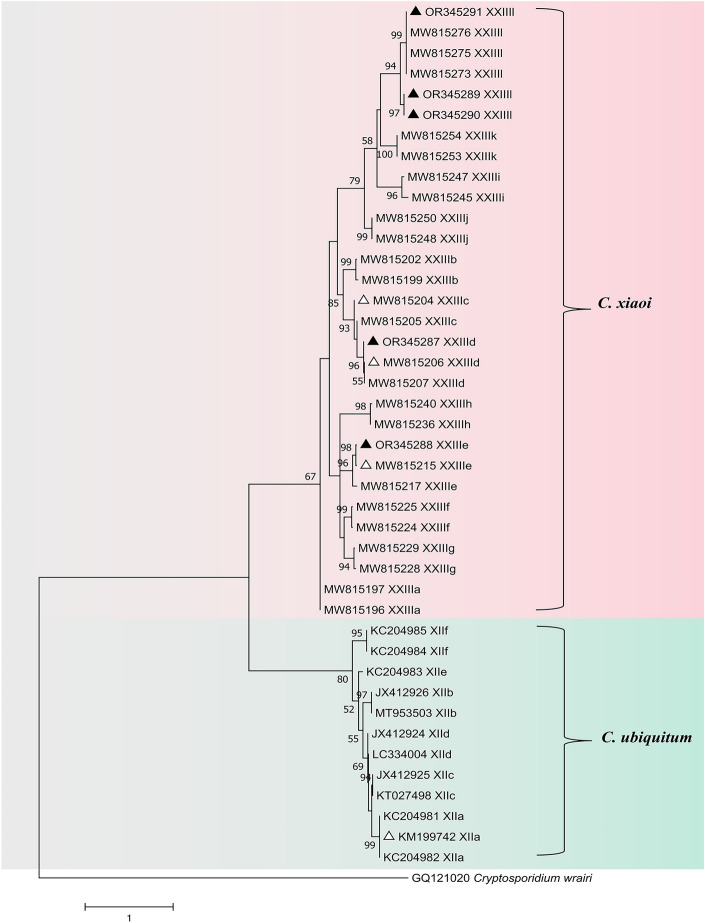
Cryptosporidium spp. are significant zoonotic intestinal parasites that induce diarrhea and even death across most vertebrates, including humans. Previous studies showed that sheep are important hosts for Cryptosporidium and that its distribution in sheep is influenced by geography, feeding patterns, age, and season. Environmental factors also influence the transmission of Cryptosporidium. Molecular studies of Cryptosporidium in sheep have been conducted in only a few regions of China, and studies into the effect of sheep-housing environments on Cryptosporidium transmission are even rarer. To detect the prevalence of Cryptosporidium in large-scale sheep-housing farms, a total of 1241 fecal samples were collected from sheep, 727 environmental samples were taken from sheep housing, and 30 water samples were collected in six regions of China. To ascertain the existence of the parasite and identify the species of Cryptosporidium spp., we conducted nested PCR amplification of DNA extracted from all samples using the small-subunit (SSU) rRNA gene as a target. For a more in-depth analysis of Cryptosporidium spp. subtypes, C. xiaoi-and C. ubiquitum-positive samples underwent separate nested PCR amplification targeting the 60 kDa glycoprotein (gp60) gene. The amplification of the Cryptosporidium spp. SSU rRNA gene locus from the whole genomic DNA of all samples yielded a positive rate of 1.2% (20/1241) in fecal samples, 0.1% (1/727) in environmental samples, and no positive samples were found in water samples. The prevalence of Cryptosporidium spp. infection in large-scale housed sheep was 1.7%, which was higher than that in free-ranging sheep (0.0%). The highest prevalence of infection was found in weaning lambs (6.8%). Among the different seasons, the peaks were found in the fall and winter. The most prevalent species were C. xiaoi and C. ubiquitum, with the former accounting for the majority of infections. The distribution of C. xiaoi subtypes was diverse, with XXIIIc (n = 1), XXIIId (n = 2), XXIIIe (n = 2), and XXIIIl (n = 4) identified. In contrast, only one subtype, XIIa (n = 9), was found in C. ubiquitum. In this study, C. xiaoi and C. ubiquitum were found to be the predominant species, and Cryptosporidium was found to be present in the environment. These findings provide an important foundation for the comprehensive prevention and management of Cryptosporidium in intensively reared sheep. Furthermore, by elucidating the prevalence of Cryptosporidium in sheep and its potential role in environmental transmission, this study deepens our understanding of the intricate interactions between animal health, environmental contamination, and public health dynamics.
期刊介绍:
We publish original research from all areas of the natural sciences, psychology, medicine and engineering. You can learn more about what we publish by browsing our specific scientific subject areas below or explore Scientific Reports by browsing all articles and collections.
Scientific Reports has a 2-year impact factor: 4.380 (2021), and is the 6th most-cited journal in the world, with more than 540,000 citations in 2020 (Clarivate Analytics, 2021).
•Engineering
Engineering covers all aspects of engineering, technology, and applied science. It plays a crucial role in the development of technologies to address some of the world''s biggest challenges, helping to save lives and improve the way we live.
•Physical sciences
Physical sciences are those academic disciplines that aim to uncover the underlying laws of nature — often written in the language of mathematics. It is a collective term for areas of study including astronomy, chemistry, materials science and physics.
•Earth and environmental sciences
Earth and environmental sciences cover all aspects of Earth and planetary science and broadly encompass solid Earth processes, surface and atmospheric dynamics, Earth system history, climate and climate change, marine and freshwater systems, and ecology. It also considers the interactions between humans and these systems.
•Biological sciences
Biological sciences encompass all the divisions of natural sciences examining various aspects of vital processes. The concept includes anatomy, physiology, cell biology, biochemistry and biophysics, and covers all organisms from microorganisms, animals to plants.
•Health sciences
The health sciences study health, disease and healthcare. This field of study aims to develop knowledge, interventions and technology for use in healthcare to improve the treatment of patients.



 京公网安备 11010802042870号
京ICP备2023020795号-1
京公网安备 11010802042870号
京ICP备2023020795号-1

 分享
分享
 求助内容:
求助内容: 应助结果提醒方式:
 扫码关注我们
