Yebohao Zhou, Ziwei Zeng, Ze Li, Lei Ruan, Hao Xie, Fujin Ye, Liang Huang, Huashan Liu, Liang Kang
{"title":"The relationship of KRAS expression with KRAS status, prognosis, and tumor-infiltrated T lymphocytes in colorectal cancer.","authors":"Yebohao Zhou, Ziwei Zeng, Ze Li, Lei Ruan, Hao Xie, Fujin Ye, Liang Huang, Huashan Liu, Liang Kang","doi":"10.1177/17562848241249387","DOIUrl":null,"url":null,"abstract":"<p><strong>Background: </strong>The significance of Kirsten rat sarcoma viral oncogene (KRAS) mutation in colorectal cancer (CRC) is well established; yet, its association with KRAS expression and prognosis warrants further investigation. While high KRAS expression is commonly linked with poorer prognosis in other cancers, its role in CRC remains relatively understudied.</p><p><strong>Objective: </strong>To explore the correlation between KRAS expression, KRAS status, prognosis, and tumor-infiltrating T lymphocyte density in CRC.</p><p><strong>Design: </strong>Single-center retrospective study.</p><p><strong>Methods: </strong>Conducted between 2010 and 2020, this study utilized tumor samples to assess KRAS expression and quantify CD3+/CD8+ T lymphocytes. The Cox proportional hazards model and linear regression analysis were employed to examine the relationship between KRAS expression, prognosis, and tumor-infiltrating T lymphocytes.</p><p><strong>Results: </strong>This study included 265 CRC patients who underwent radical surgery. No significant association was observed between KRAS expression and KRAS status (<i>p</i> > 0.05). High KRAS expression was associated with poorer overall survival and disease-free survival (<i>p</i> < 0.05). Subgroup analysis revealed that high KRAS expression remained indicative of a worse prognosis in the group with mismatch repair-deficient (dMMR) and KRAS mutant type (<i>p</i> < 0.05). Multivariate analysis confirmed KRAS expression as an unfavorable prognostic factor (<i>p</i> < 0.05). However, the significance of KRAS expression was lost in the dMMR and KRAS mutant-type group regarding overall survival (<i>p</i> > 0.05). Notably, KRAS expression showed a negative correlation with the density of CD8+ T lymphocytes in tumor tissue (<i>p</i> < 0.05), a finding also observed in the dMMR group (<i>p</i> < 0.05).</p><p><strong>Conclusion: </strong>No association was found between KRAS expression and KRAS mutation status in CRC. Higher KRAS expression was indicative of poorer prognosis for CRC patients, except for those with proficient mismatch repair and KRAS wild type. In addition, in patients with dMMR, KRAS expression was associated with a lower density of CD8+ T lymphocytes in tumor tissue.</p>","PeriodicalId":48770,"journal":{"name":"Therapeutic Advances in Gastroenterology","volume":"17 ","pages":"17562848241249387"},"PeriodicalIF":3.4000,"publicationDate":"2024-05-15","publicationTypes":"Journal Article","fieldsOfStudy":null,"isOpenAccess":false,"openAccessPdf":"https://www.ncbi.nlm.nih.gov/pmc/articles/PMC11097731/pdf/","citationCount":"0","resultStr":null,"platform":"Semanticscholar","paperid":null,"PeriodicalName":"Therapeutic Advances in Gastroenterology","FirstCategoryId":"3","ListUrlMain":"https://doi.org/10.1177/17562848241249387","RegionNum":3,"RegionCategory":"医学","ArticlePicture":[],"TitleCN":null,"AbstractTextCN":null,"PMCID":null,"EPubDate":"2024/1/1 0:00:00","PubModel":"eCollection","JCR":"Q1","JCRName":"GASTROENTEROLOGY & HEPATOLOGY","Score":null,"Total":0}
引用次数: 0
Abstract
Background: The significance of Kirsten rat sarcoma viral oncogene (KRAS) mutation in colorectal cancer (CRC) is well established; yet, its association with KRAS expression and prognosis warrants further investigation. While high KRAS expression is commonly linked with poorer prognosis in other cancers, its role in CRC remains relatively understudied.
Objective: To explore the correlation between KRAS expression, KRAS status, prognosis, and tumor-infiltrating T lymphocyte density in CRC.
Design: Single-center retrospective study.
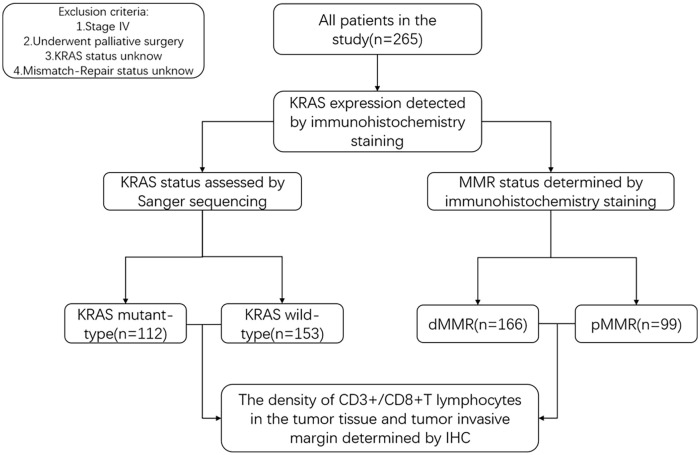
Methods: Conducted between 2010 and 2020, this study utilized tumor samples to assess KRAS expression and quantify CD3+/CD8+ T lymphocytes. The Cox proportional hazards model and linear regression analysis were employed to examine the relationship between KRAS expression, prognosis, and tumor-infiltrating T lymphocytes.
Results: This study included 265 CRC patients who underwent radical surgery. No significant association was observed between KRAS expression and KRAS status (p > 0.05). High KRAS expression was associated with poorer overall survival and disease-free survival (p < 0.05). Subgroup analysis revealed that high KRAS expression remained indicative of a worse prognosis in the group with mismatch repair-deficient (dMMR) and KRAS mutant type (p < 0.05). Multivariate analysis confirmed KRAS expression as an unfavorable prognostic factor (p < 0.05). However, the significance of KRAS expression was lost in the dMMR and KRAS mutant-type group regarding overall survival (p > 0.05). Notably, KRAS expression showed a negative correlation with the density of CD8+ T lymphocytes in tumor tissue (p < 0.05), a finding also observed in the dMMR group (p < 0.05).
Conclusion: No association was found between KRAS expression and KRAS mutation status in CRC. Higher KRAS expression was indicative of poorer prognosis for CRC patients, except for those with proficient mismatch repair and KRAS wild type. In addition, in patients with dMMR, KRAS expression was associated with a lower density of CD8+ T lymphocytes in tumor tissue.
期刊介绍:
Therapeutic Advances in Gastroenterology is an open access journal which delivers the highest quality peer-reviewed original research articles, reviews, and scholarly comment on pioneering efforts and innovative studies in the medical treatment of gastrointestinal and hepatic disorders. The journal has a strong clinical and pharmacological focus and is aimed at an international audience of clinicians and researchers in gastroenterology and related disciplines, providing an online forum for rapid dissemination of recent research and perspectives in this area.
The editors welcome original research articles across all areas of gastroenterology and hepatology.
The journal publishes original research articles and review articles primarily. Original research manuscripts may include laboratory, animal or human/clinical studies – all phases. Letters to the Editor and Case Reports will also be considered.





 京公网安备 11010802042870号
京ICP备2023020795号-1
京公网安备 11010802042870号
京ICP备2023020795号-1

 分享
分享
 求助内容:
求助内容: 应助结果提醒方式:
 扫码关注我们
