Bertrand Renaud, R. Chocron, Guillaume Reverdito, Anne Blanchard, Thong Hua-Huy, J. Diehl, M. Livrozet, Marielle Subileau, Cédric Lemogne, Salma El-Batti, Edouard Auclin, A. Jannot, B. Rance, Elie Mousseaux, David Smadja, D. Lebeaux, J. Hulot, O. Sanchez, Sven Günther
{"title":"Persistent disabilities 28 months after COVID-19 hospitalization, a prospective cohort study","authors":"Bertrand Renaud, R. Chocron, Guillaume Reverdito, Anne Blanchard, Thong Hua-Huy, J. Diehl, M. Livrozet, Marielle Subileau, Cédric Lemogne, Salma El-Batti, Edouard Auclin, A. Jannot, B. Rance, Elie Mousseaux, David Smadja, D. Lebeaux, J. Hulot, O. Sanchez, Sven Günther","doi":"10.1183/23120541.00104-2024","DOIUrl":null,"url":null,"abstract":"Limited data are available on long-term respiratory disabilities in patients following acute COVID-19.This prospective, monocentric, observational cohort study included patients admitted to our hospital with acute COVID-19 between March 3 and April 24, 2020. Clinical, functional, and radiological data were collected up to 28 months after hospital discharge.Among 715 patients hospitalized for COVID-19, 493 (69.0%) were discharged alive. We could access complete medical records for 268/493 patients (54.4%); 138/268 (51.5%) exhibited persistent respiratory symptoms and agreed with the data collection and follow-up. Patients were predominantly male (64.5%), with a mean (±sd) age of 58.9±15.3 years. At the last follow-up, the leading symptoms were asthenia (31.5%), dyspnoea (29.8%), and neuropsychological symptoms (17.7%). Lung function improved up to the last visit. Mean diffusing capacity of the lung for carbon monoxide (DLCO) was 77.8% of predicted value, total lung capacity (TLC) 83.5%, and O2desaturation during exercise (O2desaturation) −2.3%. While DLCO improved over the entire period, TLC improved in the early phase and O2desaturation in the late phase. Except for those with lung comorbidities, only one patient presented with minor functional and chest radiological alterations at 28-months.Patients with acute COVID-19 discharged alive showed improved clinical symptoms, lung function parameters and radiological signs up to 28 months post infection. Persistent symptoms consisted mainly of asthenia and dyspnoea, with lung function returning to normal. One patient without prior respiratory issues exhibited moderate pulmonary fibrosis.","PeriodicalId":4,"journal":{"name":"ACS Applied Energy Materials","volume":"34 7","pages":""},"PeriodicalIF":5.5000,"publicationDate":"2024-05-16","publicationTypes":"Journal Article","fieldsOfStudy":null,"isOpenAccess":false,"openAccessPdf":"","citationCount":"0","resultStr":null,"platform":"Semanticscholar","paperid":null,"PeriodicalName":"ACS Applied Energy Materials","FirstCategoryId":"3","ListUrlMain":"https://doi.org/10.1183/23120541.00104-2024","RegionNum":3,"RegionCategory":"材料科学","ArticlePicture":[],"TitleCN":null,"AbstractTextCN":null,"PMCID":null,"EPubDate":"","PubModel":"","JCR":"Q2","JCRName":"CHEMISTRY, PHYSICAL","Score":null,"Total":0}
引用次数: 0
Abstract
Limited data are available on long-term respiratory disabilities in patients following acute COVID-19.This prospective, monocentric, observational cohort study included patients admitted to our hospital with acute COVID-19 between March 3 and April 24, 2020. Clinical, functional, and radiological data were collected up to 28 months after hospital discharge.Among 715 patients hospitalized for COVID-19, 493 (69.0%) were discharged alive. We could access complete medical records for 268/493 patients (54.4%); 138/268 (51.5%) exhibited persistent respiratory symptoms and agreed with the data collection and follow-up. Patients were predominantly male (64.5%), with a mean (±sd) age of 58.9±15.3 years. At the last follow-up, the leading symptoms were asthenia (31.5%), dyspnoea (29.8%), and neuropsychological symptoms (17.7%). Lung function improved up to the last visit. Mean diffusing capacity of the lung for carbon monoxide (DLCO) was 77.8% of predicted value, total lung capacity (TLC) 83.5%, and O2desaturation during exercise (O2desaturation) −2.3%. While DLCO improved over the entire period, TLC improved in the early phase and O2desaturation in the late phase. Except for those with lung comorbidities, only one patient presented with minor functional and chest radiological alterations at 28-months.Patients with acute COVID-19 discharged alive showed improved clinical symptoms, lung function parameters and radiological signs up to 28 months post infection. Persistent symptoms consisted mainly of asthenia and dyspnoea, with lung function returning to normal. One patient without prior respiratory issues exhibited moderate pulmonary fibrosis.
期刊介绍:
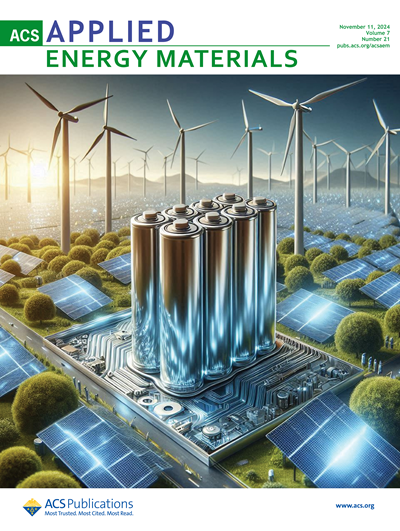
ACS Applied Energy Materials is an interdisciplinary journal publishing original research covering all aspects of materials, engineering, chemistry, physics and biology relevant to energy conversion and storage. The journal is devoted to reports of new and original experimental and theoretical research of an applied nature that integrate knowledge in the areas of materials, engineering, physics, bioscience, and chemistry into important energy applications.



 京公网安备 11010802042870号
京ICP备2023020795号-1
京公网安备 11010802042870号
京ICP备2023020795号-1

 分享
分享
 求助内容:
求助内容: 应助结果提醒方式:
 扫码关注我们
