Xiangtao Chen
(, ), Chao Zhen
(, ), Jianhang Qiu
(, ), Na Li
(, ), Nan Jia
(, ), Gang Liu
(, )
{"title":"Modulating band alignment at the 3D metal/semiconductor interface of liquid metal-embraced semiconductor photoelectrodes for water splitting","authors":"Xiangtao Chen \n (, ), Chao Zhen \n (, ), Jianhang Qiu \n (, ), Na Li \n (, ), Nan Jia \n (, ), Gang Liu \n (, )","doi":"10.1007/s40843-024-2929-6","DOIUrl":null,"url":null,"abstract":"<div><p>The transfer of photogenerated charges from semiconductors as photoabsorbers to conductive substrates as current collectors is closely correlated with the interface band alignment, particularly for an emerging class of photoelectrodes possessing the three dimensional (3D) interface that semiconductors are embraced by low-melting-point (LMP) metals (i.e., Field’s metals). Herein, the interface band alignment is modulated to promote the transfer of photogenerated charges by taking advantage of the composition-dependent work function (WF) of liquid metal as the current collector. It is found that embracing ZnO particles by indium tin (IT) alloy leads to the Ohmic contact, while embracing ZnO particles by bismuth indium tin (BIT) alloy leads to the Schottky contact. Consequently, the photocurrent density of the resulting IT-embraced ZnO (IT/ZnO) photoelectrode with superior charge collection and separation ability for photoelectrochemical water splitting is increased by 19% from 0.52 mA cm<sup>−2</sup> of BIT-embraced ZnO (BIT/ZnO) to 0.62 mA cm<sup>−2</sup>, ranging on the top of the representative ZnO photoelectrodes. In contrast, the photoelectrodes of WO<sub>3</sub>, TiO<sub>2</sub>, and Cu<sub>2</sub>O embraced with IT or BIT have the same contact type and nearly identical performance. This work demonstrates the potential of changing the metal/semiconductor contact type to enhance the performance of LMP metal-embraced semiconductor photoelectrodes by choosing liquid metals with different WFs, paving a way to build efficient photoelectrodes.</p></div>","PeriodicalId":773,"journal":{"name":"Science China Materials","volume":"67 6","pages":"1804 - 1811"},"PeriodicalIF":7.4000,"publicationDate":"2024-05-15","publicationTypes":"Journal Article","fieldsOfStudy":null,"isOpenAccess":false,"openAccessPdf":"","citationCount":"0","resultStr":null,"platform":"Semanticscholar","paperid":null,"PeriodicalName":"Science China Materials","FirstCategoryId":"88","ListUrlMain":"https://link.springer.com/article/10.1007/s40843-024-2929-6","RegionNum":2,"RegionCategory":"材料科学","ArticlePicture":[],"TitleCN":null,"AbstractTextCN":null,"PMCID":null,"EPubDate":"","PubModel":"","JCR":"Q1","JCRName":"MATERIALS SCIENCE, MULTIDISCIPLINARY","Score":null,"Total":0}
引用次数: 0
Abstract
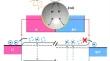
The transfer of photogenerated charges from semiconductors as photoabsorbers to conductive substrates as current collectors is closely correlated with the interface band alignment, particularly for an emerging class of photoelectrodes possessing the three dimensional (3D) interface that semiconductors are embraced by low-melting-point (LMP) metals (i.e., Field’s metals). Herein, the interface band alignment is modulated to promote the transfer of photogenerated charges by taking advantage of the composition-dependent work function (WF) of liquid metal as the current collector. It is found that embracing ZnO particles by indium tin (IT) alloy leads to the Ohmic contact, while embracing ZnO particles by bismuth indium tin (BIT) alloy leads to the Schottky contact. Consequently, the photocurrent density of the resulting IT-embraced ZnO (IT/ZnO) photoelectrode with superior charge collection and separation ability for photoelectrochemical water splitting is increased by 19% from 0.52 mA cm−2 of BIT-embraced ZnO (BIT/ZnO) to 0.62 mA cm−2, ranging on the top of the representative ZnO photoelectrodes. In contrast, the photoelectrodes of WO3, TiO2, and Cu2O embraced with IT or BIT have the same contact type and nearly identical performance. This work demonstrates the potential of changing the metal/semiconductor contact type to enhance the performance of LMP metal-embraced semiconductor photoelectrodes by choosing liquid metals with different WFs, paving a way to build efficient photoelectrodes.
光生电荷从作为光吸收体的半导体向作为集电体的导电基底的转移与界面带排列密切相关,特别是对于一类新兴的光电极,它具有半导体被低熔点(LMP)金属(即菲尔德金属)拥抱的三维(3D)界面。在这里,利用液态金属作为集流体的功函数(WF),通过调节界面带排列来促进光生电荷的转移。研究发现,用铟锡(IT)合金包容氧化锌颗粒会导致欧姆接触,而用铋铟锡(BIT)合金包容氧化锌颗粒则会导致肖特基接触。因此,所制得的 IT 包覆氧化锌(IT/ZnO)光电极的光电流密度提高了 19%,从 BIT 包覆氧化锌(BIT/ZnO)的 0.52 mA cm-2 提高到 0.62 mA cm-2,在具有代表性的氧化锌光电极中名列前茅。相比之下,用 IT 或 BIT 包覆的 WO3、TiO2 和 Cu2O 光电极具有相同的接触类型和几乎相同的性能。这项工作证明了改变金属/半导体接触类型的潜力,通过选择不同WF的液态金属来提高LMP金属包覆半导体光电极的性能,为构建高效光电极铺平了道路。
期刊介绍:
Science China Materials (SCM) is a globally peer-reviewed journal that covers all facets of materials science. It is supervised by the Chinese Academy of Sciences and co-sponsored by the Chinese Academy of Sciences and the National Natural Science Foundation of China. The journal is jointly published monthly in both printed and electronic forms by Science China Press and Springer. The aim of SCM is to encourage communication of high-quality, innovative research results at the cutting-edge interface of materials science with chemistry, physics, biology, and engineering. It focuses on breakthroughs from around the world and aims to become a world-leading academic journal for materials science.




 京公网安备 11010802042870号
京ICP备2023020795号-1
京公网安备 11010802042870号
京ICP备2023020795号-1

 分享
分享
 求助内容:
求助内容: 应助结果提醒方式:
 扫码关注我们
