Yuanyong Huang
(, ), Hong Yang
(, ), Shuo Feng
(, ), Changwen Ma
(, ), Peiyi Cao
(, ), Feifei Li
(, ), Xinyu Lu
(, ), Weidong Shi
(, )
{"title":"Facile defect engineering in ZnIn2S4 nanosheets for enhanced NIR-driven H2 evolution","authors":"Yuanyong Huang \n (, ), Hong Yang \n (, ), Shuo Feng \n (, ), Changwen Ma \n (, ), Peiyi Cao \n (, ), Feifei Li \n (, ), Xinyu Lu \n (, ), Weidong Shi \n (, )","doi":"10.1007/s40843-024-2844-8","DOIUrl":null,"url":null,"abstract":"<div><p>Near-infrared (NIR) light-driven water splitting to produce hydrogen (H<sub>2</sub>) has long been of great interest in photocatalysis, but it remains a formidable challenge so far due to both kinetic and thermodynamic shortcomings. To break through this limitation, we demonstrate a noble metal-free two-dimensional ZnIn<sub>2</sub>S<sub>4</sub>-based photocatalyst rich in sulfur vacancies <i>via</i> a facile hydrothermal method and firstly realized NIR-driven H<sub>2</sub> production beyond 800 nm using single component ZnIn<sub>2</sub>S<sub>4</sub>-based materials. We disclosed the existence of an efficient Urbach tail transition to absorb long-wavelength NIR light according to the valence-band spectra, ultraviolet-visible-NIR diffuse reflectance spectra, steady-state photoluminescence spectra, transient photocurrent response, and electron paramagnetic resonance measurements. The successful construction of sulfur vacancies in ZnIn<sub>2</sub>S<sub>4</sub> nanosheets not only extends the spectral absorption range but also has an excellent carrier diffusion property as well as an abundance of active sites. Therefore, our findings may provide an effective and promising perspective for the future development of NIR-responsive ZnIn<sub>2</sub>S<sub>4</sub>-based photocatalysts for highly efficient H<sub>2</sub> production.\n</p><div><figure><div><div><picture><source><img></source></picture></div></div></figure></div></div>","PeriodicalId":773,"journal":{"name":"Science China Materials","volume":"67 6","pages":"1812 - 1819"},"PeriodicalIF":7.4000,"publicationDate":"2024-05-15","publicationTypes":"Journal Article","fieldsOfStudy":null,"isOpenAccess":false,"openAccessPdf":"","citationCount":"0","resultStr":null,"platform":"Semanticscholar","paperid":null,"PeriodicalName":"Science China Materials","FirstCategoryId":"88","ListUrlMain":"https://link.springer.com/article/10.1007/s40843-024-2844-8","RegionNum":2,"RegionCategory":"材料科学","ArticlePicture":[],"TitleCN":null,"AbstractTextCN":null,"PMCID":null,"EPubDate":"","PubModel":"","JCR":"Q1","JCRName":"MATERIALS SCIENCE, MULTIDISCIPLINARY","Score":null,"Total":0}
引用次数: 0
Abstract
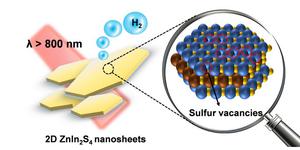
Near-infrared (NIR) light-driven water splitting to produce hydrogen (H2) has long been of great interest in photocatalysis, but it remains a formidable challenge so far due to both kinetic and thermodynamic shortcomings. To break through this limitation, we demonstrate a noble metal-free two-dimensional ZnIn2S4-based photocatalyst rich in sulfur vacancies via a facile hydrothermal method and firstly realized NIR-driven H2 production beyond 800 nm using single component ZnIn2S4-based materials. We disclosed the existence of an efficient Urbach tail transition to absorb long-wavelength NIR light according to the valence-band spectra, ultraviolet-visible-NIR diffuse reflectance spectra, steady-state photoluminescence spectra, transient photocurrent response, and electron paramagnetic resonance measurements. The successful construction of sulfur vacancies in ZnIn2S4 nanosheets not only extends the spectral absorption range but also has an excellent carrier diffusion property as well as an abundance of active sites. Therefore, our findings may provide an effective and promising perspective for the future development of NIR-responsive ZnIn2S4-based photocatalysts for highly efficient H2 production.
期刊介绍:
Science China Materials (SCM) is a globally peer-reviewed journal that covers all facets of materials science. It is supervised by the Chinese Academy of Sciences and co-sponsored by the Chinese Academy of Sciences and the National Natural Science Foundation of China. The journal is jointly published monthly in both printed and electronic forms by Science China Press and Springer. The aim of SCM is to encourage communication of high-quality, innovative research results at the cutting-edge interface of materials science with chemistry, physics, biology, and engineering. It focuses on breakthroughs from around the world and aims to become a world-leading academic journal for materials science.



 京公网安备 11010802042870号
京ICP备2023020795号-1
京公网安备 11010802042870号
京ICP备2023020795号-1

 分享
分享
 求助内容:
求助内容: 应助结果提醒方式:
 扫码关注我们
