Junjie Li
(, ), Zirui Li
(, ), Shuai Li
(, ), Cong Xu
(, ), Ang Li
(, ), Lei Tong
(, ), Haiwei Liang
(, )
{"title":"High-temperature annealing improves Pt utilization of proton exchange membrane fuel cell cathode catalysts","authors":"Junjie Li \n (, ), Zirui Li \n (, ), Shuai Li \n (, ), Cong Xu \n (, ), Ang Li \n (, ), Lei Tong \n (, ), Haiwei Liang \n (, )","doi":"10.1007/s40843-024-2871-1","DOIUrl":null,"url":null,"abstract":"<div><p>High-temperature annealing is widely recognized as an effective way to improve the durability of Pt/C cathode catalysts used in proton exchange membrane fuel cells (PEMFCs), yet systematic studies on its effects on PEMFC performance are still lacking. Herein, we explore the effect of high-temperature annealing on the PEMFC performance, based on a thorough comparative analysis of Pt/C catalysts annealed at temperatures ranging from 500–900°C. Our results reveal that high-temperature annealing not only enhances the catalyst durability but also substantially increases Pt utilization, which in turn drives the increase in mass activity and the enhancement of low-current-density performance. Based on an array of electrochemical and physical characterization results, we infer that the increased utilization of Pt might stem from nanoparticle migration induced by high-temperature annealing, leading to closer proximity between Pt nanoparticles and ionomers. This reduced distance potentially enhances the accessibility of protons to the Pt nanoparticles, thereby improving the Pt utilization.\n</p><div><figure><div><div><picture><source><img></source></picture></div></div></figure></div></div>","PeriodicalId":773,"journal":{"name":"Science China Materials","volume":"67 6","pages":"1851 - 1857"},"PeriodicalIF":7.4000,"publicationDate":"2024-05-13","publicationTypes":"Journal Article","fieldsOfStudy":null,"isOpenAccess":false,"openAccessPdf":"","citationCount":"0","resultStr":null,"platform":"Semanticscholar","paperid":null,"PeriodicalName":"Science China Materials","FirstCategoryId":"88","ListUrlMain":"https://link.springer.com/article/10.1007/s40843-024-2871-1","RegionNum":2,"RegionCategory":"材料科学","ArticlePicture":[],"TitleCN":null,"AbstractTextCN":null,"PMCID":null,"EPubDate":"","PubModel":"","JCR":"Q1","JCRName":"MATERIALS SCIENCE, MULTIDISCIPLINARY","Score":null,"Total":0}
引用次数: 0
Abstract
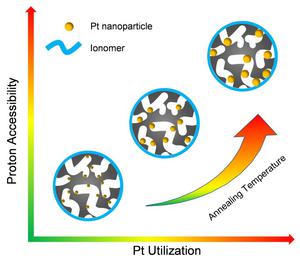
High-temperature annealing is widely recognized as an effective way to improve the durability of Pt/C cathode catalysts used in proton exchange membrane fuel cells (PEMFCs), yet systematic studies on its effects on PEMFC performance are still lacking. Herein, we explore the effect of high-temperature annealing on the PEMFC performance, based on a thorough comparative analysis of Pt/C catalysts annealed at temperatures ranging from 500–900°C. Our results reveal that high-temperature annealing not only enhances the catalyst durability but also substantially increases Pt utilization, which in turn drives the increase in mass activity and the enhancement of low-current-density performance. Based on an array of electrochemical and physical characterization results, we infer that the increased utilization of Pt might stem from nanoparticle migration induced by high-temperature annealing, leading to closer proximity between Pt nanoparticles and ionomers. This reduced distance potentially enhances the accessibility of protons to the Pt nanoparticles, thereby improving the Pt utilization.
期刊介绍:
Science China Materials (SCM) is a globally peer-reviewed journal that covers all facets of materials science. It is supervised by the Chinese Academy of Sciences and co-sponsored by the Chinese Academy of Sciences and the National Natural Science Foundation of China. The journal is jointly published monthly in both printed and electronic forms by Science China Press and Springer. The aim of SCM is to encourage communication of high-quality, innovative research results at the cutting-edge interface of materials science with chemistry, physics, biology, and engineering. It focuses on breakthroughs from around the world and aims to become a world-leading academic journal for materials science.



 京公网安备 11010802042870号
京ICP备2023020795号-1
京公网安备 11010802042870号
京ICP备2023020795号-1

 分享
分享
 求助内容:
求助内容: 应助结果提醒方式:
 扫码关注我们
