Weibo Yin
(, ), Bowen Liu
(, ), Xiaolei Wang
(, ), Wenqian Wang
(, ), Zichen Song
(, ), Zhiyu Ren
(, ), Honggang Fu
(, )
{"title":"Regulating p-orbital of metallic bismuth nanosheets via transition-metal oxides enables advanced CO2 electroreduction","authors":"Weibo Yin \n (, ), Bowen Liu \n (, ), Xiaolei Wang \n (, ), Wenqian Wang \n (, ), Zichen Song \n (, ), Zhiyu Ren \n (, ), Honggang Fu \n (, )","doi":"10.1007/s40843-024-2921-6","DOIUrl":null,"url":null,"abstract":"<div><p>The interaction of <i>p</i>-<i>d</i> orbitals can be used to efficiently improve electrocatalytic performance. However, the enhanced mechanism of electrocatalytic CO<sub>2</sub> reduction reaction (eCO<sub>2</sub>RR) on main group metals inspired by the <i>p</i>-<i>d</i> orbital interactions is still unclear. Herein, a series of transition-metal oxides (TMOs: Fe<sub>2</sub>O<sub>3</sub>, Co<sub>3</sub>O<sub>4</sub>, and NiO) are introduced to metallic bismuth (Bi) nanosheets (NSs), which is proposed as a proof of concept for investigating the effect of introduced TMOs on the eCO<sub>2</sub>RR performance for Bi. Based on the results from <i>in-situ</i> Fourier transform infrared (FTIR) spectra and CO<sub>2</sub>-temperature programmed deposition (TPD), the TMOs in the Bi/TMOs NSs can enhance the adsorption and/or activation ability of CO<sub>2</sub>. Density functional theory (DFT) calculations reveal that the regulated adsorption energy of *OCHO and <i>p</i>-orbital of Bi sites can decrease theoretical overpotentials for both the CO<sub>2</sub>-to-*OCHO process and the *OCHO-to-HCOOH process. Moreover, the electron rearrangement that occurred due to the contact between Bi and TMO can also promote electron transport between the catalyst and reactants. Therefore, under the dual positive effect of thermodynamics and kinetics, the Bi sites in Bi/TMO NSs exhibit the maximum catalytic ability, realizing high catalytic activity and selectivity for HCOOH over a wider potential region. In particular, Bi/Fe<sub>2</sub>O<sub>3</sub> NSs can present the most significant enhancement effect. It can yield a wide potential region of 500 mV with a high FE<sub>HCOOH</sub> (>90%) and achieve a maximum FE<sub>HCOOH</sub> of 99.7% (1.11 times that of Bi) at −0.8 V<sub>RHE</sub> with the HCOOH partial current density of 12.65 mA cm<sup>−2</sup> (1.86 times that of Bi). This study establishes a relationship between the enhanced performance and the introduced TMOs and provides a practicable and scalable avenue for rationally engineering high-powered electrocatalysts.</p><div><figure><div><div><picture><source><img></source></picture></div></div></figure></div></div>","PeriodicalId":773,"journal":{"name":"Science China Materials","volume":"67 6","pages":"1965 - 1974"},"PeriodicalIF":7.4000,"publicationDate":"2024-05-11","publicationTypes":"Journal Article","fieldsOfStudy":null,"isOpenAccess":false,"openAccessPdf":"","citationCount":"0","resultStr":null,"platform":"Semanticscholar","paperid":null,"PeriodicalName":"Science China Materials","FirstCategoryId":"88","ListUrlMain":"https://link.springer.com/article/10.1007/s40843-024-2921-6","RegionNum":2,"RegionCategory":"材料科学","ArticlePicture":[],"TitleCN":null,"AbstractTextCN":null,"PMCID":null,"EPubDate":"","PubModel":"","JCR":"Q1","JCRName":"MATERIALS SCIENCE, MULTIDISCIPLINARY","Score":null,"Total":0}
引用次数: 0
Abstract
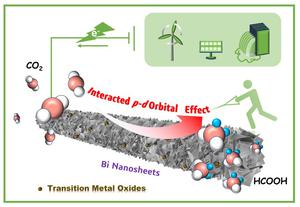
The interaction of p-d orbitals can be used to efficiently improve electrocatalytic performance. However, the enhanced mechanism of electrocatalytic CO2 reduction reaction (eCO2RR) on main group metals inspired by the p-d orbital interactions is still unclear. Herein, a series of transition-metal oxides (TMOs: Fe2O3, Co3O4, and NiO) are introduced to metallic bismuth (Bi) nanosheets (NSs), which is proposed as a proof of concept for investigating the effect of introduced TMOs on the eCO2RR performance for Bi. Based on the results from in-situ Fourier transform infrared (FTIR) spectra and CO2-temperature programmed deposition (TPD), the TMOs in the Bi/TMOs NSs can enhance the adsorption and/or activation ability of CO2. Density functional theory (DFT) calculations reveal that the regulated adsorption energy of *OCHO and p-orbital of Bi sites can decrease theoretical overpotentials for both the CO2-to-*OCHO process and the *OCHO-to-HCOOH process. Moreover, the electron rearrangement that occurred due to the contact between Bi and TMO can also promote electron transport between the catalyst and reactants. Therefore, under the dual positive effect of thermodynamics and kinetics, the Bi sites in Bi/TMO NSs exhibit the maximum catalytic ability, realizing high catalytic activity and selectivity for HCOOH over a wider potential region. In particular, Bi/Fe2O3 NSs can present the most significant enhancement effect. It can yield a wide potential region of 500 mV with a high FEHCOOH (>90%) and achieve a maximum FEHCOOH of 99.7% (1.11 times that of Bi) at −0.8 VRHE with the HCOOH partial current density of 12.65 mA cm−2 (1.86 times that of Bi). This study establishes a relationship between the enhanced performance and the introduced TMOs and provides a practicable and scalable avenue for rationally engineering high-powered electrocatalysts.
期刊介绍:
Science China Materials (SCM) is a globally peer-reviewed journal that covers all facets of materials science. It is supervised by the Chinese Academy of Sciences and co-sponsored by the Chinese Academy of Sciences and the National Natural Science Foundation of China. The journal is jointly published monthly in both printed and electronic forms by Science China Press and Springer. The aim of SCM is to encourage communication of high-quality, innovative research results at the cutting-edge interface of materials science with chemistry, physics, biology, and engineering. It focuses on breakthroughs from around the world and aims to become a world-leading academic journal for materials science.



 京公网安备 11010802042870号
京ICP备2023020795号-1
京公网安备 11010802042870号
京ICP备2023020795号-1

 分享
分享
 求助内容:
求助内容: 应助结果提醒方式:
 扫码关注我们
