Yaying Li
(, ), Huijuan Yang
(, ), Jili Li
(, ), Yefei Li
(, ), Wei Ren
(, ), Jin Wen
(, ), Qi Xiao
(, ), Jingsan Xu
(, )
{"title":"One-step direct construction of S-scheme BaTi2O5/g-C3N4 heterojunction for enhanced photocatalytic hydrogen evolution","authors":"Yaying Li \n (, ), Huijuan Yang \n (, ), Jili Li \n (, ), Yefei Li \n (, ), Wei Ren \n (, ), Jin Wen \n (, ), Qi Xiao \n (, ), Jingsan Xu \n (, )","doi":"10.1007/s40843-024-2852-9","DOIUrl":null,"url":null,"abstract":"<div><p>Heterojunction photocatalysis has been widely studied as a means of efficiently converting solar energy to chemicals. However, the major challenge in developing high-performing heterojunction photocatalytic systems lies in achieving efficient transfer of electrons between the components. Herein, a novel S-scheme heterojunction photocatalyst was developed by combining BaTi<sub>2</sub>O5 nanorods with g-C<sub>3</sub>N<sub>4</sub> lamellae. The preferential deposition of Pt nanoparticles as cocatalyst <i>via</i> the one-step impregnation-reduction method on g-C<sub>3</sub>N<sub>4</sub> nanosheets with enhanced interfacial contact and strong electronic interaction has been proved essential for the photocatalytic performance. The developed Pti<sub>mp</sub>/20BaTi<sub>2</sub>O<sub>5</sub>/g-C<sub>3</sub>N<sub>4</sub> photocatalyst delivers the optimal hydrogen production rate of 2587 µmol g<sup>−1</sup> h<sup>−1</sup> with high stability after cycles. Photoelectrochemical analysis and theoretical calculation suggest that the formation of BaTi<sub>2</sub>O<sub>5</sub>/g-C<sub>3</sub>N<sub>4</sub> heterojunction results in the staggered band alignment and improved charge carrier dynamics. This work highlights the importance and feasibility of promoting photocatalysis by a new S-scheme heterojunction with viable cocatalysts.</p><div><figure><div><div><picture><source><img></source></picture></div></div></figure></div></div>","PeriodicalId":773,"journal":{"name":"Science China Materials","volume":"67 7","pages":"2142 - 2152"},"PeriodicalIF":7.4000,"publicationDate":"2024-05-11","publicationTypes":"Journal Article","fieldsOfStudy":null,"isOpenAccess":false,"openAccessPdf":"","citationCount":"0","resultStr":null,"platform":"Semanticscholar","paperid":null,"PeriodicalName":"Science China Materials","FirstCategoryId":"88","ListUrlMain":"https://link.springer.com/article/10.1007/s40843-024-2852-9","RegionNum":2,"RegionCategory":"材料科学","ArticlePicture":[],"TitleCN":null,"AbstractTextCN":null,"PMCID":null,"EPubDate":"","PubModel":"","JCR":"Q1","JCRName":"MATERIALS SCIENCE, MULTIDISCIPLINARY","Score":null,"Total":0}
引用次数: 0
Abstract
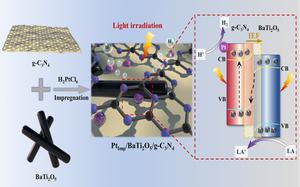
Heterojunction photocatalysis has been widely studied as a means of efficiently converting solar energy to chemicals. However, the major challenge in developing high-performing heterojunction photocatalytic systems lies in achieving efficient transfer of electrons between the components. Herein, a novel S-scheme heterojunction photocatalyst was developed by combining BaTi2O5 nanorods with g-C3N4 lamellae. The preferential deposition of Pt nanoparticles as cocatalyst via the one-step impregnation-reduction method on g-C3N4 nanosheets with enhanced interfacial contact and strong electronic interaction has been proved essential for the photocatalytic performance. The developed Ptimp/20BaTi2O5/g-C3N4 photocatalyst delivers the optimal hydrogen production rate of 2587 µmol g−1 h−1 with high stability after cycles. Photoelectrochemical analysis and theoretical calculation suggest that the formation of BaTi2O5/g-C3N4 heterojunction results in the staggered band alignment and improved charge carrier dynamics. This work highlights the importance and feasibility of promoting photocatalysis by a new S-scheme heterojunction with viable cocatalysts.
期刊介绍:
Science China Materials (SCM) is a globally peer-reviewed journal that covers all facets of materials science. It is supervised by the Chinese Academy of Sciences and co-sponsored by the Chinese Academy of Sciences and the National Natural Science Foundation of China. The journal is jointly published monthly in both printed and electronic forms by Science China Press and Springer. The aim of SCM is to encourage communication of high-quality, innovative research results at the cutting-edge interface of materials science with chemistry, physics, biology, and engineering. It focuses on breakthroughs from around the world and aims to become a world-leading academic journal for materials science.



 京公网安备 11010802042870号
京ICP备2023020795号-1
京公网安备 11010802042870号
京ICP备2023020795号-1

 分享
分享
 求助内容:
求助内容: 应助结果提醒方式:
 扫码关注我们
