Leyuan Chen
(, ), Yanyan Sun
(, ), Zhi Chang
(, ), Simin Chai
(, ), Qiong He
(, ), Anqiang Pan
(, )
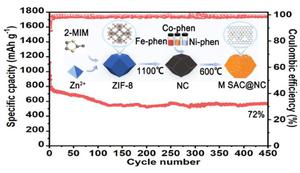
{"title":"Single-atomic nickel supported on nitrogen-doped porous carbon to boost polysulfide conversion in lithium-sulfur batteries","authors":"Leyuan Chen \n (, ), Yanyan Sun \n (, ), Zhi Chang \n (, ), Simin Chai \n (, ), Qiong He \n (, ), Anqiang Pan \n (, )","doi":"10.1007/s40843-024-2934-9","DOIUrl":null,"url":null,"abstract":"<div><p>Single-atomic catalysts consisting of atomically dispersed metal sites within nitrogen-doped carbon matrix (M SAC@NC) have emerged as high-performance electrocatalytic materials in Li-S batteries due to their maximum atom utilization, unique physicochemical properties, and superior catalytic activity. In the present work, a series of M SAC@NC (M = Ni, Co, Fe) with similar structural and physicochemical properties have been successfully prepared by the combination of physical adsorption and pyrolysis. The combination of the aberration-corrected high-angle annular dark-field scanning transmission electron microscopy and X-ray adsorption spectra indicates the successful formation of single-atomic metal sites. Moreover, the catalytic activity trend toward sulfur redox reaction is observed to be Ni SAC@NC > Co SAC@NC > Fe SAC@NC, and the Ni SAC@NC delivers the highest capacity of 1,280.6 mAh g<sup>−1</sup> and long-time stability at a decay rate of 0.07% per cycle for 800 cycles at 0.5 C, demonstrating excellent battery performance.</p><div><figure><div><div><picture><source><img></source></picture></div></div></figure></div></div>","PeriodicalId":773,"journal":{"name":"Science China Materials","volume":"67 6","pages":"1938 - 1946"},"PeriodicalIF":7.4000,"publicationDate":"2024-05-11","publicationTypes":"Journal Article","fieldsOfStudy":null,"isOpenAccess":false,"openAccessPdf":"","citationCount":"0","resultStr":null,"platform":"Semanticscholar","paperid":null,"PeriodicalName":"Science China Materials","FirstCategoryId":"88","ListUrlMain":"https://link.springer.com/article/10.1007/s40843-024-2934-9","RegionNum":2,"RegionCategory":"材料科学","ArticlePicture":[],"TitleCN":null,"AbstractTextCN":null,"PMCID":null,"EPubDate":"","PubModel":"","JCR":"Q1","JCRName":"MATERIALS SCIENCE, MULTIDISCIPLINARY","Score":null,"Total":0}
引用次数: 0
Abstract
Single-atomic catalysts consisting of atomically dispersed metal sites within nitrogen-doped carbon matrix (M SAC@NC) have emerged as high-performance electrocatalytic materials in Li-S batteries due to their maximum atom utilization, unique physicochemical properties, and superior catalytic activity. In the present work, a series of M SAC@NC (M = Ni, Co, Fe) with similar structural and physicochemical properties have been successfully prepared by the combination of physical adsorption and pyrolysis. The combination of the aberration-corrected high-angle annular dark-field scanning transmission electron microscopy and X-ray adsorption spectra indicates the successful formation of single-atomic metal sites. Moreover, the catalytic activity trend toward sulfur redox reaction is observed to be Ni SAC@NC > Co SAC@NC > Fe SAC@NC, and the Ni SAC@NC delivers the highest capacity of 1,280.6 mAh g−1 and long-time stability at a decay rate of 0.07% per cycle for 800 cycles at 0.5 C, demonstrating excellent battery performance.
由原子分散在掺氮碳基质中的金属位点组成的单原子催化剂(M SAC@NC)因其最大程度的原子利用率、独特的物理化学性质和优异的催化活性,已成为锂-S 电池中的高性能电催化材料。本研究采用物理吸附和热解相结合的方法,成功制备了一系列具有相似结构和理化性质的 M SAC@NC(M = Ni、Co、Fe)。结合像差校正高角度环形暗场扫描透射电子显微镜和 X 射线吸附光谱,表明成功形成了单原子金属位点。此外,观察到硫氧化还原反应的催化活性趋势为 Ni SAC@NC > Co SAC@NC > Fe SAC@NC,其中 Ni SAC@NC 在 0.5 C 下循环 800 次,可提供最高容量 1,280.6 mAh g-1,且每次循环的衰减率为 0.07%,表现出优异的电池性能。
期刊介绍:
Science China Materials (SCM) is a globally peer-reviewed journal that covers all facets of materials science. It is supervised by the Chinese Academy of Sciences and co-sponsored by the Chinese Academy of Sciences and the National Natural Science Foundation of China. The journal is jointly published monthly in both printed and electronic forms by Science China Press and Springer. The aim of SCM is to encourage communication of high-quality, innovative research results at the cutting-edge interface of materials science with chemistry, physics, biology, and engineering. It focuses on breakthroughs from around the world and aims to become a world-leading academic journal for materials science.



 京公网安备 11010802042870号
京ICP备2023020795号-1
京公网安备 11010802042870号
京ICP备2023020795号-1

 分享
分享
 求助内容:
求助内容: 应助结果提醒方式:
 扫码关注我们
