George P. Ball, Hessam Bavafa, Christian C. Blanco, Hyunwoo Park, Kaitlin D. Wowak
{"title":"EXPRESS: Gender and Serious Drug Recalls: a Textual Sentiment Analysis of Drug Reviews on WebMD","authors":"George P. Ball, Hessam Bavafa, Christian C. Blanco, Hyunwoo Park, Kaitlin D. Wowak","doi":"10.1177/10591478241256644","DOIUrl":null,"url":null,"abstract":"Consumers taking prescription drugs have limited ability to ascertain drug quality before taking the drug. After drug use, however, consumers frequently report their personal experiences with prescription drugs on one of the world’s largest medical websites: WebMD. Drug reviews on WebMD are a potentially rich source of free-form text that can be utilized to inform firms, consumers, researchers, and the Food and Drug Administration (FDA) about the quality and safety of prescription drugs. Additionally, because men and women communicate in starkly different ways, the gender of the reviewer may play a key role in drug reviews signaling drug quality problems. We examine if drug review textual sentiment is associated with the hazard of a serious drug recall and whether this relationship varies depending on the gender of the reviewer. We analyze textual sentiment on drug reviews from WebMD along with 13 years of drug recall data using several hazard models. We find that the more negative the drug review sentiment, the greater the hazard of a serious recall on that drug. This relationship is completely explained by drug reviews written by females; reviews written by males have no explanatory power. Our findings are confirmed by numerous robustness checks. In post-hoc analysis, we explore possible mechanisms by comparing female and male adverse events on the recalled drugs in our study. Our contributions to gender diversity and drug quality literature leads to implications for the FDA, WebMD, and firms that manufacture prescription drugs.","PeriodicalId":4,"journal":{"name":"ACS Applied Energy Materials","volume":" 11","pages":""},"PeriodicalIF":5.5000,"publicationDate":"2024-05-09","publicationTypes":"Journal Article","fieldsOfStudy":null,"isOpenAccess":false,"openAccessPdf":"","citationCount":"0","resultStr":null,"platform":"Semanticscholar","paperid":null,"PeriodicalName":"ACS Applied Energy Materials","FirstCategoryId":"91","ListUrlMain":"https://doi.org/10.1177/10591478241256644","RegionNum":3,"RegionCategory":"材料科学","ArticlePicture":[],"TitleCN":null,"AbstractTextCN":null,"PMCID":null,"EPubDate":"","PubModel":"","JCR":"Q2","JCRName":"CHEMISTRY, PHYSICAL","Score":null,"Total":0}
引用次数: 0
Abstract
Consumers taking prescription drugs have limited ability to ascertain drug quality before taking the drug. After drug use, however, consumers frequently report their personal experiences with prescription drugs on one of the world’s largest medical websites: WebMD. Drug reviews on WebMD are a potentially rich source of free-form text that can be utilized to inform firms, consumers, researchers, and the Food and Drug Administration (FDA) about the quality and safety of prescription drugs. Additionally, because men and women communicate in starkly different ways, the gender of the reviewer may play a key role in drug reviews signaling drug quality problems. We examine if drug review textual sentiment is associated with the hazard of a serious drug recall and whether this relationship varies depending on the gender of the reviewer. We analyze textual sentiment on drug reviews from WebMD along with 13 years of drug recall data using several hazard models. We find that the more negative the drug review sentiment, the greater the hazard of a serious recall on that drug. This relationship is completely explained by drug reviews written by females; reviews written by males have no explanatory power. Our findings are confirmed by numerous robustness checks. In post-hoc analysis, we explore possible mechanisms by comparing female and male adverse events on the recalled drugs in our study. Our contributions to gender diversity and drug quality literature leads to implications for the FDA, WebMD, and firms that manufacture prescription drugs.
期刊介绍:
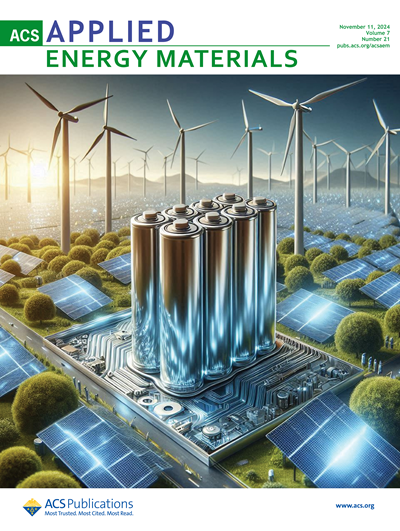
ACS Applied Energy Materials is an interdisciplinary journal publishing original research covering all aspects of materials, engineering, chemistry, physics and biology relevant to energy conversion and storage. The journal is devoted to reports of new and original experimental and theoretical research of an applied nature that integrate knowledge in the areas of materials, engineering, physics, bioscience, and chemistry into important energy applications.



 京公网安备 11010802042870号
京ICP备2023020795号-1
京公网安备 11010802042870号
京ICP备2023020795号-1

 分享
分享
 求助内容:
求助内容: 应助结果提醒方式:
 扫码关注我们
