{"title":"Monarch Butterfly Optimization-Based Genetic Algorithm Operators for Nonlinear Constrained Optimization and Design of Engineering Problems","authors":"M. A. El-Shorbagy, Taghreed Hamdi Alhadbani","doi":"10.1093/jcde/qwae044","DOIUrl":null,"url":null,"abstract":"\n This paper aims to present a hybrid method to solve nonlinear constrained optimization problems and engineering design problems (EDPs). The hybrid method is a combination of MBO with the crossover and mutation operators of the genetic algorithm (GA). It is called a hybrid monarch butterfly optimization with genetic algorithm operators (MBO-GAO). Combining MBO and GA operators is meant to overcome the drawbacks of both algorithms while merging their advantages. The self-adaptive crossover (SAC) and the real-valued mutation are the GA operators that are used in MBO-GAO. These operators are merged in a distinctive way within MBO processes to improve the variety of solutions in the later stages of the search process, speed up the convergence process, keep the search from getting stuck in local optima, and achieve a balance between the tendencies of exploration and exploitation. In addition, the greedy approach is presented in both the migration operator and the butterfly adjusting operator, which can only accept offspring of the monarch butterfly groups who are fitter than their parents. Finally, popular test problems, including a set of 19 benchmark problems, are used to test the proposed hybrid algorithm, MBO-GAO. The findings obtained provide evidence supporting the higher performance of MBO-GAO compared to other search techniques. Additionally, the performance of the MBO-GAO is examined for several engineering design problems. The computational results show that the MBO-GAO method exhibits competitiveness and superiority over other optimization algorithms employed for the resolution of engineering design problems.","PeriodicalId":4,"journal":{"name":"ACS Applied Energy Materials","volume":" 42","pages":""},"PeriodicalIF":5.5000,"publicationDate":"2024-05-08","publicationTypes":"Journal Article","fieldsOfStudy":null,"isOpenAccess":false,"openAccessPdf":"","citationCount":"0","resultStr":null,"platform":"Semanticscholar","paperid":null,"PeriodicalName":"ACS Applied Energy Materials","FirstCategoryId":"5","ListUrlMain":"https://doi.org/10.1093/jcde/qwae044","RegionNum":3,"RegionCategory":"材料科学","ArticlePicture":[],"TitleCN":null,"AbstractTextCN":null,"PMCID":null,"EPubDate":"","PubModel":"","JCR":"Q2","JCRName":"CHEMISTRY, PHYSICAL","Score":null,"Total":0}
引用次数: 0
Abstract
This paper aims to present a hybrid method to solve nonlinear constrained optimization problems and engineering design problems (EDPs). The hybrid method is a combination of MBO with the crossover and mutation operators of the genetic algorithm (GA). It is called a hybrid monarch butterfly optimization with genetic algorithm operators (MBO-GAO). Combining MBO and GA operators is meant to overcome the drawbacks of both algorithms while merging their advantages. The self-adaptive crossover (SAC) and the real-valued mutation are the GA operators that are used in MBO-GAO. These operators are merged in a distinctive way within MBO processes to improve the variety of solutions in the later stages of the search process, speed up the convergence process, keep the search from getting stuck in local optima, and achieve a balance between the tendencies of exploration and exploitation. In addition, the greedy approach is presented in both the migration operator and the butterfly adjusting operator, which can only accept offspring of the monarch butterfly groups who are fitter than their parents. Finally, popular test problems, including a set of 19 benchmark problems, are used to test the proposed hybrid algorithm, MBO-GAO. The findings obtained provide evidence supporting the higher performance of MBO-GAO compared to other search techniques. Additionally, the performance of the MBO-GAO is examined for several engineering design problems. The computational results show that the MBO-GAO method exhibits competitiveness and superiority over other optimization algorithms employed for the resolution of engineering design problems.
期刊介绍:
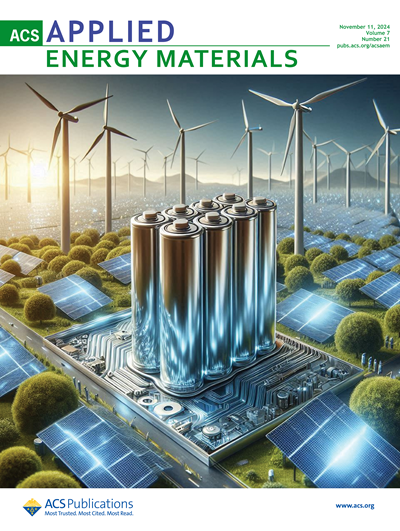
ACS Applied Energy Materials is an interdisciplinary journal publishing original research covering all aspects of materials, engineering, chemistry, physics and biology relevant to energy conversion and storage. The journal is devoted to reports of new and original experimental and theoretical research of an applied nature that integrate knowledge in the areas of materials, engineering, physics, bioscience, and chemistry into important energy applications.



 京公网安备 11010802042870号
京ICP备2023020795号-1
京公网安备 11010802042870号
京ICP备2023020795号-1

 分享
分享
 求助内容:
求助内容: 应助结果提醒方式:
 扫码关注我们
