{"title":"Crash-Resilient Decentralized Synchronous Runtime Verification","authors":"Ritam Ganguly, Shokufeh Kazemloo, Borzoo Bonakdarpour","doi":"10.1109/TDSC.2023.3265566","DOIUrl":null,"url":null,"abstract":"<italic>Runtime verification</italic> is a technique, where a <italic>monitor</italic> process extracts information from a running system in order to evaluate whether system executions violate or satisfy a given correctness specification. In this article, we consider runtime verification of synchronous distributed systems, where a set of decentralized monitors that only have a partial view of the system are subject to <italic>crash failures</italic>. In this context, it is unavoidable that monitors may have different views of the underlying system, and, therefore, have different opinions about the correctness property. We propose an automata-based synchronous monitoring algorithm that copes with <inline-formula><tex-math notation=\"LaTeX\">$t$</tex-math><alternatives><mml:math><mml:mi>t</mml:mi></mml:math><inline-graphic xlink:href=\"bonakdarpour-ieq1-3265566.gif\"/></alternatives></inline-formula> crash monitor failures. In our proposed approach, local monitors do not communicate their explicit reading of the underlying system. Rather, they emit a <italic>symbolic verdict</italic> that efficiently encodes their partial views. This significantly reduces the communication overhead. To this end, we also introduce an (offline) SMT-based monitor synthesis algorithm, which results in minimizing the size of monitoring messages. We evaluate our algorithm on a wide range of formulas and observe an average of 2.5 times increase in the number of states of the monitor automaton.","PeriodicalId":7,"journal":{"name":"ACS Applied Polymer Materials","volume":"22 1","pages":"1017-1031"},"PeriodicalIF":4.7000,"publicationDate":"2024-05-01","publicationTypes":"Journal Article","fieldsOfStudy":null,"isOpenAccess":false,"openAccessPdf":"","citationCount":"0","resultStr":null,"platform":"Semanticscholar","paperid":null,"PeriodicalName":"ACS Applied Polymer Materials","FirstCategoryId":"94","ListUrlMain":"https://doi.org/10.1109/TDSC.2023.3265566","RegionNum":2,"RegionCategory":"化学","ArticlePicture":[],"TitleCN":null,"AbstractTextCN":null,"PMCID":null,"EPubDate":"","PubModel":"","JCR":"Q2","JCRName":"MATERIALS SCIENCE, MULTIDISCIPLINARY","Score":null,"Total":0}
引用次数: 0
Abstract
Runtime verification is a technique, where a monitor process extracts information from a running system in order to evaluate whether system executions violate or satisfy a given correctness specification. In this article, we consider runtime verification of synchronous distributed systems, where a set of decentralized monitors that only have a partial view of the system are subject to crash failures. In this context, it is unavoidable that monitors may have different views of the underlying system, and, therefore, have different opinions about the correctness property. We propose an automata-based synchronous monitoring algorithm that copes with $t$t crash monitor failures. In our proposed approach, local monitors do not communicate their explicit reading of the underlying system. Rather, they emit a symbolic verdict that efficiently encodes their partial views. This significantly reduces the communication overhead. To this end, we also introduce an (offline) SMT-based monitor synthesis algorithm, which results in minimizing the size of monitoring messages. We evaluate our algorithm on a wide range of formulas and observe an average of 2.5 times increase in the number of states of the monitor automaton.
期刊介绍:
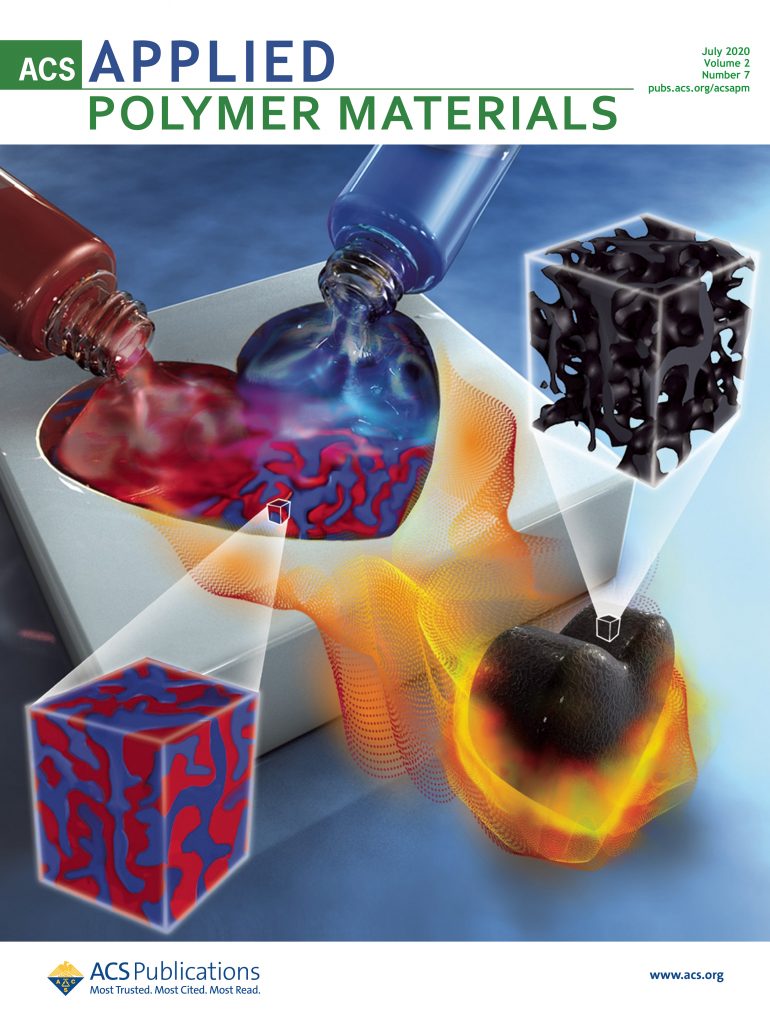
ACS Applied Polymer Materials is an interdisciplinary journal publishing original research covering all aspects of engineering, chemistry, physics, and biology relevant to applications of polymers.
The journal is devoted to reports of new and original experimental and theoretical research of an applied nature that integrates fundamental knowledge in the areas of materials, engineering, physics, bioscience, polymer science and chemistry into important polymer applications. The journal is specifically interested in work that addresses relationships among structure, processing, morphology, chemistry, properties, and function as well as work that provide insights into mechanisms critical to the performance of the polymer for applications.



 京公网安备 11010802042870号
京ICP备2023020795号-1
京公网安备 11010802042870号
京ICP备2023020795号-1

 分享
分享
 求助内容:
求助内容: 应助结果提醒方式:
 扫码关注我们
