Long Xu MD , Haojie Si MD , Fenghui Zhuang MD , Chongwu Li MD , Lei Zhang MD , Yue Zhao MD , Tao Chen MD , Yichen Dong MD , Tingting Wang MD , Likun Hou MD , Tao Hu MD , Tianlin Sun MD , Yunlang She MD , Xuefei Hu MD , Dong Xie MD , Junqi Wu MD , Chunyan Wu MD , Deping Zhao MD , Chang Chen MD, PhD
{"title":"Predicting therapeutic response to neoadjuvant immunotherapy based on an integration model in resectable stage IIIA (N2) non–small cell lung cancer","authors":"Long Xu MD , Haojie Si MD , Fenghui Zhuang MD , Chongwu Li MD , Lei Zhang MD , Yue Zhao MD , Tao Chen MD , Yichen Dong MD , Tingting Wang MD , Likun Hou MD , Tao Hu MD , Tianlin Sun MD , Yunlang She MD , Xuefei Hu MD , Dong Xie MD , Junqi Wu MD , Chunyan Wu MD , Deping Zhao MD , Chang Chen MD, PhD","doi":"10.1016/j.jtcvs.2024.05.006","DOIUrl":null,"url":null,"abstract":"<div><h3>Objective</h3><div>Accurately predicting response during neoadjuvant chemoimmunotherapy for resectable non–small cell lung cancer remains clinically challenging. In this study, we investigated the effectiveness of blood-based tumor mutational burden (bTMB) and a deep learning (DL) model in predicting major pathologic response (MPR) and survival from a phase 2 trial.</div></div><div><h3>Methods</h3><div>Blood samples were prospectively collected from 45 patients with stage IIIA (N2) non–small cell lung cancer undergoing neoadjuvant chemoimmunotherapy. An integrated model, combining the computed tomography–based DL score, bTMB, and clinical factors, was developed to predict tumor response to neoadjuvant chemoimmunotherapy.</div></div><div><h3>Results</h3><div>At baseline, bTMB were detected in 77.8% (35 of 45) of patients. Baseline bTMB ≥11 mutations/megabase was associated with significantly greater MPR rates (77.8% vs 38.5%, <em>P</em> = .042), and longer disease-free survival (<em>P</em><span> = .043), but not overall survival (</span><em>P</em><span> = .131), compared with bTMB <11 mutations/megabase in 35 patients with bTMB available. The developed DL model achieved an area under the curve of 0.703 in all patients. Importantly, the predictive performance of the integrated model improved to an area under the curve of 0.820 when combining the DL score with bTMB and clinical factors. Baseline circulating tumor DNA (ctDNA) status was not associated with pathologic response and survival. Compared with ctDNA residual, ctDNA clearance before surgery was associated with significantly greater MPR rates (88.2% vs 11.1%, </span><em>P</em> < .001) and improved disease-free survival (<em>P</em> = .010).</div></div><div><h3>Conclusions</h3><div>The integrated model shows promise as a predictor of tumor response to neoadjuvant chemoimmunotherapy. Serial ctDNA dynamics provide a reliable tool for monitoring tumor response.</div></div>","PeriodicalId":49975,"journal":{"name":"Journal of Thoracic and Cardiovascular Surgery","volume":"169 1","pages":"Pages 242-253.e4"},"PeriodicalIF":4.4000,"publicationDate":"2025-01-01","publicationTypes":"Journal Article","fieldsOfStudy":null,"isOpenAccess":false,"openAccessPdf":"","citationCount":"0","resultStr":null,"platform":"Semanticscholar","paperid":null,"PeriodicalName":"Journal of Thoracic and Cardiovascular Surgery","FirstCategoryId":"3","ListUrlMain":"https://www.sciencedirect.com/science/article/pii/S0022522324004379","RegionNum":1,"RegionCategory":"医学","ArticlePicture":[],"TitleCN":null,"AbstractTextCN":null,"PMCID":null,"EPubDate":"2024/5/17 0:00:00","PubModel":"Epub","JCR":"Q1","JCRName":"CARDIAC & CARDIOVASCULAR SYSTEMS","Score":null,"Total":0}
引用次数: 0
Abstract
Objective
Accurately predicting response during neoadjuvant chemoimmunotherapy for resectable non–small cell lung cancer remains clinically challenging. In this study, we investigated the effectiveness of blood-based tumor mutational burden (bTMB) and a deep learning (DL) model in predicting major pathologic response (MPR) and survival from a phase 2 trial.
Methods
Blood samples were prospectively collected from 45 patients with stage IIIA (N2) non–small cell lung cancer undergoing neoadjuvant chemoimmunotherapy. An integrated model, combining the computed tomography–based DL score, bTMB, and clinical factors, was developed to predict tumor response to neoadjuvant chemoimmunotherapy.
Results
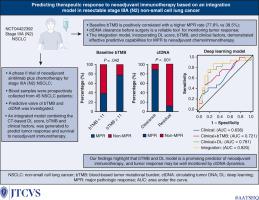
At baseline, bTMB were detected in 77.8% (35 of 45) of patients. Baseline bTMB ≥11 mutations/megabase was associated with significantly greater MPR rates (77.8% vs 38.5%, P = .042), and longer disease-free survival (P = .043), but not overall survival (P = .131), compared with bTMB <11 mutations/megabase in 35 patients with bTMB available. The developed DL model achieved an area under the curve of 0.703 in all patients. Importantly, the predictive performance of the integrated model improved to an area under the curve of 0.820 when combining the DL score with bTMB and clinical factors. Baseline circulating tumor DNA (ctDNA) status was not associated with pathologic response and survival. Compared with ctDNA residual, ctDNA clearance before surgery was associated with significantly greater MPR rates (88.2% vs 11.1%, P < .001) and improved disease-free survival (P = .010).
Conclusions
The integrated model shows promise as a predictor of tumor response to neoadjuvant chemoimmunotherapy. Serial ctDNA dynamics provide a reliable tool for monitoring tumor response.
目的准确预测可切除非小细胞肺癌新辅助化疗免疫治疗的疗效仍是临床挑战。在这项研究中,我们研究了基于血液的肿瘤突变负担(bTMB)和深度学习(DL)模型在预测主要病理反应(MPR)和生存期的有效性。方法前瞻性采集45例IIIA (N2)期非小细胞肺癌患者进行新辅助化疗免疫治疗。结合基于计算机断层扫描的DL评分、bTMB和临床因素,建立了一个综合模型来预测肿瘤对新辅助化疗免疫治疗的反应。结果基线时,45例患者中有35例(77.8%)检出bTMB。基线bTMB≥11个突变/megabase与更高的MPR率(77.8% vs 38.5%, P = 0.042)和更长的无病生存期(P = 0.043)相关,但与35例bTMB患者中bTMB≥11个突变/megabase的总生存期(P = 0.131)无关。所建立的DL模型在所有患者的曲线下面积均达到0.703。重要的是,当DL评分与bTMB及临床因素相结合时,综合模型的预测性能提高到曲线下面积0.820。基线循环肿瘤DNA (ctDNA)状态与病理反应和生存无关。与ctDNA残留相比,术前ctDNA清除率显著高于MPR率(88.2% vs 11.1%, P <;.001)和无病生存率的提高(P = .010)。结论该综合模型有望预测肿瘤对新辅助化疗免疫治疗的反应。序列ctDNA动力学为监测肿瘤反应提供了可靠的工具。
期刊介绍:
The Journal of Thoracic and Cardiovascular Surgery presents original, peer-reviewed articles on diseases of the heart, great vessels, lungs and thorax with emphasis on surgical interventions. An official publication of The American Association for Thoracic Surgery and The Western Thoracic Surgical Association, the Journal focuses on techniques and developments in acquired cardiac surgery, congenital cardiac repair, thoracic procedures, heart and lung transplantation, mechanical circulatory support and other procedures.




 京公网安备 11010802042870号
京ICP备2023020795号-1
京公网安备 11010802042870号
京ICP备2023020795号-1

 分享
分享
 求助内容:
求助内容: 应助结果提醒方式:
 扫码关注我们
