Fen Liu , Ji-Hong Gu , Zi-Yue Zhang , Qiong Zhan , Hai-Xia Yang , Yun Hu , Jin-Yan Zhang , Wei Tang , Wen-Cai Ye , Lei Wang
{"title":"Xanthrysols A–D, novel meroterpenoids with antiviral activities from Xanthostemon chrysanthus†","authors":"Fen Liu , Ji-Hong Gu , Zi-Yue Zhang , Qiong Zhan , Hai-Xia Yang , Yun Hu , Jin-Yan Zhang , Wei Tang , Wen-Cai Ye , Lei Wang","doi":"10.1039/d4qo00520a","DOIUrl":null,"url":null,"abstract":"<div><div>(+)/(−)-Xanthrysol A (<strong>1</strong>), an enantiomeric pair of novel macrocyclic meroterpenoids, along with three enantiomeric pairs of biogenetically related meroterpenoids (+)/(−)-xanthrysols B–D (<strong>2–4</strong>), were isolated and identified from the leaves of <em>Xanthostemon chrysanthus</em>. Structurally, compounds <strong>1–4</strong> are unique phenylpropanoyl–phloroglucinol-based meroterpenoids with three kinds of new carbon skeletons. Notably, xanthrysol A (<strong>1</strong>) features an unprecedented 6/6/16 fused ring system, incorporating a 2,4,16-trioxatricyclo[12.6.2.0<sup>17,21</sup>]docosane core. Their structures with absolute configurations were established by comprehensive spectroscopic analyses, single-crystal X-ray diffraction, and quantum chemical calculations. A plausible biogenetic pathway for <strong>1–4</strong> was proposed. Moreover, xanthrysol A demonstrated potent antiviral activity against respiratory syncytial virus (RSV) and acyclovir-resistant strains of herpes simplex virus type 1 (HSV-1/106, HSV-1/blue and HSV-1/153) with IC<sub>50</sub> values ranging from 4.68 to 8.10 μM. Time-of-addition assays showed that compound <strong>1</strong> specifically acts on the early stages of the virus replication process in both RSV and HSV-1.</div></div>","PeriodicalId":94379,"journal":{"name":"Organic chemistry frontiers : an international journal of organic chemistry","volume":"11 14","pages":"Pages 3814-3820"},"PeriodicalIF":0.0000,"publicationDate":"2024-07-09","publicationTypes":"Journal Article","fieldsOfStudy":null,"isOpenAccess":false,"openAccessPdf":"","citationCount":"0","resultStr":null,"platform":"Semanticscholar","paperid":null,"PeriodicalName":"Organic chemistry frontiers : an international journal of organic chemistry","FirstCategoryId":"1085","ListUrlMain":"https://www.sciencedirect.com/org/science/article/pii/S2052412924003796","RegionNum":0,"RegionCategory":null,"ArticlePicture":[],"TitleCN":null,"AbstractTextCN":null,"PMCID":null,"EPubDate":"","PubModel":"","JCR":"","JCRName":"","Score":null,"Total":0}
引用次数: 0
Abstract
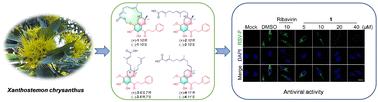
(+)/(−)-Xanthrysol A (1), an enantiomeric pair of novel macrocyclic meroterpenoids, along with three enantiomeric pairs of biogenetically related meroterpenoids (+)/(−)-xanthrysols B–D (2–4), were isolated and identified from the leaves of Xanthostemon chrysanthus. Structurally, compounds 1–4 are unique phenylpropanoyl–phloroglucinol-based meroterpenoids with three kinds of new carbon skeletons. Notably, xanthrysol A (1) features an unprecedented 6/6/16 fused ring system, incorporating a 2,4,16-trioxatricyclo[12.6.2.017,21]docosane core. Their structures with absolute configurations were established by comprehensive spectroscopic analyses, single-crystal X-ray diffraction, and quantum chemical calculations. A plausible biogenetic pathway for 1–4 was proposed. Moreover, xanthrysol A demonstrated potent antiviral activity against respiratory syncytial virus (RSV) and acyclovir-resistant strains of herpes simplex virus type 1 (HSV-1/106, HSV-1/blue and HSV-1/153) with IC50 values ranging from 4.68 to 8.10 μM. Time-of-addition assays showed that compound 1 specifically acts on the early stages of the virus replication process in both RSV and HSV-1.



 京公网安备 11010802042870号
京ICP备2023020795号-1
京公网安备 11010802042870号
京ICP备2023020795号-1

 分享
分享

 求助内容:
求助内容: 应助结果提醒方式:
 扫码关注我们
