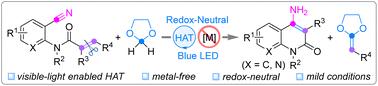
Merging 2,3-butanedione and N-hydroxysuccinimide as visible-light-enabled hydrogen atom transfer catalysts for CC double bond cleavage of 2-cyanoaryl acrylamides toward the synthesis of 4-amino-2-quinolones†
{"title":"Merging 2,3-butanedione and N-hydroxysuccinimide as visible-light-enabled hydrogen atom transfer catalysts for CC double bond cleavage of 2-cyanoaryl acrylamides toward the synthesis of 4-amino-2-quinolones†","authors":"Jun Huang , Fengting Zhu , Jinlian Wen , Jiali Xu , Jing-Mei Yuan , Wenqiang Chen","doi":"10.1039/d4qo00458b","DOIUrl":null,"url":null,"abstract":"<div><div>The CC double bond cleavage of 2-cyanoaryl acrylamides through merging 2,3-butanedione and <em>N</em>-hydroxysuccinimide as visible-light-enabled hydrogen atom transfer catalysts is effectively established for generating functionalized 4-amino-2-quinolones under metal-free and redox neutral conditions. Detailed mechanism studies indicate that the solvent 1,3-dioxolane offers the crucial 1,3-dioxolan-2-yl radical facilitated by the <em>in situ</em> formed H-atom abstracting species, and 2-alkenyl-1,3-dioxolane is probably another product in this photocatalytic protocol.</div></div>","PeriodicalId":94379,"journal":{"name":"Organic chemistry frontiers : an international journal of organic chemistry","volume":"11 14","pages":"Pages 3855-3860"},"PeriodicalIF":0.0000,"publicationDate":"2024-07-09","publicationTypes":"Journal Article","fieldsOfStudy":null,"isOpenAccess":false,"openAccessPdf":"","citationCount":"0","resultStr":null,"platform":"Semanticscholar","paperid":null,"PeriodicalName":"Organic chemistry frontiers : an international journal of organic chemistry","FirstCategoryId":"1085","ListUrlMain":"https://www.sciencedirect.com/org/science/article/pii/S205241292400384X","RegionNum":0,"RegionCategory":null,"ArticlePicture":[],"TitleCN":null,"AbstractTextCN":null,"PMCID":null,"EPubDate":"","PubModel":"","JCR":"","JCRName":"","Score":null,"Total":0}
引用次数: 0
Abstract
The CC double bond cleavage of 2-cyanoaryl acrylamides through merging 2,3-butanedione and N-hydroxysuccinimide as visible-light-enabled hydrogen atom transfer catalysts is effectively established for generating functionalized 4-amino-2-quinolones under metal-free and redox neutral conditions. Detailed mechanism studies indicate that the solvent 1,3-dioxolane offers the crucial 1,3-dioxolan-2-yl radical facilitated by the in situ formed H-atom abstracting species, and 2-alkenyl-1,3-dioxolane is probably another product in this photocatalytic protocol.



 京公网安备 11010802042870号
京ICP备2023020795号-1
京公网安备 11010802042870号
京ICP备2023020795号-1

 分享
分享

 求助内容:
求助内容: 应助结果提醒方式:
 扫码关注我们
