{"title":"The use of happy faces as visual stimuli improves the performance of the hybrid SSVEP+P300 brain computer interface","authors":"Deepak D. Kapgate","doi":"10.1016/j.jneumeth.2024.110170","DOIUrl":null,"url":null,"abstract":"<div><h3>Background</h3><p>This study illustrates a hybrid brain-computer interface (BCI) in which steady-state visual evoked potentials (SSVEP) and event-related potentials (P300) are evoked simultaneously. The goal of this study was to improve the performance of the current hybrid SSVEP+P300 BCI systems by incorporating a happy face into visual stimuli.</p></div><div><h3>New method</h3><p>In this study, happy and sad faces were added to a visual stimulus to induce stronger cortical signals in a hybrid SSVEP+P300 BCI. Additionally, we developed a paradigm in which SSVEP responses were triggered by non-face stimuli, whereas P300 responses were triggered by face stimuli. We tested four paradigms: happy face paradigm (HF), sad face paradigm (SF), happy face and flicker paradigm (HFF), and sad face and flicker paradigm (SFF).</p></div><div><h3>Results and conclusions</h3><p>The results demonstrated that the HFF paradigm elicited more robust cortical responses, which resulted in enhanced system accuracy and information transfer rate (ITR). The HFF paradigm has a system communication rate of 25.9 bits per second and an average accuracy of 96.1%. Compared with other paradigms, the HFF paradigm is the best choice for BCI applications because it has the highest ITR and maximum level of comfort.</p></div>","PeriodicalId":16415,"journal":{"name":"Journal of Neuroscience Methods","volume":"408 ","pages":"Article 110170"},"PeriodicalIF":2.3000,"publicationDate":"2024-05-21","publicationTypes":"Journal Article","fieldsOfStudy":null,"isOpenAccess":false,"openAccessPdf":"","citationCount":"0","resultStr":null,"platform":"Semanticscholar","paperid":null,"PeriodicalName":"Journal of Neuroscience Methods","FirstCategoryId":"3","ListUrlMain":"https://www.sciencedirect.com/science/article/pii/S0165027024001158","RegionNum":4,"RegionCategory":"医学","ArticlePicture":[],"TitleCN":null,"AbstractTextCN":null,"PMCID":null,"EPubDate":"","PubModel":"","JCR":"Q2","JCRName":"BIOCHEMICAL RESEARCH METHODS","Score":null,"Total":0}
引用次数: 0
Abstract
Background
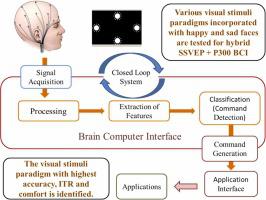
This study illustrates a hybrid brain-computer interface (BCI) in which steady-state visual evoked potentials (SSVEP) and event-related potentials (P300) are evoked simultaneously. The goal of this study was to improve the performance of the current hybrid SSVEP+P300 BCI systems by incorporating a happy face into visual stimuli.
New method
In this study, happy and sad faces were added to a visual stimulus to induce stronger cortical signals in a hybrid SSVEP+P300 BCI. Additionally, we developed a paradigm in which SSVEP responses were triggered by non-face stimuli, whereas P300 responses were triggered by face stimuli. We tested four paradigms: happy face paradigm (HF), sad face paradigm (SF), happy face and flicker paradigm (HFF), and sad face and flicker paradigm (SFF).
Results and conclusions
The results demonstrated that the HFF paradigm elicited more robust cortical responses, which resulted in enhanced system accuracy and information transfer rate (ITR). The HFF paradigm has a system communication rate of 25.9 bits per second and an average accuracy of 96.1%. Compared with other paradigms, the HFF paradigm is the best choice for BCI applications because it has the highest ITR and maximum level of comfort.
期刊介绍:
The Journal of Neuroscience Methods publishes papers that describe new methods that are specifically for neuroscience research conducted in invertebrates, vertebrates or in man. Major methodological improvements or important refinements of established neuroscience methods are also considered for publication. The Journal''s Scope includes all aspects of contemporary neuroscience research, including anatomical, behavioural, biochemical, cellular, computational, molecular, invasive and non-invasive imaging, optogenetic, and physiological research investigations.



 京公网安备 11010802042870号
京ICP备2023020795号-1
京公网安备 11010802042870号
京ICP备2023020795号-1

 分享
分享
 求助内容:
求助内容: 应助结果提醒方式:
 扫码关注我们
