{"title":"Preoperative evaluation of visceral pleural invasion in peripheral lung cancer utilizing deep learning technology.","authors":"Yujin Kudo, Akira Saito, Tomoaki Horiuchi, Kotaro Murakami, Masaharu Kobayashi, Jun Matsubayashi, Toshitaka Nagao, Tatsuo Ohira, Masahiko Kuroda, Norihiko Ikeda","doi":"10.1007/s00595-024-02869-z","DOIUrl":null,"url":null,"abstract":"<p><strong>Purpose: </strong>This study aimed to assess the efficiency of artificial intelligence (AI) in the detection of visceral pleural invasion (VPI) of lung cancer using high-resolution computed tomography (HRCT) images, which is challenging for experts because of its significance in T-classification and lymph node metastasis prediction.</p><p><strong>Methods: </strong>This retrospective analysis was conducted on preoperative HRCT images of 472 patients with stage I non-small cell lung cancer (NSCLC), focusing on lesions adjacent to the pleura to predict VPI. YOLOv4.0 was utilized for tumor localization, and EfficientNetv2 was applied for VPI prediction with HRCT images meticulously annotated for AI model training and validation.</p><p><strong>Results: </strong>Of the 472 lung cancer cases (500 CT images) studied, the AI algorithm successfully identified tumors, with YOLOv4.0 accurately localizing tumors in 98% of the test images. In the EfficientNet v2-M analysis, the receiver operating characteristic curve exhibited an area under the curve of 0.78. It demonstrated powerful diagnostic performance with a sensitivity, specificity, and precision of 76.4% in VPI prediction.</p><p><strong>Conclusion: </strong>AI is a promising tool for improving the diagnostic accuracy of VPI for NSCLC. Furthermore, incorporating AI into the diagnostic workflow is advocated because of its potential to improve the accuracy of preoperative diagnosis and patient outcomes in NSCLC.</p>","PeriodicalId":22163,"journal":{"name":"Surgery Today","volume":" ","pages":"18-28"},"PeriodicalIF":1.6000,"publicationDate":"2025-01-01","publicationTypes":"Journal Article","fieldsOfStudy":null,"isOpenAccess":false,"openAccessPdf":"","citationCount":"0","resultStr":null,"platform":"Semanticscholar","paperid":null,"PeriodicalName":"Surgery Today","FirstCategoryId":"3","ListUrlMain":"https://doi.org/10.1007/s00595-024-02869-z","RegionNum":4,"RegionCategory":"医学","ArticlePicture":[],"TitleCN":null,"AbstractTextCN":null,"PMCID":null,"EPubDate":"2024/5/23 0:00:00","PubModel":"Epub","JCR":"Q2","JCRName":"SURGERY","Score":null,"Total":0}
引用次数: 0
Abstract
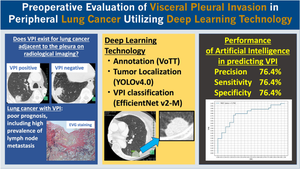
Purpose: This study aimed to assess the efficiency of artificial intelligence (AI) in the detection of visceral pleural invasion (VPI) of lung cancer using high-resolution computed tomography (HRCT) images, which is challenging for experts because of its significance in T-classification and lymph node metastasis prediction.
Methods: This retrospective analysis was conducted on preoperative HRCT images of 472 patients with stage I non-small cell lung cancer (NSCLC), focusing on lesions adjacent to the pleura to predict VPI. YOLOv4.0 was utilized for tumor localization, and EfficientNetv2 was applied for VPI prediction with HRCT images meticulously annotated for AI model training and validation.
Results: Of the 472 lung cancer cases (500 CT images) studied, the AI algorithm successfully identified tumors, with YOLOv4.0 accurately localizing tumors in 98% of the test images. In the EfficientNet v2-M analysis, the receiver operating characteristic curve exhibited an area under the curve of 0.78. It demonstrated powerful diagnostic performance with a sensitivity, specificity, and precision of 76.4% in VPI prediction.
Conclusion: AI is a promising tool for improving the diagnostic accuracy of VPI for NSCLC. Furthermore, incorporating AI into the diagnostic workflow is advocated because of its potential to improve the accuracy of preoperative diagnosis and patient outcomes in NSCLC.
期刊介绍:
Surgery Today is the official journal of the Japan Surgical Society. The main purpose of the journal is to provide a place for the publication of high-quality papers documenting recent advances and new developments in all fields of surgery, both clinical and experimental. The journal welcomes original papers, review articles, and short communications, as well as short technical reports("How to do it").
The "How to do it" section will includes short articles on methods or techniques recommended for practical surgery. Papers submitted to the journal are reviewed by an international editorial board. Field of interest: All fields of surgery.



 京公网安备 11010802042870号
京ICP备2023020795号-1
京公网安备 11010802042870号
京ICP备2023020795号-1

 分享
分享
 求助内容:
求助内容: 应助结果提醒方式:
 扫码关注我们
