{"title":"Effect of migrations on synchrony in host-parasitoid system","authors":"Appilineni Kushal , Alan Hastings","doi":"10.1016/j.jtbi.2024.111855","DOIUrl":null,"url":null,"abstract":"<div><p>Insect outbreaks can cause large scale defoliation of forest trees or destruction of crops, leading to ecosystem degradation and economic losses. Some outbreaks occur simultaneously across large geographic scales and some outbreaks occur periodically every few years across space. Parasitoids are a natural enemy of these defoliators and could help mitigate these pest outbreaks. A holistic understanding of the host-parasitoid interactions in a spatial context would thus enhance our ability to understand, predict and prevent these outbreaks. We use a discrete time deterministic model of the host parasitoid system with populations migrating between 2 patches to elucidate features of spatial host outbreaks. We show that whenever populations persist indefinitely, host outbreaks in both patches can occur alternatively (out of phase) at low migration between patches whereas host outbreaks always occur simultaneously (in phase) in both patches at high migration between patches. We show that our results are robust across a large range of parameters across different modelling approaches used typically to model intraspecific competition among hosts and parasitism, in the host-parasitoid literature. We give an analytical expression for the period of oscillations when the migration is low <em>i.e.</em>, when host outbreaks in both patches are out of phase, show it is in agreement with numerical results. We end our paper by showing that we get the same results whether we include the biologically rooted formulations from May et al. (1981) or a general cellular automata model with qualitative rules.</p></div>","PeriodicalId":54763,"journal":{"name":"Journal of Theoretical Biology","volume":"590 ","pages":"Article 111855"},"PeriodicalIF":2.0000,"publicationDate":"2024-08-07","publicationTypes":"Journal Article","fieldsOfStudy":null,"isOpenAccess":false,"openAccessPdf":"","citationCount":"0","resultStr":null,"platform":"Semanticscholar","paperid":null,"PeriodicalName":"Journal of Theoretical Biology","FirstCategoryId":"99","ListUrlMain":"https://www.sciencedirect.com/science/article/pii/S002251932400136X","RegionNum":4,"RegionCategory":"数学","ArticlePicture":[],"TitleCN":null,"AbstractTextCN":null,"PMCID":null,"EPubDate":"2024/5/22 0:00:00","PubModel":"Epub","JCR":"Q2","JCRName":"BIOLOGY","Score":null,"Total":0}
引用次数: 0
Abstract
Insect outbreaks can cause large scale defoliation of forest trees or destruction of crops, leading to ecosystem degradation and economic losses. Some outbreaks occur simultaneously across large geographic scales and some outbreaks occur periodically every few years across space. Parasitoids are a natural enemy of these defoliators and could help mitigate these pest outbreaks. A holistic understanding of the host-parasitoid interactions in a spatial context would thus enhance our ability to understand, predict and prevent these outbreaks. We use a discrete time deterministic model of the host parasitoid system with populations migrating between 2 patches to elucidate features of spatial host outbreaks. We show that whenever populations persist indefinitely, host outbreaks in both patches can occur alternatively (out of phase) at low migration between patches whereas host outbreaks always occur simultaneously (in phase) in both patches at high migration between patches. We show that our results are robust across a large range of parameters across different modelling approaches used typically to model intraspecific competition among hosts and parasitism, in the host-parasitoid literature. We give an analytical expression for the period of oscillations when the migration is low i.e., when host outbreaks in both patches are out of phase, show it is in agreement with numerical results. We end our paper by showing that we get the same results whether we include the biologically rooted formulations from May et al. (1981) or a general cellular automata model with qualitative rules.
昆虫爆发会造成林木大面积落叶或农作物被毁,导致生态系统退化和经济损失。有些虫害在大范围内同时爆发,有些虫害则每隔几年在空间上定期爆发。寄生虫是这些落叶虫的天敌,可以帮助减轻这些害虫的爆发。因此,全面了解寄主与寄生虫在空间范围内的相互作用将提高我们理解、预测和预防这些虫害爆发的能力。我们利用寄主寄生系统的离散时间确定性模型(种群在两个斑块之间迁移)来阐明空间寄主爆发的特征。我们的研究表明,当种群无限期地持续存在时,两个斑块中的寄主爆发会在斑块间迁移量较低时交替发生(不同步),而在斑块间迁移量较高时,寄主爆发总是在两个斑块中同时发生(同步)。我们的研究结果表明,在宿主-寄生虫文献中,我们的研究结果在很大的参数范围内都是稳健的,这些参数跨越了通常用于模拟宿主和寄生虫种内竞争的不同建模方法。我们给出了低迁移率(即两个斑块中的寄主爆发不同步)时振荡周期的分析表达式,结果显示与数值结果一致。最后,我们证明,无论我们采用 May 等人(1981 年)的生物学公式,还是采用具有定性规则的一般细胞自动机模型,都能得到相同的结果。
期刊介绍:
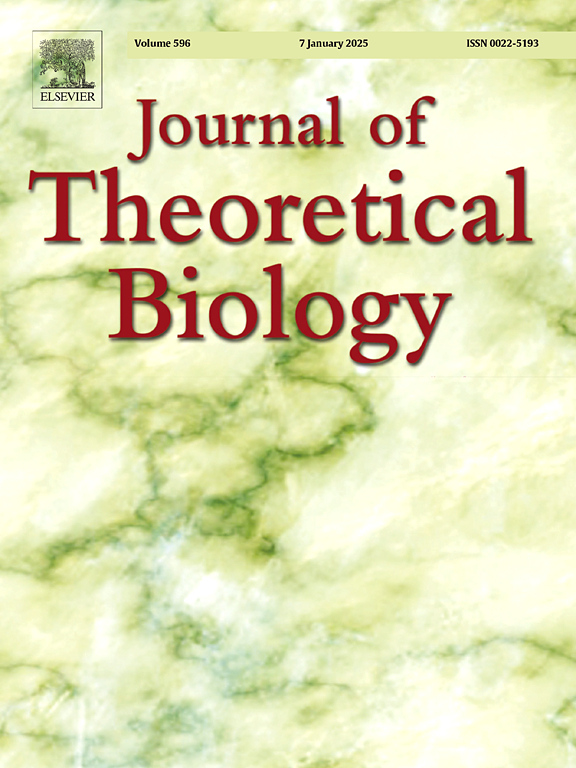
The Journal of Theoretical Biology is the leading forum for theoretical perspectives that give insight into biological processes. It covers a very wide range of topics and is of interest to biologists in many areas of research, including:
• Brain and Neuroscience
• Cancer Growth and Treatment
• Cell Biology
• Developmental Biology
• Ecology
• Evolution
• Immunology,
• Infectious and non-infectious Diseases,
• Mathematical, Computational, Biophysical and Statistical Modeling
• Microbiology, Molecular Biology, and Biochemistry
• Networks and Complex Systems
• Physiology
• Pharmacodynamics
• Animal Behavior and Game Theory
Acceptable papers are those that bear significant importance on the biology per se being presented, and not on the mathematical analysis. Papers that include some data or experimental material bearing on theory will be considered, including those that contain comparative study, statistical data analysis, mathematical proof, computer simulations, experiments, field observations, or even philosophical arguments, which are all methods to support or reject theoretical ideas. However, there should be a concerted effort to make papers intelligible to biologists in the chosen field.



 京公网安备 11010802042870号
京ICP备2023020795号-1
京公网安备 11010802042870号
京ICP备2023020795号-1

 分享
分享
 求助内容:
求助内容: 应助结果提醒方式:
 扫码关注我们
