Visual and Sensitive Detection of Milk Adulterant Melamine by Localized Surface Plasmon Resonance Optical Characteristics of Ag-MOF@Fe/SnO2 Nanocomposite
Tayyaba Shahzadi, Hajra Bibi, Tauheeda Riaz, Maria Zaib, Tabinda Malik
{"title":"Visual and Sensitive Detection of Milk Adulterant Melamine by Localized Surface Plasmon Resonance Optical Characteristics of Ag-MOF@Fe/SnO2 Nanocomposite","authors":"Tayyaba Shahzadi, Hajra Bibi, Tauheeda Riaz, Maria Zaib, Tabinda Malik","doi":"10.1007/s11468-024-02333-1","DOIUrl":null,"url":null,"abstract":"<div><p>Melamine is being added in pet food, milk and infant formula to enhance its “false” apparent protein contents but when it is present in milk beyond its allowed limit, it causes serious health problems which leads to renal failure and kidney stones. In this work a highly selective, sensitive and rapid method has been developed for determination of melamine as potential milk adulterant. Ag-MOFs doped with magnetic nanocatalyst were synthesized by using chemical reduction method and characterized through UV-Vis spectroscopy, Fourier transformed infrared spectroscopy (FTIR), scanning electron microscopy (SEM), X-ray diffraction (XRD) and energy dispersive X-ray spectroscopy (EDX). The strong SPR peak of Ag-MOFs was observed at 400–500 nm and Fe-SnO<sub>2</sub> was observed at 250–300 nm. The absorption band of Ag-MOF@Fe/SnO<sub>2</sub> was found at 250–350 nm with energy band gap of 2.78. The average particle size of nanocomposite was found to be 54.11 nm having uniform and crystalline shape. Different factors i.e. adsorbent dose, adsorbate dose, pH, temperature and time were optimized for maximum sensing of melamine. Prepared nanocomposite showed 97% detection efficiency for melamine at pH = 8 and 45 °C temperature in time limit of 25 min. Feasibility of prepared nanocomposite was also checked by standard melamine samples and pre-treated spiked milk sample. Prepared nanocomposite gave a rapid sensitive detection of melamine with limit of detection 1.8 ppm and 77% recovery from spiked raw milk without using any costly instrument.</p><h3>Graphical Abstract</h3>\n<div><figure><div><div><picture><source><img></source></picture></div></div></figure></div></div>","PeriodicalId":736,"journal":{"name":"Plasmonics","volume":"20 3","pages":"1169 - 1181"},"PeriodicalIF":4.3000,"publicationDate":"2024-05-24","publicationTypes":"Journal Article","fieldsOfStudy":null,"isOpenAccess":false,"openAccessPdf":"","citationCount":"0","resultStr":null,"platform":"Semanticscholar","paperid":null,"PeriodicalName":"Plasmonics","FirstCategoryId":"101","ListUrlMain":"https://link.springer.com/article/10.1007/s11468-024-02333-1","RegionNum":4,"RegionCategory":"物理与天体物理","ArticlePicture":[],"TitleCN":null,"AbstractTextCN":null,"PMCID":null,"EPubDate":"","PubModel":"","JCR":"Q2","JCRName":"CHEMISTRY, PHYSICAL","Score":null,"Total":0}
引用次数: 0
Abstract
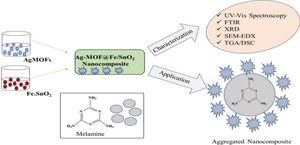
Melamine is being added in pet food, milk and infant formula to enhance its “false” apparent protein contents but when it is present in milk beyond its allowed limit, it causes serious health problems which leads to renal failure and kidney stones. In this work a highly selective, sensitive and rapid method has been developed for determination of melamine as potential milk adulterant. Ag-MOFs doped with magnetic nanocatalyst were synthesized by using chemical reduction method and characterized through UV-Vis spectroscopy, Fourier transformed infrared spectroscopy (FTIR), scanning electron microscopy (SEM), X-ray diffraction (XRD) and energy dispersive X-ray spectroscopy (EDX). The strong SPR peak of Ag-MOFs was observed at 400–500 nm and Fe-SnO2 was observed at 250–300 nm. The absorption band of Ag-MOF@Fe/SnO2 was found at 250–350 nm with energy band gap of 2.78. The average particle size of nanocomposite was found to be 54.11 nm having uniform and crystalline shape. Different factors i.e. adsorbent dose, adsorbate dose, pH, temperature and time were optimized for maximum sensing of melamine. Prepared nanocomposite showed 97% detection efficiency for melamine at pH = 8 and 45 °C temperature in time limit of 25 min. Feasibility of prepared nanocomposite was also checked by standard melamine samples and pre-treated spiked milk sample. Prepared nanocomposite gave a rapid sensitive detection of melamine with limit of detection 1.8 ppm and 77% recovery from spiked raw milk without using any costly instrument.
期刊介绍:
Plasmonics is an international forum for the publication of peer-reviewed leading-edge original articles that both advance and report our knowledge base and practice of the interactions of free-metal electrons, Plasmons.
Topics covered include notable advances in the theory, Physics, and applications of surface plasmons in metals, to the rapidly emerging areas of nanotechnology, biophotonics, sensing, biochemistry and medicine. Topics, including the theory, synthesis and optical properties of noble metal nanostructures, patterned surfaces or materials, continuous or grated surfaces, devices, or wires for their multifarious applications are particularly welcome. Typical applications might include but are not limited to, surface enhanced spectroscopic properties, such as Raman scattering or fluorescence, as well developments in techniques such as surface plasmon resonance and near-field scanning optical microscopy.




 京公网安备 11010802042870号
京ICP备2023020795号-1
京公网安备 11010802042870号
京ICP备2023020795号-1

 分享
分享
 求助内容:
求助内容: 应助结果提醒方式:
 扫码关注我们
