{"title":"Balancing Human Likeness in Social Robots: Impact on Children’s Lexical Alignment and Self-disclosure for Trust Assessment","authors":"Natalia Calvo-Barajas, Anastasia Akkuzu, Ginevra Castellano","doi":"10.1145/3659062","DOIUrl":null,"url":null,"abstract":"While there is evidence that human-like characteristics in robots could benefit child-robot interaction in many ways, open questions remain about the appropriate degree of human likeness that should be implemented in robots to avoid adverse effects on acceptance and trust. This study investigates how human likeness, appearance and behavior, influence children’s social and competency trust in a robot. We first designed two versions of the Furhat robot with visual and auditory human-like and machine-like cues validated in two online studies. Secondly, we created verbal behaviors where human likeness was manipulated as responsiveness regarding the robot’s lexical matching. Then, 52 children (7-10 years old) played a storytelling game in a between-subjects experimental design. Results show that the conditions did not affect subjective trust measures. However, objective measures showed that human likeness affects trust differently. While low human-like appearance enhanced social trust, high human-like behavior improved children’s acceptance of the robot’s task-related suggestions. This work provides empirical evidence on manipulating facial features and behavior to control human likeness in a robot with a highly human-like morphology. We discuss the implications and importance of balancing human likeness in robot design and its impacts on task performance, as it directly impacts trust-building with children.","PeriodicalId":4,"journal":{"name":"ACS Applied Energy Materials","volume":"27 17","pages":""},"PeriodicalIF":5.5000,"publicationDate":"2024-05-23","publicationTypes":"Journal Article","fieldsOfStudy":null,"isOpenAccess":false,"openAccessPdf":"","citationCount":"0","resultStr":null,"platform":"Semanticscholar","paperid":null,"PeriodicalName":"ACS Applied Energy Materials","FirstCategoryId":"1085","ListUrlMain":"https://doi.org/10.1145/3659062","RegionNum":3,"RegionCategory":"材料科学","ArticlePicture":[],"TitleCN":null,"AbstractTextCN":null,"PMCID":null,"EPubDate":"","PubModel":"","JCR":"Q2","JCRName":"CHEMISTRY, PHYSICAL","Score":null,"Total":0}
引用次数: 0
Abstract
While there is evidence that human-like characteristics in robots could benefit child-robot interaction in many ways, open questions remain about the appropriate degree of human likeness that should be implemented in robots to avoid adverse effects on acceptance and trust. This study investigates how human likeness, appearance and behavior, influence children’s social and competency trust in a robot. We first designed two versions of the Furhat robot with visual and auditory human-like and machine-like cues validated in two online studies. Secondly, we created verbal behaviors where human likeness was manipulated as responsiveness regarding the robot’s lexical matching. Then, 52 children (7-10 years old) played a storytelling game in a between-subjects experimental design. Results show that the conditions did not affect subjective trust measures. However, objective measures showed that human likeness affects trust differently. While low human-like appearance enhanced social trust, high human-like behavior improved children’s acceptance of the robot’s task-related suggestions. This work provides empirical evidence on manipulating facial features and behavior to control human likeness in a robot with a highly human-like morphology. We discuss the implications and importance of balancing human likeness in robot design and its impacts on task performance, as it directly impacts trust-building with children.
期刊介绍:
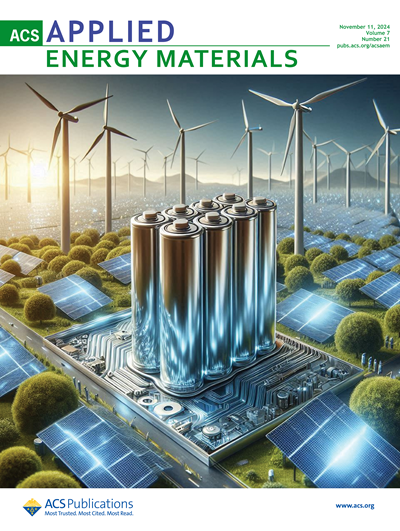
ACS Applied Energy Materials is an interdisciplinary journal publishing original research covering all aspects of materials, engineering, chemistry, physics and biology relevant to energy conversion and storage. The journal is devoted to reports of new and original experimental and theoretical research of an applied nature that integrate knowledge in the areas of materials, engineering, physics, bioscience, and chemistry into important energy applications.




 京公网安备 11010802042870号
京ICP备2023020795号-1
京公网安备 11010802042870号
京ICP备2023020795号-1

 分享
分享
 求助内容:
求助内容: 应助结果提醒方式:
 扫码关注我们
