{"title":"On the Plasmon-Exciton Coupling in a Metal/Dielectric CTF/TMD Trilayer Structure","authors":"F. Babaei","doi":"10.1007/s11468-024-02357-7","DOIUrl":null,"url":null,"abstract":"<div><p>In this study, the effect of a columnar thin film as a spacer layer in controlling and designing the coupling between plasmons and excitons in a prism-coupled configuration is reported. It turned out that the structural parameters of the columnar thin film have a significant effect on the Rabi splitting energy and coupling strength between plasmons and excitons. We found two anticrossing behaviors between the plexcitonic hybrid states due to the interaction of a plasmonic mode of the metal thin film and two excitonic modes of the transition metal dichalcogenide thin film. The localization and the local absorbance of hybrid modes were investigated by the time-averaged Poynting vector and the divergence of the Poynting vector. The obtained results showed that the hybrid modes are more localized at the metal/CTF interface and also the low plexciton state is long-lived than the medium and upper plexciton states. In our work, the most plexcitonic states were in the strong coupling regime, and the double Rabi splitting energy was available as high as 837 meV.</p></div>","PeriodicalId":736,"journal":{"name":"Plasmonics","volume":"20 2","pages":"753 - 762"},"PeriodicalIF":4.3000,"publicationDate":"2024-05-22","publicationTypes":"Journal Article","fieldsOfStudy":null,"isOpenAccess":false,"openAccessPdf":"","citationCount":"0","resultStr":null,"platform":"Semanticscholar","paperid":null,"PeriodicalName":"Plasmonics","FirstCategoryId":"101","ListUrlMain":"https://link.springer.com/article/10.1007/s11468-024-02357-7","RegionNum":4,"RegionCategory":"物理与天体物理","ArticlePicture":[],"TitleCN":null,"AbstractTextCN":null,"PMCID":null,"EPubDate":"","PubModel":"","JCR":"Q2","JCRName":"CHEMISTRY, PHYSICAL","Score":null,"Total":0}
引用次数: 0
Abstract
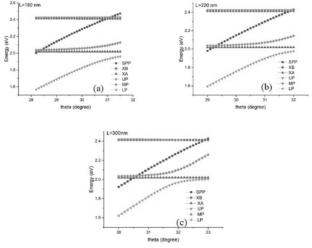
In this study, the effect of a columnar thin film as a spacer layer in controlling and designing the coupling between plasmons and excitons in a prism-coupled configuration is reported. It turned out that the structural parameters of the columnar thin film have a significant effect on the Rabi splitting energy and coupling strength between plasmons and excitons. We found two anticrossing behaviors between the plexcitonic hybrid states due to the interaction of a plasmonic mode of the metal thin film and two excitonic modes of the transition metal dichalcogenide thin film. The localization and the local absorbance of hybrid modes were investigated by the time-averaged Poynting vector and the divergence of the Poynting vector. The obtained results showed that the hybrid modes are more localized at the metal/CTF interface and also the low plexciton state is long-lived than the medium and upper plexciton states. In our work, the most plexcitonic states were in the strong coupling regime, and the double Rabi splitting energy was available as high as 837 meV.
期刊介绍:
Plasmonics is an international forum for the publication of peer-reviewed leading-edge original articles that both advance and report our knowledge base and practice of the interactions of free-metal electrons, Plasmons.
Topics covered include notable advances in the theory, Physics, and applications of surface plasmons in metals, to the rapidly emerging areas of nanotechnology, biophotonics, sensing, biochemistry and medicine. Topics, including the theory, synthesis and optical properties of noble metal nanostructures, patterned surfaces or materials, continuous or grated surfaces, devices, or wires for their multifarious applications are particularly welcome. Typical applications might include but are not limited to, surface enhanced spectroscopic properties, such as Raman scattering or fluorescence, as well developments in techniques such as surface plasmon resonance and near-field scanning optical microscopy.