Zhang Ye, Wendy C. Sheu, Huan Qu, Bin Peng, Jia Liu, Li Zhang, Fanen Yuan, Yuxin Wei, Jiangbing Zhou, Qianxue Chen, Xuan Xiao, Shenqi Zhang
{"title":"Autocatalytic, Brain Tumor‐Targeting Delivery of Bardoxolone Methyl Self‐Assembled Nanoparticles for Glioblastoma Treatment","authors":"Zhang Ye, Wendy C. Sheu, Huan Qu, Bin Peng, Jia Liu, Li Zhang, Fanen Yuan, Yuxin Wei, Jiangbing Zhou, Qianxue Chen, Xuan Xiao, Shenqi Zhang","doi":"10.1002/smsc.202400081","DOIUrl":null,"url":null,"abstract":"Glioblastoma multiforme (GBM) is a formidable cancer to treat due to the lack of effective drugs that can also efficiently cross the blood–brain barrier (BBB). Herein, a novel strategy involving the synthesis of p28 peptide‐conjugated, lexiscan (LEX)‐loaded, bardoxolone methyl (BM) self‐assembled nanoparticles, designated as p28‐LBM NPs, is introduced. These NPs are designed to overcome the dual challenges of effectively killing GBM cells and efficiently penetrating the brain. The p28 peptide is chosen for targeted delivery to brain tumors, and LEX is employed to enhance drug penetration across the BBB. The successful penetration of brain tumors by the p28‐LBM NPs after intravenous administration is demonstrated, with BM delivered as part of the NPs significantly inhibiting GBM tumor growth and extending the survival of mice with tumors. In conclusion, the p28‐LBM NPs present a promising approach for GBM treatment, with potential for effective and safe clinical applications in the future.","PeriodicalId":11,"journal":{"name":"ACS Chemical Biology","volume":"63 20","pages":""},"PeriodicalIF":3.8000,"publicationDate":"2024-05-22","publicationTypes":"Journal Article","fieldsOfStudy":null,"isOpenAccess":false,"openAccessPdf":"","citationCount":"0","resultStr":null,"platform":"Semanticscholar","paperid":null,"PeriodicalName":"ACS Chemical Biology","FirstCategoryId":"1085","ListUrlMain":"https://doi.org/10.1002/smsc.202400081","RegionNum":2,"RegionCategory":"生物学","ArticlePicture":[],"TitleCN":null,"AbstractTextCN":null,"PMCID":null,"EPubDate":"","PubModel":"","JCR":"Q2","JCRName":"BIOCHEMISTRY & MOLECULAR BIOLOGY","Score":null,"Total":0}
引用次数: 0
Abstract
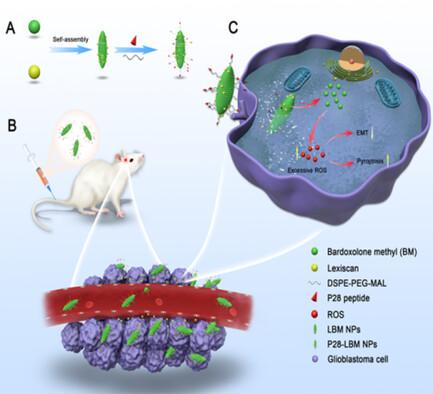
Glioblastoma multiforme (GBM) is a formidable cancer to treat due to the lack of effective drugs that can also efficiently cross the blood–brain barrier (BBB). Herein, a novel strategy involving the synthesis of p28 peptide‐conjugated, lexiscan (LEX)‐loaded, bardoxolone methyl (BM) self‐assembled nanoparticles, designated as p28‐LBM NPs, is introduced. These NPs are designed to overcome the dual challenges of effectively killing GBM cells and efficiently penetrating the brain. The p28 peptide is chosen for targeted delivery to brain tumors, and LEX is employed to enhance drug penetration across the BBB. The successful penetration of brain tumors by the p28‐LBM NPs after intravenous administration is demonstrated, with BM delivered as part of the NPs significantly inhibiting GBM tumor growth and extending the survival of mice with tumors. In conclusion, the p28‐LBM NPs present a promising approach for GBM treatment, with potential for effective and safe clinical applications in the future.
期刊介绍:
ACS Chemical Biology provides an international forum for the rapid communication of research that broadly embraces the interface between chemistry and biology.
The journal also serves as a forum to facilitate the communication between biologists and chemists that will translate into new research opportunities and discoveries. Results will be published in which molecular reasoning has been used to probe questions through in vitro investigations, cell biological methods, or organismic studies.
We welcome mechanistic studies on proteins, nucleic acids, sugars, lipids, and nonbiological polymers. The journal serves a large scientific community, exploring cellular function from both chemical and biological perspectives. It is understood that submitted work is based upon original results and has not been published previously.




 京公网安备 11010802042870号
京ICP备2023020795号-1
京公网安备 11010802042870号
京ICP备2023020795号-1

 分享
分享
 求助内容:
求助内容: 应助结果提醒方式:
 扫码关注我们
