Jenny E. Jaffe, Sonja Metzger, Kerstin Mätz-Rensing, Alexis Ribas, Roman M. Wittig, Fabian H. Leendertz
{"title":"Oesophagostomum stephanostomum causing parasitic granulomas in wild chimpanzees (Pan troglodytes verus) of Taï National Park, Côte d'Ivoire","authors":"Jenny E. Jaffe, Sonja Metzger, Kerstin Mätz-Rensing, Alexis Ribas, Roman M. Wittig, Fabian H. Leendertz","doi":"10.1002/ajp.23652","DOIUrl":null,"url":null,"abstract":"<p>Nematodes belonging to the genus <i>Oesophagostomum</i> frequently infect wild chimpanzees (<i>Pan troglodytes</i>) across widely separated field sites. Nodular lesions (granulomas) containing <i>Oesophagostomum</i> are commonly seen in the abdomen of infected chimpanzees post-mortem. At Taï National Park, Côte d'Ivoire, previous studies have identified larvae of a variety of <i>Oesophagostomum</i> spp. in wild chimpanzee stool, based on sequencing of larval DNA, and nodular lesions associated with <i>Oesophagostomum</i>, identified morphologically to the genus level but not sequenced. Here we present three recent cases of parasitic granulomas found post-mortem in chimpanzees at Taï. We complement descriptions of gross pathology, histopathology and parasitology with PCR and sequencing of DNA isolated from the parasitic nodules and from adult worms found inside the nodules. In all three cases, we identify <i>Oesophagostomum stephanostomum</i> as the causative agent. The sequences from this study were identical to the only other published sequences from nodules in nonhuman primates—those from the wild chimpanzees of Gombe, Tanzania.</p>","PeriodicalId":7662,"journal":{"name":"American Journal of Primatology","volume":"86 8","pages":""},"PeriodicalIF":1.8000,"publicationDate":"2024-05-28","publicationTypes":"Journal Article","fieldsOfStudy":null,"isOpenAccess":false,"openAccessPdf":"https://onlinelibrary.wiley.com/doi/epdf/10.1002/ajp.23652","citationCount":"0","resultStr":null,"platform":"Semanticscholar","paperid":null,"PeriodicalName":"American Journal of Primatology","FirstCategoryId":"99","ListUrlMain":"https://onlinelibrary.wiley.com/doi/10.1002/ajp.23652","RegionNum":3,"RegionCategory":"生物学","ArticlePicture":[],"TitleCN":null,"AbstractTextCN":null,"PMCID":null,"EPubDate":"","PubModel":"","JCR":"Q1","JCRName":"ZOOLOGY","Score":null,"Total":0}
引用次数: 0
Abstract
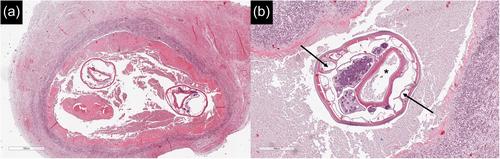
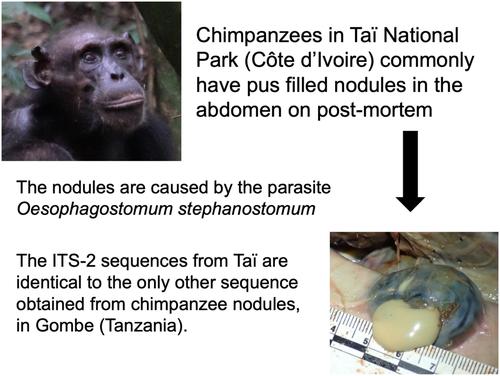
Nematodes belonging to the genus Oesophagostomum frequently infect wild chimpanzees (Pan troglodytes) across widely separated field sites. Nodular lesions (granulomas) containing Oesophagostomum are commonly seen in the abdomen of infected chimpanzees post-mortem. At Taï National Park, Côte d'Ivoire, previous studies have identified larvae of a variety of Oesophagostomum spp. in wild chimpanzee stool, based on sequencing of larval DNA, and nodular lesions associated with Oesophagostomum, identified morphologically to the genus level but not sequenced. Here we present three recent cases of parasitic granulomas found post-mortem in chimpanzees at Taï. We complement descriptions of gross pathology, histopathology and parasitology with PCR and sequencing of DNA isolated from the parasitic nodules and from adult worms found inside the nodules. In all three cases, we identify Oesophagostomum stephanostomum as the causative agent. The sequences from this study were identical to the only other published sequences from nodules in nonhuman primates—those from the wild chimpanzees of Gombe, Tanzania.
期刊介绍:
The objective of the American Journal of Primatology is to provide a forum for the exchange of ideas and findings among primatologists and to convey our increasing understanding of this order of animals to specialists and interested readers alike.
Primatology is an unusual science in that its practitioners work in a wide variety of departments and institutions, live in countries throughout the world, and carry out a vast range of research procedures. Whether we are anthropologists, psychologists, biologists, or medical researchers, whether we live in Japan, Kenya, Brazil, or the United States, whether we conduct naturalistic observations in the field or experiments in the lab, we are united in our goal of better understanding primates. Our studies of nonhuman primates are of interest to scientists in many other disciplines ranging from entomology to sociology.




 京公网安备 11010802042870号
京ICP备2023020795号-1
京公网安备 11010802042870号
京ICP备2023020795号-1

 分享
分享
 求助内容:
求助内容: 应助结果提醒方式:
 扫码关注我们
