Yiwen Luo, Qing Zheng, Zhiyong Luo, Shuqing Xiang and Mei Dai
{"title":"Removal of 3,4-dichlorophenol from water utilizing ferrate(vi): kinetic and mechanistic investigations and effects of coexisting anions†","authors":"Yiwen Luo, Qing Zheng, Zhiyong Luo, Shuqing Xiang and Mei Dai","doi":"10.1039/D4EW00274A","DOIUrl":null,"url":null,"abstract":"<p >3,4-Dichlorophenol (3,4-DCP) has been detected in industrial and domestic effluents, posing adverse effects on human health. Herein, the ferrate (Fe(<small>VI</small>)) oxidation of 3,4-DCP was systemically and comprehensively investigated by determining its kinetics, mechanisms, and effect of anions. The pH dependence of the reaction kinetics was found to be strong and the second-order reaction rate constant <em>k</em> varied nonlinearly from 342.82 ± 21.81 M<small><sup>−1</sup></small> s<small><sup>−1</sup></small> to 8.21 ± 0.27 M<small><sup>−1</sup></small> s<small><sup>−1</sup></small> with the increase in pH from 6.5 to 10.5, whereas its temperature dependence was quite weak. The individual species-specific second-order rate constants for the reaction were obtained using a least-squares regression approach. Protonated Fe(<small>VI</small>) has higher reactivity than its unprotonated species, while 3,4-DCP was just the opposite, leading to the reaction of HFeO<small><sub>4</sub></small><small><sup>−</sup></small> with 3,4-DCP<small><sup>−</sup></small> occurring fastest among the four parallel reactions. Significantly, 3,4-DCP removal kinetics was inhibited by coexisting anions. Meanwhile, the efficiency of 3,4-DCP removal by Fe(<small>VI</small>) at different Fe(<small>VI</small>) concentrations, solution pH, and coexisting anions was determined. Furthermore, eight intermediates of 3,4-DCP oxidation were identified, and a detailed mechanism involving hydroxylation, substitution, dechlorination, and ring-opening steps of the Fe(<small>VI</small>)/3,4-DCP reaction was proposed. The removal of 3,4-DCP was enhanced in actual water samples, demonstrating that Fe(<small>VI</small>) technology could be regarded as an efficient approach for removing 3,4-DCP from water.</p>","PeriodicalId":75,"journal":{"name":"Environmental Science: Water Research & Technology","volume":" 8","pages":" 1840-1855"},"PeriodicalIF":3.1000,"publicationDate":"2024-05-28","publicationTypes":"Journal Article","fieldsOfStudy":null,"isOpenAccess":false,"openAccessPdf":"","citationCount":"0","resultStr":null,"platform":"Semanticscholar","paperid":null,"PeriodicalName":"Environmental Science: Water Research & Technology","FirstCategoryId":"93","ListUrlMain":"https://pubs.rsc.org/en/content/articlelanding/2024/ew/d4ew00274a","RegionNum":4,"RegionCategory":"环境科学与生态学","ArticlePicture":[],"TitleCN":null,"AbstractTextCN":null,"PMCID":null,"EPubDate":"","PubModel":"","JCR":"Q3","JCRName":"ENGINEERING, ENVIRONMENTAL","Score":null,"Total":0}
引用次数: 0
Abstract
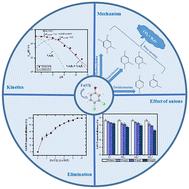
3,4-Dichlorophenol (3,4-DCP) has been detected in industrial and domestic effluents, posing adverse effects on human health. Herein, the ferrate (Fe(VI)) oxidation of 3,4-DCP was systemically and comprehensively investigated by determining its kinetics, mechanisms, and effect of anions. The pH dependence of the reaction kinetics was found to be strong and the second-order reaction rate constant k varied nonlinearly from 342.82 ± 21.81 M−1 s−1 to 8.21 ± 0.27 M−1 s−1 with the increase in pH from 6.5 to 10.5, whereas its temperature dependence was quite weak. The individual species-specific second-order rate constants for the reaction were obtained using a least-squares regression approach. Protonated Fe(VI) has higher reactivity than its unprotonated species, while 3,4-DCP was just the opposite, leading to the reaction of HFeO4− with 3,4-DCP− occurring fastest among the four parallel reactions. Significantly, 3,4-DCP removal kinetics was inhibited by coexisting anions. Meanwhile, the efficiency of 3,4-DCP removal by Fe(VI) at different Fe(VI) concentrations, solution pH, and coexisting anions was determined. Furthermore, eight intermediates of 3,4-DCP oxidation were identified, and a detailed mechanism involving hydroxylation, substitution, dechlorination, and ring-opening steps of the Fe(VI)/3,4-DCP reaction was proposed. The removal of 3,4-DCP was enhanced in actual water samples, demonstrating that Fe(VI) technology could be regarded as an efficient approach for removing 3,4-DCP from water.
期刊介绍:
Environmental Science: Water Research & Technology seeks to showcase high quality research about fundamental science, innovative technologies, and management practices that promote sustainable water.



 京公网安备 11010802042870号
京ICP备2023020795号-1
京公网安备 11010802042870号
京ICP备2023020795号-1

 分享
分享
 求助内容:
求助内容: 应助结果提醒方式:
 扫码关注我们
