Winfried Stock;Robert T. Schwarz;Christian A. Hofmann;Andreas Knopp
{"title":"Survey on Opportunistic PNT With Signals From LEO Communication Satellites","authors":"Winfried Stock;Robert T. Schwarz;Christian A. Hofmann;Andreas Knopp","doi":"10.1109/COMST.2024.3406990","DOIUrl":null,"url":null,"abstract":"Positioning, Navigation, and Timing (PNT) is an essential service for modern societies, their industries, and governmental organizations. Mobility, logistics, and agriculture, among others, depend heavily on reliable PNT and will do so even more in the future. However, the predominant Global Navigation Satellite Systems (GNSS) are highly susceptible to jamming and spoofing, a threat that has increased in the recent years. As a result, there is a growing need for a robust, independent PNT backup system. A promising approach to meet this demand is to use the communication signals of satellites in Low Earth Orbit (LEO) as signals of opportunity (opportunistic LEO-PNT). In recent years, opportunistic LEO-PNT has gained relevance in academic research due to the emergence of megaconstellations. This survey provides an holistic overview of opportunistic LEO-PNT and an exhaustive review of the academic work in the field. Error sources and challenges with respect to the development of operational systems are evaluated, and the state of the art performance is analyzed. System-level strategies to mitigate the error sources and challenges are identified, including the combination of opportunistic LEO-PNT with GNSS or other sensors, or the use of base stations. Future research directions, such as the investigation of non-accuracy related KPIs, the required receiver hardware, or the use in low SNR scenarios, are derived.","PeriodicalId":55029,"journal":{"name":"IEEE Communications Surveys and Tutorials","volume":"27 1","pages":"77-107"},"PeriodicalIF":34.4000,"publicationDate":"2024-03-30","publicationTypes":"Journal Article","fieldsOfStudy":null,"isOpenAccess":false,"openAccessPdf":"","citationCount":"0","resultStr":null,"platform":"Semanticscholar","paperid":null,"PeriodicalName":"IEEE Communications Surveys and Tutorials","FirstCategoryId":"94","ListUrlMain":"https://ieeexplore.ieee.org/document/10542356/","RegionNum":1,"RegionCategory":"计算机科学","ArticlePicture":[],"TitleCN":null,"AbstractTextCN":null,"PMCID":null,"EPubDate":"","PubModel":"","JCR":"Q1","JCRName":"COMPUTER SCIENCE, INFORMATION SYSTEMS","Score":null,"Total":0}
引用次数: 0
Abstract
Positioning, Navigation, and Timing (PNT) is an essential service for modern societies, their industries, and governmental organizations. Mobility, logistics, and agriculture, among others, depend heavily on reliable PNT and will do so even more in the future. However, the predominant Global Navigation Satellite Systems (GNSS) are highly susceptible to jamming and spoofing, a threat that has increased in the recent years. As a result, there is a growing need for a robust, independent PNT backup system. A promising approach to meet this demand is to use the communication signals of satellites in Low Earth Orbit (LEO) as signals of opportunity (opportunistic LEO-PNT). In recent years, opportunistic LEO-PNT has gained relevance in academic research due to the emergence of megaconstellations. This survey provides an holistic overview of opportunistic LEO-PNT and an exhaustive review of the academic work in the field. Error sources and challenges with respect to the development of operational systems are evaluated, and the state of the art performance is analyzed. System-level strategies to mitigate the error sources and challenges are identified, including the combination of opportunistic LEO-PNT with GNSS or other sensors, or the use of base stations. Future research directions, such as the investigation of non-accuracy related KPIs, the required receiver hardware, or the use in low SNR scenarios, are derived.
期刊介绍:
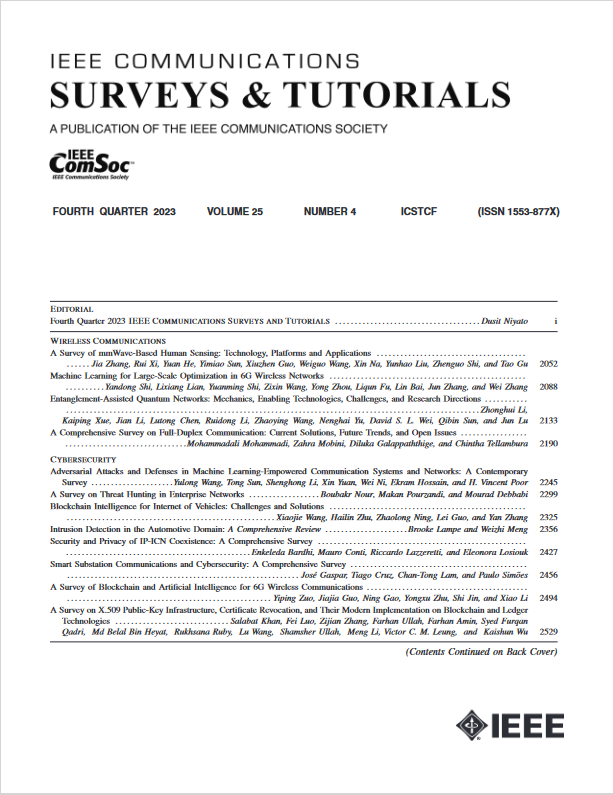
IEEE Communications Surveys & Tutorials is an online journal published by the IEEE Communications Society for tutorials and surveys covering all aspects of the communications field. Telecommunications technology is progressing at a rapid pace, and the IEEE Communications Society is committed to providing researchers and other professionals the information and tools to stay abreast. IEEE Communications Surveys and Tutorials focuses on integrating and adding understanding to the existing literature on communications, putting results in context. Whether searching for in-depth information about a familiar area or an introduction into a new area, IEEE Communications Surveys & Tutorials aims to be the premier source of peer-reviewed, comprehensive tutorials and surveys, and pointers to further sources. IEEE Communications Surveys & Tutorials publishes only articles exclusively written for IEEE Communications Surveys & Tutorials and go through a rigorous review process before their publication in the quarterly issues.
A tutorial article in the IEEE Communications Surveys & Tutorials should be designed to help the reader to become familiar with and learn something specific about a chosen topic. In contrast, the term survey, as applied here, is defined to mean a survey of the literature. A survey article in IEEE Communications Surveys & Tutorials should provide a comprehensive review of developments in a selected area, covering its development from its inception to its current state and beyond, and illustrating its development through liberal citations from the literature. Both tutorials and surveys should be tutorial in nature and should be written in a style comprehensible to readers outside the specialty of the article.




 京公网安备 11010802042870号
京ICP备2023020795号-1
京公网安备 11010802042870号
京ICP备2023020795号-1

 分享
分享
 求助内容:
求助内容: 应助结果提醒方式:
 扫码关注我们
