{"title":"Identification of phosphorylated small ORF-encoded peptides in Hep3B cells by LC/MS/MS","authors":"Mingbo Peng , Yutian Zhou , Cuihong Wan","doi":"10.1016/j.jprot.2024.105214","DOIUrl":null,"url":null,"abstract":"<div><p>Small ORF-encoded peptides (SEPs) are a class of low molecular weight proteins and peptides comprising <100 amino acids with important functions in various life activities. Although the sequence length is short, SEPs might also have post-translational modification (PTM). Phosphorylation is one of the most essential PTMs of proteins. In this work, we enriched phosphopeptides with IMAC and TiO<sub>2</sub> materials and analyzed the phosphorylated SEPs in Hep3B cells. A total of 24 phosphorylated SEPs were identified, and 11 SEPs were coded by ncRNA. For the sequence analysis, we found that the general characteristics of phosphorylated SEPs are roughly the same as canonical proteins. Besides, two phosphorylation SEPs have the Stathmin family signature 2 motif, which can regulate the microtubule cytoskeleton. Some SEPs have domains or signal peptides, indicating their specific functions and subcellular locations. Kinase network analysis found a small number of kinases that may be a clue to the specific functions of some SEPs. However, only one-fifth of the predicted phosphorylation sites were identified by LC/MS/MS, indicating that many SEP PTMs are hidden in the dark, waiting to be uncovered and verified. This study helps expand our understanding of SEP and provides information for further SEP function investigation.</p></div><div><h3>Significance</h3><p>Small ORF-encoded peptides (SEPs) are important in various life activities. Although the sequence length is short (<100AA), SEPs might also have post-translational modification (PTM). Phosphorylation is one of the most essential PTMs of proteins. We enriched phosphopeptides and analyzed the phosphorylated SEPs in Hep3B cells. That is the first time to explore the PTM of SPEs systematically. Kinase network analysis found a small number of kinases that may be a clue to the specific functions of SEPs. More SEP PTMs are hidden in the dark and waiting to be uncovered and verified. This study helps expand our understanding of SEP and provides information for further SEP function investigation.</p></div>","PeriodicalId":16891,"journal":{"name":"Journal of proteomics","volume":"303 ","pages":"Article 105214"},"PeriodicalIF":2.8000,"publicationDate":"2024-07-15","publicationTypes":"Journal Article","fieldsOfStudy":null,"isOpenAccess":false,"openAccessPdf":"","citationCount":"0","resultStr":null,"platform":"Semanticscholar","paperid":null,"PeriodicalName":"Journal of proteomics","FirstCategoryId":"99","ListUrlMain":"https://www.sciencedirect.com/science/article/pii/S1874391924001465","RegionNum":2,"RegionCategory":"生物学","ArticlePicture":[],"TitleCN":null,"AbstractTextCN":null,"PMCID":null,"EPubDate":"2024/5/31 0:00:00","PubModel":"Epub","JCR":"Q2","JCRName":"BIOCHEMICAL RESEARCH METHODS","Score":null,"Total":0}
引用次数: 0
Abstract
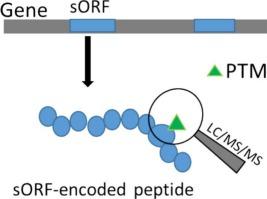
Small ORF-encoded peptides (SEPs) are a class of low molecular weight proteins and peptides comprising <100 amino acids with important functions in various life activities. Although the sequence length is short, SEPs might also have post-translational modification (PTM). Phosphorylation is one of the most essential PTMs of proteins. In this work, we enriched phosphopeptides with IMAC and TiO2 materials and analyzed the phosphorylated SEPs in Hep3B cells. A total of 24 phosphorylated SEPs were identified, and 11 SEPs were coded by ncRNA. For the sequence analysis, we found that the general characteristics of phosphorylated SEPs are roughly the same as canonical proteins. Besides, two phosphorylation SEPs have the Stathmin family signature 2 motif, which can regulate the microtubule cytoskeleton. Some SEPs have domains or signal peptides, indicating their specific functions and subcellular locations. Kinase network analysis found a small number of kinases that may be a clue to the specific functions of some SEPs. However, only one-fifth of the predicted phosphorylation sites were identified by LC/MS/MS, indicating that many SEP PTMs are hidden in the dark, waiting to be uncovered and verified. This study helps expand our understanding of SEP and provides information for further SEP function investigation.
Significance
Small ORF-encoded peptides (SEPs) are important in various life activities. Although the sequence length is short (<100AA), SEPs might also have post-translational modification (PTM). Phosphorylation is one of the most essential PTMs of proteins. We enriched phosphopeptides and analyzed the phosphorylated SEPs in Hep3B cells. That is the first time to explore the PTM of SPEs systematically. Kinase network analysis found a small number of kinases that may be a clue to the specific functions of SEPs. More SEP PTMs are hidden in the dark and waiting to be uncovered and verified. This study helps expand our understanding of SEP and provides information for further SEP function investigation.
期刊介绍:
Journal of Proteomics is aimed at protein scientists and analytical chemists in the field of proteomics, biomarker discovery, protein analytics, plant proteomics, microbial and animal proteomics, human studies, tissue imaging by mass spectrometry, non-conventional and non-model organism proteomics, and protein bioinformatics. The journal welcomes papers in new and upcoming areas such as metabolomics, genomics, systems biology, toxicogenomics, pharmacoproteomics.
Journal of Proteomics unifies both fundamental scientists and clinicians, and includes translational research. Suggestions for reviews, webinars and thematic issues are welcome.



 京公网安备 11010802042870号
京ICP备2023020795号-1
京公网安备 11010802042870号
京ICP备2023020795号-1

 分享
分享
 求助内容:
求助内容: 应助结果提醒方式:
 扫码关注我们
