{"title":"Gut microbiota metabolism disturbance is associated with postoperative atrial fibrillation after coronary artery bypass grafting","authors":"Yuhua Liu, Zhiyong Du, Yingyuan Lu, Ying Ma, Yunxiao Yang, Florian Osmanaj, Yifan Zhang, Xiaoyu Guo, Yanwen Qin, Xiubin Yang, Kun Hua","doi":"10.1038/s44325-024-00003-z","DOIUrl":null,"url":null,"abstract":"Postoperative atrial fibrillation (POAF) is a common complication after coronary artery bypass grafting (CABG) surgery. Gut microbiota and its metabolites have been implicated in the development of AF. However, whether the gut–host metabolic interaction contributes to POAF is still unknown. This study aimed to investigate the POAF-associated gut microbiota metabolism biomarkers and related risk model. The POAF (N = 30) patients and non-POAF (N = 60) patients from the discovery cohort exhibited significantly different microbiome and metabolome profiles. The differentiated features were mainly implicated in the bile acids (BAs) and short-chain fatty acids metabolism, inflammation, and oxidative stress. Random forest analysis identified the combination of five secondary BAs showed a powerful performance on predicting POAF in the discovery cohort, highlighting significant values of area under the curve (AUC = 0.954) and correct classification rate (CCR, 93.3%). In addition, the five secondary BAs-based risk model also exhibited good performance in differentiating the POAF (N = 114) and non-POAF individuals (N = 253) in an independent validation cohort (AUC = 0.872; CCR = 90.4%). This work revealed perturbed microbial and metabolic traits in POAF, providing potential avenues for the prediction and prevention of POAF after CABG.","PeriodicalId":501706,"journal":{"name":"npj Cardiovascular Health","volume":" ","pages":"1-10"},"PeriodicalIF":0.0000,"publicationDate":"2024-06-03","publicationTypes":"Journal Article","fieldsOfStudy":null,"isOpenAccess":false,"openAccessPdf":"https://www.nature.com/articles/s44325-024-00003-z.pdf","citationCount":"0","resultStr":null,"platform":"Semanticscholar","paperid":null,"PeriodicalName":"npj Cardiovascular Health","FirstCategoryId":"1085","ListUrlMain":"https://www.nature.com/articles/s44325-024-00003-z","RegionNum":0,"RegionCategory":null,"ArticlePicture":[],"TitleCN":null,"AbstractTextCN":null,"PMCID":null,"EPubDate":"","PubModel":"","JCR":"","JCRName":"","Score":null,"Total":0}
引用次数: 0
Abstract
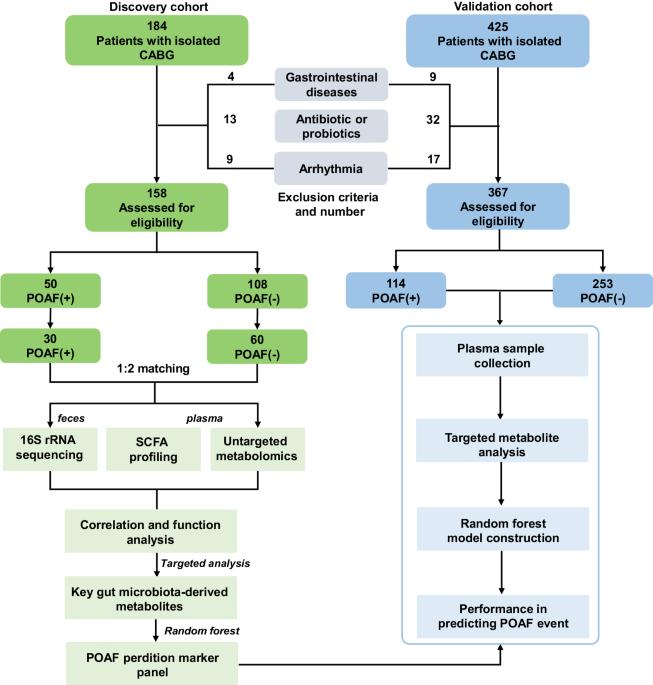
Postoperative atrial fibrillation (POAF) is a common complication after coronary artery bypass grafting (CABG) surgery. Gut microbiota and its metabolites have been implicated in the development of AF. However, whether the gut–host metabolic interaction contributes to POAF is still unknown. This study aimed to investigate the POAF-associated gut microbiota metabolism biomarkers and related risk model. The POAF (N = 30) patients and non-POAF (N = 60) patients from the discovery cohort exhibited significantly different microbiome and metabolome profiles. The differentiated features were mainly implicated in the bile acids (BAs) and short-chain fatty acids metabolism, inflammation, and oxidative stress. Random forest analysis identified the combination of five secondary BAs showed a powerful performance on predicting POAF in the discovery cohort, highlighting significant values of area under the curve (AUC = 0.954) and correct classification rate (CCR, 93.3%). In addition, the five secondary BAs-based risk model also exhibited good performance in differentiating the POAF (N = 114) and non-POAF individuals (N = 253) in an independent validation cohort (AUC = 0.872; CCR = 90.4%). This work revealed perturbed microbial and metabolic traits in POAF, providing potential avenues for the prediction and prevention of POAF after CABG.



 京公网安备 11010802042870号
京ICP备2023020795号-1
京公网安备 11010802042870号
京ICP备2023020795号-1

 分享
分享

 求助内容:
求助内容: 应助结果提醒方式:
 扫码关注我们
