{"title":"Preventing Post-incisional Dural Shrink in Craniotomy: Introducing the \"Roll-up Technique\".","authors":"Yuki Yasuoka, Ushio Yonezawa, Shinya Nabika, Takeshi Takayasu, Akira Taguchi, Naohiko Ohbayashi, Fumiyuki Yamasaki, Nobutaka Horie","doi":"10.2176/jns-nmc.2023-0247","DOIUrl":null,"url":null,"abstract":"<p><p>Dural dryness makes suturing difficult during dural closure after craniotomy. In this case, dural plasty is often performed using a membrane taken from the surrounding tissue (e.g., fascia or periosteum) or an artificial replacement membrane. Herein, we introduce our novel \"roll-up technique\" to reduce the utilization of substitute membranes and explore its effectiveness in dural closure. We retrospectively examined the medical records of 50 patients who underwent craniotomy for the first time for supratentorial intracranial lesions between 2015 and 2022. Furthermore, we divided them into two groups: (1) the conventional technique group, which consisted of patients in whom the dura mater was flipped after incision and protected with a moistened gauze (n = 23), and (2) the roll-up technique group, which consisted of patients in whom the dura mater was incised in a U shape, rolled up, and protected with a moist gauze (n = 27). After surgery, we compared the success rates of primary closure, operating time, craniotomy area, and percentage of complications (e.g., cerebrospinal fluid [CSF] leakage or infection) between the groups. Dural closure without dural substitutes using the roll-up technique had a higher success rate than that using the conventional technique (26/27 [96.3%] cases vs. 14/23 [60.9%] cases; P = 0.003). Postoperative CSF leakage or infection did not occur, and no statistically significant difference was observed in the operating time between the groups (P = 0.247). The roll-up technique for dural closure may effectively prevent post-incisional dural shrink after craniotomy.</p>","PeriodicalId":19225,"journal":{"name":"Neurologia medico-chirurgica","volume":" ","pages":"278-282"},"PeriodicalIF":2.3000,"publicationDate":"2024-07-15","publicationTypes":"Journal Article","fieldsOfStudy":null,"isOpenAccess":false,"openAccessPdf":"https://www.ncbi.nlm.nih.gov/pmc/articles/PMC11304445/pdf/","citationCount":"0","resultStr":null,"platform":"Semanticscholar","paperid":null,"PeriodicalName":"Neurologia medico-chirurgica","FirstCategoryId":"3","ListUrlMain":"https://doi.org/10.2176/jns-nmc.2023-0247","RegionNum":4,"RegionCategory":"医学","ArticlePicture":[],"TitleCN":null,"AbstractTextCN":null,"PMCID":null,"EPubDate":"2024/6/5 0:00:00","PubModel":"Epub","JCR":"Q2","JCRName":"CLINICAL NEUROLOGY","Score":null,"Total":0}
引用次数: 0
Abstract
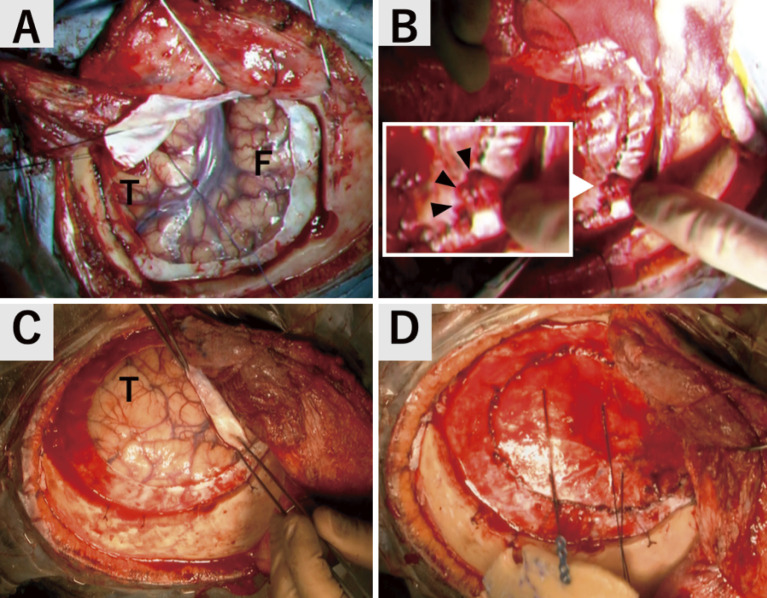
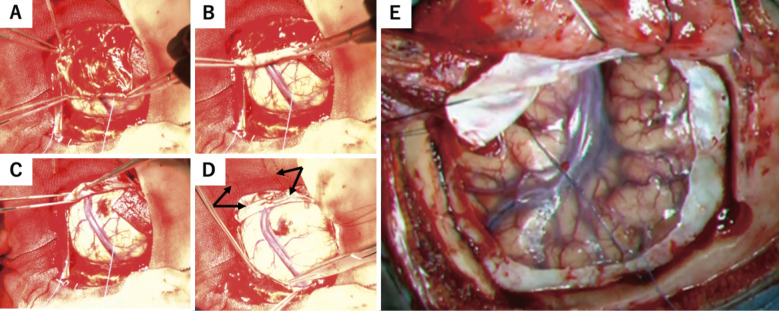
Dural dryness makes suturing difficult during dural closure after craniotomy. In this case, dural plasty is often performed using a membrane taken from the surrounding tissue (e.g., fascia or periosteum) or an artificial replacement membrane. Herein, we introduce our novel "roll-up technique" to reduce the utilization of substitute membranes and explore its effectiveness in dural closure. We retrospectively examined the medical records of 50 patients who underwent craniotomy for the first time for supratentorial intracranial lesions between 2015 and 2022. Furthermore, we divided them into two groups: (1) the conventional technique group, which consisted of patients in whom the dura mater was flipped after incision and protected with a moistened gauze (n = 23), and (2) the roll-up technique group, which consisted of patients in whom the dura mater was incised in a U shape, rolled up, and protected with a moist gauze (n = 27). After surgery, we compared the success rates of primary closure, operating time, craniotomy area, and percentage of complications (e.g., cerebrospinal fluid [CSF] leakage or infection) between the groups. Dural closure without dural substitutes using the roll-up technique had a higher success rate than that using the conventional technique (26/27 [96.3%] cases vs. 14/23 [60.9%] cases; P = 0.003). Postoperative CSF leakage or infection did not occur, and no statistically significant difference was observed in the operating time between the groups (P = 0.247). The roll-up technique for dural closure may effectively prevent post-incisional dural shrink after craniotomy.



 京公网安备 11010802042870号
京ICP备2023020795号-1
京公网安备 11010802042870号
京ICP备2023020795号-1

 分享
分享
 求助内容:
求助内容: 应助结果提醒方式:
 扫码关注我们
