{"title":"Deciphering the Biophysical Impact of Permafrost Greening on Summer Surface Offset","authors":"Jian Wang, Desheng Liu","doi":"10.1029/2023EF004077","DOIUrl":null,"url":null,"abstract":"<p>Satellite observations have shown widespread greening during the last few decades over the northern permafrost region, but the impact of vegetation greening on permafrost thermal dynamics remains poorly understood, hindering the understanding of permafrost-vegetation-climate feedbacks. Summer surface offset (SSO), defined as the difference between surface soil temperature and near-surface air temperature in summer (June-August), is often predicted as a function of surface thermal characteristics for permafrost modeling. Here we examined the impact of leaf area index (LAI), detected by satellite as a proxy to permafrost vegetation dynamics, on SSO variations from 2003 to 2021 across the northern permafrost region. We observed latitude- and biome-dependent patterns of SSO changes, with a pronounced increase in Siberian shrublands and a decrease in Tibetan grasslands. Based on partial correlation and sensitivity analyses, we found a strong LAI signal (∼30% of climatic signal) on SSO with varying elevation- and canopy height-dependent patterns. Positive correlations or sensitivities, that is, increases in LAI lead to higher SSO, were distributed in relatively cold and wet areas. Biophysical effects of permafrost greening on surface albedo, evapotranspiration, and soil moisture (SM) could link the connection between LAI and SSO. Increased LAI substantially reduced surface albedo and enhanced evapotranspiration, influenced energy redistribution, and further controlled interannual variability of SSO. We also found contrasting effects of LAI on surface SM, consequently leading to divergent impacts on SSO. The results offer a fresh perspective on how greening affects the thermal balance and dynamics of permafrost, which is enlightening for improved permafrost projections.</p>","PeriodicalId":48748,"journal":{"name":"Earths Future","volume":"12 6","pages":""},"PeriodicalIF":8.2000,"publicationDate":"2024-06-06","publicationTypes":"Journal Article","fieldsOfStudy":null,"isOpenAccess":false,"openAccessPdf":"https://onlinelibrary.wiley.com/doi/epdf/10.1029/2023EF004077","citationCount":"0","resultStr":null,"platform":"Semanticscholar","paperid":null,"PeriodicalName":"Earths Future","FirstCategoryId":"89","ListUrlMain":"https://agupubs.onlinelibrary.wiley.com/doi/10.1029/2023EF004077","RegionNum":1,"RegionCategory":"地球科学","ArticlePicture":[],"TitleCN":null,"AbstractTextCN":null,"PMCID":null,"EPubDate":"","PubModel":"","JCR":"Q1","JCRName":"ENVIRONMENTAL SCIENCES","Score":null,"Total":0}
引用次数: 0
Abstract
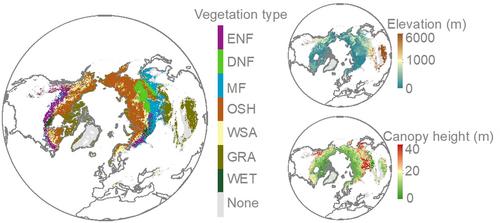
Satellite observations have shown widespread greening during the last few decades over the northern permafrost region, but the impact of vegetation greening on permafrost thermal dynamics remains poorly understood, hindering the understanding of permafrost-vegetation-climate feedbacks. Summer surface offset (SSO), defined as the difference between surface soil temperature and near-surface air temperature in summer (June-August), is often predicted as a function of surface thermal characteristics for permafrost modeling. Here we examined the impact of leaf area index (LAI), detected by satellite as a proxy to permafrost vegetation dynamics, on SSO variations from 2003 to 2021 across the northern permafrost region. We observed latitude- and biome-dependent patterns of SSO changes, with a pronounced increase in Siberian shrublands and a decrease in Tibetan grasslands. Based on partial correlation and sensitivity analyses, we found a strong LAI signal (∼30% of climatic signal) on SSO with varying elevation- and canopy height-dependent patterns. Positive correlations or sensitivities, that is, increases in LAI lead to higher SSO, were distributed in relatively cold and wet areas. Biophysical effects of permafrost greening on surface albedo, evapotranspiration, and soil moisture (SM) could link the connection between LAI and SSO. Increased LAI substantially reduced surface albedo and enhanced evapotranspiration, influenced energy redistribution, and further controlled interannual variability of SSO. We also found contrasting effects of LAI on surface SM, consequently leading to divergent impacts on SSO. The results offer a fresh perspective on how greening affects the thermal balance and dynamics of permafrost, which is enlightening for improved permafrost projections.
期刊介绍:
Earth’s Future: A transdisciplinary open access journal, Earth’s Future focuses on the state of the Earth and the prediction of the planet’s future. By publishing peer-reviewed articles as well as editorials, essays, reviews, and commentaries, this journal will be the preeminent scholarly resource on the Anthropocene. It will also help assess the risks and opportunities associated with environmental changes and challenges.





 京公网安备 11010802042870号
京ICP备2023020795号-1
京公网安备 11010802042870号
京ICP备2023020795号-1

 分享
分享
 求助内容:
求助内容: 应助结果提醒方式:
 扫码关注我们
