Yafia Kousin Mirza , Partha Sarathi Bera , Sachin Balaso Mohite , Ajeet Kumar Pandey , Milan Bera
{"title":"Silanes as a versatile hydride source for Ni–H catalysis: a promising tool for π-hydro functionalization","authors":"Yafia Kousin Mirza , Partha Sarathi Bera , Sachin Balaso Mohite , Ajeet Kumar Pandey , Milan Bera","doi":"10.1039/d4qo00860j","DOIUrl":null,"url":null,"abstract":"<div><div>Silanes are used as a simple and common hydride source owing to their chemical stability, neat and easy-to-handle nature and advantage of generally not requiring any precautions during their activation <em>via</em> nickel catalysis. Due to their hydride donor nature, upon reaction with a ligand-tailored nickel complex, they generate reactive Ni–H species, which are normally more prone to facile addition to the π-bond, resulting in an organonickel intermediate, which can undergo various sequential cross-coupling reactions. Notably, recent developments have brought π-hydrofunctionalization reactions facilitated by Ni–H catalysis to the forefront. In addition, the use of suitable chiral ligands has paved the way for the realization of asymmetric hydrofunctionalization reactions in the realm of π-bonds. This review aims to provide an in-depth analysis of the latest advancements in C–C and C–heteroatom bond formation <em>via</em> silane-mediated hydrofunctionalization catalyzed by nickel hydride. In particular, the NiH/ligand-catalytic system exhibits remarkable reactivity with π-substrates, including alkenes, alkynes, and allenes. A thorough mechanistic understanding of these processes offers insights into the trends and future directions to drive innovation in catalyst design, fine tune reaction systems, and develop new cross-coupling reactions with π-substrates.</div></div>","PeriodicalId":94379,"journal":{"name":"Organic chemistry frontiers : an international journal of organic chemistry","volume":"11 15","pages":"Pages 4290-4317"},"PeriodicalIF":0.0000,"publicationDate":"2024-07-23","publicationTypes":"Journal Article","fieldsOfStudy":null,"isOpenAccess":false,"openAccessPdf":"","citationCount":"0","resultStr":null,"platform":"Semanticscholar","paperid":null,"PeriodicalName":"Organic chemistry frontiers : an international journal of organic chemistry","FirstCategoryId":"1085","ListUrlMain":"https://www.sciencedirect.com/org/science/article/pii/S2052412924004327","RegionNum":0,"RegionCategory":null,"ArticlePicture":[],"TitleCN":null,"AbstractTextCN":null,"PMCID":null,"EPubDate":"2024/6/7 0:00:00","PubModel":"Epub","JCR":"","JCRName":"","Score":null,"Total":0}
引用次数: 0
Abstract
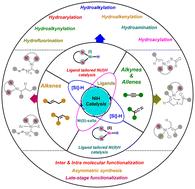
Silanes are used as a simple and common hydride source owing to their chemical stability, neat and easy-to-handle nature and advantage of generally not requiring any precautions during their activation via nickel catalysis. Due to their hydride donor nature, upon reaction with a ligand-tailored nickel complex, they generate reactive Ni–H species, which are normally more prone to facile addition to the π-bond, resulting in an organonickel intermediate, which can undergo various sequential cross-coupling reactions. Notably, recent developments have brought π-hydrofunctionalization reactions facilitated by Ni–H catalysis to the forefront. In addition, the use of suitable chiral ligands has paved the way for the realization of asymmetric hydrofunctionalization reactions in the realm of π-bonds. This review aims to provide an in-depth analysis of the latest advancements in C–C and C–heteroatom bond formation via silane-mediated hydrofunctionalization catalyzed by nickel hydride. In particular, the NiH/ligand-catalytic system exhibits remarkable reactivity with π-substrates, including alkenes, alkynes, and allenes. A thorough mechanistic understanding of these processes offers insights into the trends and future directions to drive innovation in catalyst design, fine tune reaction systems, and develop new cross-coupling reactions with π-substrates.



 京公网安备 11010802042870号
京ICP备2023020795号-1
京公网安备 11010802042870号
京ICP备2023020795号-1

 分享
分享

 求助内容:
求助内容: 应助结果提醒方式:
 扫码关注我们
