{"title":"Reactive oxygen species regulation by NCF1 governs ferroptosis susceptibility of Kupffer cells to MASH","authors":"Jing Zhang, Yu Wang, Meiyang Fan, Yanglong Guan, Wentao Zhang, Fumeng Huang, Zhengqiang Zhang, Xiaomeng Li, Bingyu Yuan, Wenbin Liu, Manman Geng, Xiaowei Li, Jing Xu, Congshan Jiang, Wenjuan Zhao, Feng Ye, Wenhua Zhu, Liesu Meng, Shemin Lu, Rikard Holmdahl","doi":"10.1016/j.cmet.2024.05.008","DOIUrl":null,"url":null,"abstract":"<p>Impaired self-renewal of Kupffer cells (KCs) leads to inflammation in metabolic dysfunction-associated steatohepatitis (MASH). Here, we identify neutrophil cytosolic factor 1 (NCF1) as a critical regulator of iron homeostasis in KCs. NCF1 is upregulated in liver macrophages and dendritic cells in humans with metabolic dysfunction-associated steatotic liver disease and in MASH mice. Macrophage NCF1, but not dendritic cell NCF1, triggers KC iron overload, ferroptosis, and monocyte-derived macrophage infiltration, thus aggravating MASH progression. Mechanistically, elevated oxidized phospholipids induced by macrophage NCF1 promote Toll-like receptor (TLR4)-dependent hepatocyte hepcidin production, leading to increased KC iron deposition and subsequent KC ferroptosis. Importantly, the human low-functional polymorphic variant NCF1<sup>90H</sup> alleviates KC ferroptosis and MASH in mice. In conclusion, macrophage NCF1 impairs iron homeostasis in KCs by oxidizing phospholipids, triggering hepatocyte hepcidin release and KC ferroptosis in MASH, highlighting NCF1 as a therapeutic target for improving KC fate and limiting MASH progression.</p>","PeriodicalId":9840,"journal":{"name":"Cell metabolism","volume":"32 1","pages":""},"PeriodicalIF":30.9000,"publicationDate":"2024-06-07","publicationTypes":"Journal Article","fieldsOfStudy":null,"isOpenAccess":false,"openAccessPdf":"","citationCount":"0","resultStr":null,"platform":"Semanticscholar","paperid":null,"PeriodicalName":"Cell metabolism","FirstCategoryId":"99","ListUrlMain":"https://doi.org/10.1016/j.cmet.2024.05.008","RegionNum":1,"RegionCategory":"生物学","ArticlePicture":[],"TitleCN":null,"AbstractTextCN":null,"PMCID":null,"EPubDate":"","PubModel":"","JCR":"Q1","JCRName":"CELL BIOLOGY","Score":null,"Total":0}
引用次数: 0
Abstract
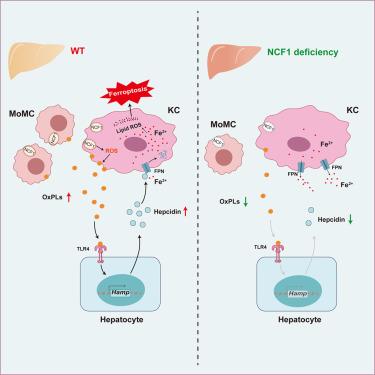
Impaired self-renewal of Kupffer cells (KCs) leads to inflammation in metabolic dysfunction-associated steatohepatitis (MASH). Here, we identify neutrophil cytosolic factor 1 (NCF1) as a critical regulator of iron homeostasis in KCs. NCF1 is upregulated in liver macrophages and dendritic cells in humans with metabolic dysfunction-associated steatotic liver disease and in MASH mice. Macrophage NCF1, but not dendritic cell NCF1, triggers KC iron overload, ferroptosis, and monocyte-derived macrophage infiltration, thus aggravating MASH progression. Mechanistically, elevated oxidized phospholipids induced by macrophage NCF1 promote Toll-like receptor (TLR4)-dependent hepatocyte hepcidin production, leading to increased KC iron deposition and subsequent KC ferroptosis. Importantly, the human low-functional polymorphic variant NCF190H alleviates KC ferroptosis and MASH in mice. In conclusion, macrophage NCF1 impairs iron homeostasis in KCs by oxidizing phospholipids, triggering hepatocyte hepcidin release and KC ferroptosis in MASH, highlighting NCF1 as a therapeutic target for improving KC fate and limiting MASH progression.
期刊介绍:
Cell Metabolism is a top research journal established in 2005 that focuses on publishing original and impactful papers in the field of metabolic research.It covers a wide range of topics including diabetes, obesity, cardiovascular biology, aging and stress responses, circadian biology, and many others.
Cell Metabolism aims to contribute to the advancement of metabolic research by providing a platform for the publication and dissemination of high-quality research and thought-provoking articles.



 京公网安备 11010802042870号
京ICP备2023020795号-1
京公网安备 11010802042870号
京ICP备2023020795号-1

 分享
分享
 求助内容:
求助内容: 应助结果提醒方式:
 扫码关注我们
