J. Ramana Ramya , Saheb Ali , Thanigai Arul K , R. Vijayalakshmi , J. Gajendiran , S. Gnanam , K. Ramachandran
{"title":"Antimicrobial efficiency against fish pathogens on the green synthesized silver nanoparticles","authors":"J. Ramana Ramya , Saheb Ali , Thanigai Arul K , R. Vijayalakshmi , J. Gajendiran , S. Gnanam , K. Ramachandran","doi":"10.1016/j.micpath.2024.106725","DOIUrl":null,"url":null,"abstract":"<div><p>Fish-borne pathogens such as A. hydrophila and F. aquidurense are the most resistant strains in pisciculture farming. Removing the aforementioned pathogens without antibiotics presents a formidable challenge. To overcome this problem, silver nanoparticles (AgNPs) are synthesized using silver nitrate, water medium, and as an <em>AzadirachtaIndica</em> leaf extract via the green synthesis route. X-ray diffraction (XRD) pattern results authenticate the synthesized material is the face-centered cubic structure of silver. The optical absorption edge of the synthesized product was found at the wavelength of 440 nm from the UV–visible spectra, which is confirmed to relate to the Surface Plasmon Resonance peaks of silver particles. In addition, the optical band gap value of the synthesized Ag sample is measured to be 2.81 eV from the obtained optical absorption spectra. EDX spectrum of the synthesized product also supports confirming the silver particle formation. The FT-IR spectra of the neem extract and silver nanoparticles showed their characteristic functional groups, respectively. The presence of bands between 1000 cm<sup>−1</sup> to 500 cm<sup>−1</sup> indicates to the formation of silver particles. Spherical particles appeared in the synthesized Ag using Scanning Electron Microscopy (SEM) and Transmission Electron Microscopy (TEM). The particle size of Ag NPs was measured as 40 nm and 62 ± 10 nm by TEM and Dynamic Light Scattering (DLS). The zeta potential was also measured as −12 mV showing the synthesized sample's stable nature. Using the DPPH assay, synthesized AgNPs were taken along with the various concentrations of ascorbic acid (20, 40, 60, 80, and 100 μg/mL) to examine the free radical scavenging activity (RSA). RSA value is higher (84 ± 2 %) for synthesized AgNPs at higher concentration (100 μg/mL) than 21 ± 2 % at low concentration (100 μg/mL). The antimicrobial efficacy of the AgNPs against <em>A. hydrophila</em> and <em>F. aquidurense</em> was performed through the agar diffusion method and its results showed the inhibitory zones of the <em>F.aquidurense</em> and <em>A. hydrophila</em> were measured as 25 ± 3 mm, and 28 ± 4 mm respectively. The synthesized Ag particles showed excellent antimicrobial and antioxidant properties confirmed by antimicrobial and DPPH experiments. It implies that the green synthesized silver nanoparticles could be a good alternative for antibiotics in aquaculture farms. The exposure of low concentrations of silver nanoparticles to zebrafish and brine shrimp does not affect the viability and morphology. The exposure of silver nanoparticles in the fisheries in optimized concentration and time could control the fish-borne pathogens without antibiotics.</p></div>","PeriodicalId":18599,"journal":{"name":"Microbial pathogenesis","volume":"193 ","pages":"Article 106725"},"PeriodicalIF":3.5000,"publicationDate":"2024-08-01","publicationTypes":"Journal Article","fieldsOfStudy":null,"isOpenAccess":false,"openAccessPdf":"","citationCount":"0","resultStr":null,"platform":"Semanticscholar","paperid":null,"PeriodicalName":"Microbial pathogenesis","FirstCategoryId":"3","ListUrlMain":"https://www.sciencedirect.com/science/article/pii/S088240102400192X","RegionNum":3,"RegionCategory":"医学","ArticlePicture":[],"TitleCN":null,"AbstractTextCN":null,"PMCID":null,"EPubDate":"2024/6/6 0:00:00","PubModel":"Epub","JCR":"Q3","JCRName":"IMMUNOLOGY","Score":null,"Total":0}
引用次数: 0
Abstract
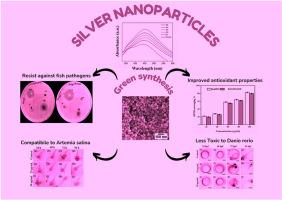
Fish-borne pathogens such as A. hydrophila and F. aquidurense are the most resistant strains in pisciculture farming. Removing the aforementioned pathogens without antibiotics presents a formidable challenge. To overcome this problem, silver nanoparticles (AgNPs) are synthesized using silver nitrate, water medium, and as an AzadirachtaIndica leaf extract via the green synthesis route. X-ray diffraction (XRD) pattern results authenticate the synthesized material is the face-centered cubic structure of silver. The optical absorption edge of the synthesized product was found at the wavelength of 440 nm from the UV–visible spectra, which is confirmed to relate to the Surface Plasmon Resonance peaks of silver particles. In addition, the optical band gap value of the synthesized Ag sample is measured to be 2.81 eV from the obtained optical absorption spectra. EDX spectrum of the synthesized product also supports confirming the silver particle formation. The FT-IR spectra of the neem extract and silver nanoparticles showed their characteristic functional groups, respectively. The presence of bands between 1000 cm−1 to 500 cm−1 indicates to the formation of silver particles. Spherical particles appeared in the synthesized Ag using Scanning Electron Microscopy (SEM) and Transmission Electron Microscopy (TEM). The particle size of Ag NPs was measured as 40 nm and 62 ± 10 nm by TEM and Dynamic Light Scattering (DLS). The zeta potential was also measured as −12 mV showing the synthesized sample's stable nature. Using the DPPH assay, synthesized AgNPs were taken along with the various concentrations of ascorbic acid (20, 40, 60, 80, and 100 μg/mL) to examine the free radical scavenging activity (RSA). RSA value is higher (84 ± 2 %) for synthesized AgNPs at higher concentration (100 μg/mL) than 21 ± 2 % at low concentration (100 μg/mL). The antimicrobial efficacy of the AgNPs against A. hydrophila and F. aquidurense was performed through the agar diffusion method and its results showed the inhibitory zones of the F.aquidurense and A. hydrophila were measured as 25 ± 3 mm, and 28 ± 4 mm respectively. The synthesized Ag particles showed excellent antimicrobial and antioxidant properties confirmed by antimicrobial and DPPH experiments. It implies that the green synthesized silver nanoparticles could be a good alternative for antibiotics in aquaculture farms. The exposure of low concentrations of silver nanoparticles to zebrafish and brine shrimp does not affect the viability and morphology. The exposure of silver nanoparticles in the fisheries in optimized concentration and time could control the fish-borne pathogens without antibiotics.
期刊介绍:
Microbial Pathogenesis publishes original contributions and reviews about the molecular and cellular mechanisms of infectious diseases. It covers microbiology, host-pathogen interaction and immunology related to infectious agents, including bacteria, fungi, viruses and protozoa. It also accepts papers in the field of clinical microbiology, with the exception of case reports.
Research Areas Include:
-Pathogenesis
-Virulence factors
-Host susceptibility or resistance
-Immune mechanisms
-Identification, cloning and sequencing of relevant genes
-Genetic studies
-Viruses, prokaryotic organisms and protozoa
-Microbiota
-Systems biology related to infectious diseases
-Targets for vaccine design (pre-clinical studies)



 京公网安备 11010802042870号
京ICP备2023020795号-1
京公网安备 11010802042870号
京ICP备2023020795号-1

 分享
分享
 求助内容:
求助内容: 应助结果提醒方式:
 扫码关注我们
