{"title":"The nutritional profile of the yellow mealworm larvae (Tenebrio molitor) reared on four different substrates","authors":"Keandra Langston , Letlhogonolo Selaledi , Chrysantus Tanga , Abdullahi Yusuf","doi":"10.1016/j.fufo.2024.100388","DOIUrl":null,"url":null,"abstract":"<div><p>The utilisation of <em>Tenebrio molitor</em> L. (the yellow mealworm) as a cheaper, alternative and readily available ingredient for food and feed is gaining interest globally. However, there has been limited research on locally and readily available substrates for mealworm mass rearing in South Africa. This study evaluated the impact of four substrates; wheat bran (control diet), wheat flour, maize flour, and Lucerne (pellets) on the rearing of mealworm larvae under controlled conditions over two generations and analysed the nutrient composition using standard nutritional analysis techniques. The results revealed that the crude protein contents of <em>T. molitor</em> larvae ranged between 28 – 36 % when raised on different substrates and varied significantly in the order Lucerne > wheat bran > wheat flour > maize flour. The major minerals found in the larvae included sodium, magnesium, phosphorus, potassium, copper, and zinc. The larvae were also rich in saturated, mono and polyunsaturated Fatty Acids (FAs) with oleic, linoleic, and palmitic as the main FAs. The nutritional profiles of first- and second-generation larvae raised on the same substrates remained the same. Wheat flour was found to be the best alternative to wheat bran. The finding demonstrates the suitability of local, inexpensive substrates for commercial production of yellow mealworm without compromising their nutritional quality and utilisation for food and feed.</p></div>","PeriodicalId":34474,"journal":{"name":"Future Foods","volume":"9 ","pages":"Article 100388"},"PeriodicalIF":8.2000,"publicationDate":"2024-06-01","publicationTypes":"Journal Article","fieldsOfStudy":null,"isOpenAccess":false,"openAccessPdf":"https://www.sciencedirect.com/science/article/pii/S2666833524000947/pdfft?md5=8f48f8ab96571afe23530d9e2b4579cb&pid=1-s2.0-S2666833524000947-main.pdf","citationCount":"0","resultStr":null,"platform":"Semanticscholar","paperid":null,"PeriodicalName":"Future Foods","FirstCategoryId":"1085","ListUrlMain":"https://www.sciencedirect.com/science/article/pii/S2666833524000947","RegionNum":0,"RegionCategory":null,"ArticlePicture":[],"TitleCN":null,"AbstractTextCN":null,"PMCID":null,"EPubDate":"2024/5/27 0:00:00","PubModel":"Epub","JCR":"Q1","JCRName":"FOOD SCIENCE & TECHNOLOGY","Score":null,"Total":0}
引用次数: 0
Abstract
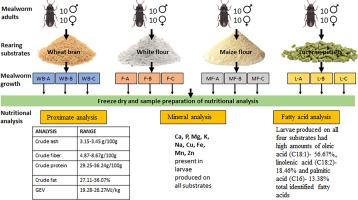
The utilisation of Tenebrio molitor L. (the yellow mealworm) as a cheaper, alternative and readily available ingredient for food and feed is gaining interest globally. However, there has been limited research on locally and readily available substrates for mealworm mass rearing in South Africa. This study evaluated the impact of four substrates; wheat bran (control diet), wheat flour, maize flour, and Lucerne (pellets) on the rearing of mealworm larvae under controlled conditions over two generations and analysed the nutrient composition using standard nutritional analysis techniques. The results revealed that the crude protein contents of T. molitor larvae ranged between 28 – 36 % when raised on different substrates and varied significantly in the order Lucerne > wheat bran > wheat flour > maize flour. The major minerals found in the larvae included sodium, magnesium, phosphorus, potassium, copper, and zinc. The larvae were also rich in saturated, mono and polyunsaturated Fatty Acids (FAs) with oleic, linoleic, and palmitic as the main FAs. The nutritional profiles of first- and second-generation larvae raised on the same substrates remained the same. Wheat flour was found to be the best alternative to wheat bran. The finding demonstrates the suitability of local, inexpensive substrates for commercial production of yellow mealworm without compromising their nutritional quality and utilisation for food and feed.
Future FoodsAgricultural and Biological Sciences-Food Science
CiteScore
8.60
自引率
0.00%
发文量
97
审稿时长
15 weeks
期刊介绍:
Future Foods is a specialized journal that is dedicated to tackling the challenges posed by climate change and the need for sustainability in the realm of food production. The journal recognizes the imperative to transform current food manufacturing and consumption practices to meet the dietary needs of a burgeoning global population while simultaneously curbing environmental degradation.
The mission of Future Foods is to disseminate research that aligns with the goal of fostering the development of innovative technologies and alternative food sources to establish more sustainable food systems. The journal is committed to publishing high-quality, peer-reviewed articles that contribute to the advancement of sustainable food practices.
Abstracting and indexing:
Scopus
Directory of Open Access Journals (DOAJ)
Emerging Sources Citation Index (ESCI)
SCImago Journal Rank (SJR)
SNIP



 京公网安备 11010802042870号
京ICP备2023020795号-1
京公网安备 11010802042870号
京ICP备2023020795号-1

 分享
分享
 求助内容:
求助内容: 应助结果提醒方式:
 扫码关注我们
