Tove Langlo Drilen, Trine Tetlie Eik-Nes, Ellen Margrete Iveland Ersfjord, Christian Andreas Klöckner, Rønnaug Astri Ødegård
{"title":"Perceptions of height and weight screening and associations with body image: a cross-sectional study in early primary school children.","authors":"Tove Langlo Drilen, Trine Tetlie Eik-Nes, Ellen Margrete Iveland Ersfjord, Christian Andreas Klöckner, Rønnaug Astri Ødegård","doi":"10.1136/bmjpo-2024-002568","DOIUrl":null,"url":null,"abstract":"<p><strong>Background: </strong>Despite parental concern, few studies have investigated children's experiences with school-based screening of growth deviations. This study aimed to explore perceptions of height and weight screening and associations with body size dissatisfaction (BSD) among third-grade children aged 8-9 years in central Norway.</p><p><strong>Methods: </strong>In a cross-sectional study between November 2021 and April 2022, perceptions of height and weight screening and BSD were assessed individually among 209 children (49% girls) through researcher-assisted interviews.</p><p><strong>Results: </strong>Most children indicated satisfaction with the screening by selecting a happy emoji, whereas only 1% indicated dissatisfaction, by selecting an unhappy emoji. However, 23%-30% selected a neutral emoji, indicating either neutrality or a response between satisfaction and dissatisfaction. No difference in the perception of height and weight screening was found between genders or body mass index (BMI). Children with parents from non-Western countries had a higher risk of being less satisfied with the height screening (OR=3.0, 95% CI 1.2 to 7.3) than those from Western origin, and children attending schools with lower socioeconomic status (SES) had increased risk of being less satisfied with both height (OR=5.5, 95% CI 2.2 to 13.5) and weight screening (OR=4.0, 95% CI 1.7 to 9.3), compared with children from schools with medium-high SES. Twenty-three percent reported BSD, in which 14% and 9% desired a thinner or larger body, respectively, independent of gender and BMI. No association was found between BSD and the perception of weighing (OR=1.1, 95% CI 0.6 to 2.4), however, BSD was associated with being more satisfied with height screening (OR=0.3, 95% CI 0.1 to 0.8).</p><p><strong>Conclusion: </strong>In the present sample, most children indicated satisfaction with school-based height and weight screening, with no differences between gender or BMI category. However, more children of non-Western origin and from areas with low SES reported less satisfaction with the screening, independent of BSD.</p>","PeriodicalId":9069,"journal":{"name":"BMJ Paediatrics Open","volume":"8 1","pages":""},"PeriodicalIF":2.3000,"publicationDate":"2024-06-08","publicationTypes":"Journal Article","fieldsOfStudy":null,"isOpenAccess":false,"openAccessPdf":"https://www.ncbi.nlm.nih.gov/pmc/articles/PMC11163671/pdf/","citationCount":"0","resultStr":null,"platform":"Semanticscholar","paperid":null,"PeriodicalName":"BMJ Paediatrics Open","FirstCategoryId":"3","ListUrlMain":"https://doi.org/10.1136/bmjpo-2024-002568","RegionNum":4,"RegionCategory":"医学","ArticlePicture":[],"TitleCN":null,"AbstractTextCN":null,"PMCID":null,"EPubDate":"","PubModel":"","JCR":"Q2","JCRName":"PEDIATRICS","Score":null,"Total":0}
引用次数: 0
Abstract
Background: Despite parental concern, few studies have investigated children's experiences with school-based screening of growth deviations. This study aimed to explore perceptions of height and weight screening and associations with body size dissatisfaction (BSD) among third-grade children aged 8-9 years in central Norway.
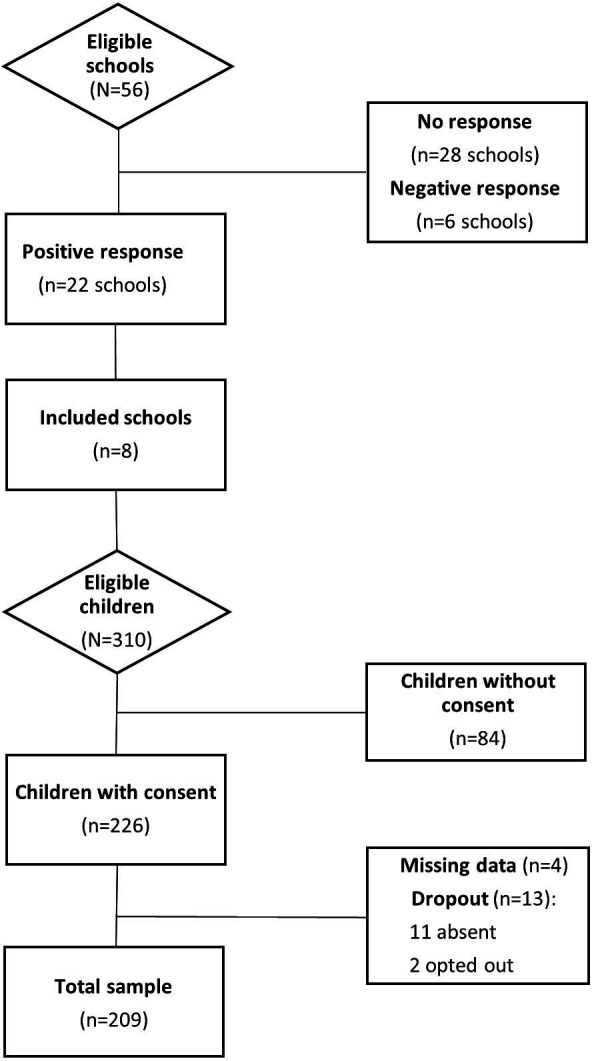
Methods: In a cross-sectional study between November 2021 and April 2022, perceptions of height and weight screening and BSD were assessed individually among 209 children (49% girls) through researcher-assisted interviews.
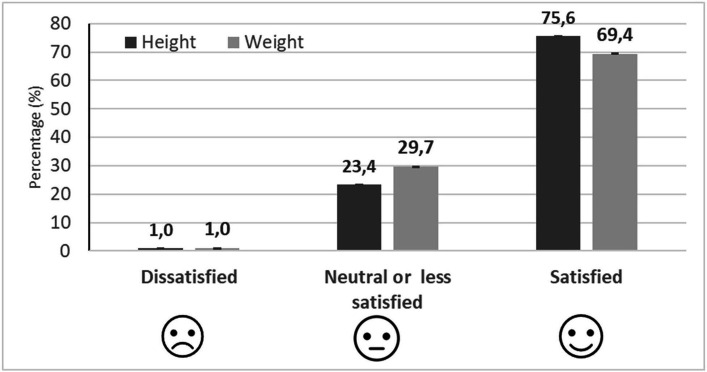
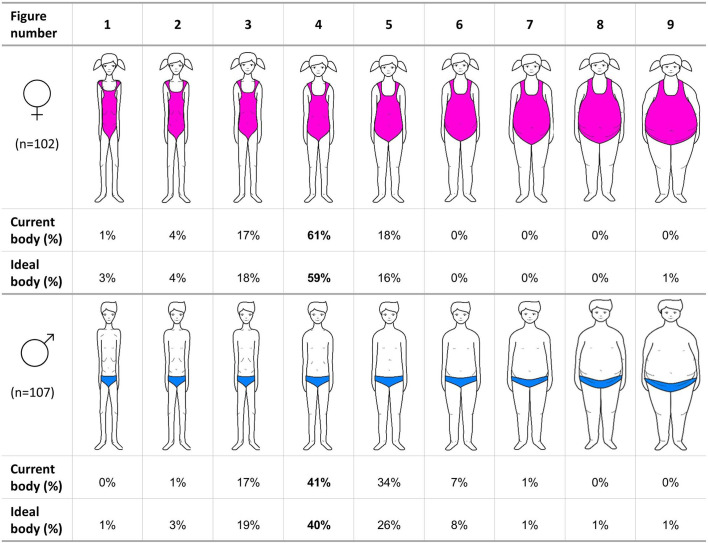
Results: Most children indicated satisfaction with the screening by selecting a happy emoji, whereas only 1% indicated dissatisfaction, by selecting an unhappy emoji. However, 23%-30% selected a neutral emoji, indicating either neutrality or a response between satisfaction and dissatisfaction. No difference in the perception of height and weight screening was found between genders or body mass index (BMI). Children with parents from non-Western countries had a higher risk of being less satisfied with the height screening (OR=3.0, 95% CI 1.2 to 7.3) than those from Western origin, and children attending schools with lower socioeconomic status (SES) had increased risk of being less satisfied with both height (OR=5.5, 95% CI 2.2 to 13.5) and weight screening (OR=4.0, 95% CI 1.7 to 9.3), compared with children from schools with medium-high SES. Twenty-three percent reported BSD, in which 14% and 9% desired a thinner or larger body, respectively, independent of gender and BMI. No association was found between BSD and the perception of weighing (OR=1.1, 95% CI 0.6 to 2.4), however, BSD was associated with being more satisfied with height screening (OR=0.3, 95% CI 0.1 to 0.8).
Conclusion: In the present sample, most children indicated satisfaction with school-based height and weight screening, with no differences between gender or BMI category. However, more children of non-Western origin and from areas with low SES reported less satisfaction with the screening, independent of BSD.





 京公网安备 11010802042870号
京ICP备2023020795号-1
京公网安备 11010802042870号
京ICP备2023020795号-1

 分享
分享
 求助内容:
求助内容: 应助结果提醒方式:
 扫码关注我们
