{"title":"Impact of Early Rehabilitation after Endovascular Treatment for Peripheral Arterial Disease.","authors":"Yuki Kato, Kenta Ushida, Miho Shimizu, Ryo Momosaki","doi":"10.2490/prm.20240021","DOIUrl":null,"url":null,"abstract":"<p><strong>Objectives: </strong>The prevalence of peripheral arterial disease (PAD) is on the rise, with endovascular treatment being a widely accepted surgical intervention. Patients with PAD often experience reduced activities of daily living (ADL). Therefore, we conducted a retrospective cohort study to investigate the impact of early rehabilitation after endovascular treatment in patients with PAD.</p><p><strong>Methods: </strong>Using data from the JMDC hospital database, the study included 529 patients who were hospitalized for PAD and underwent endovascular treatment. Patients were classified into two independent variables: early rehabilitation group (rehabilitation started within 2 days postoperatively) and control group (rehabilitation started within 3-7 days postoperatively). The outcome measures were the occurrence of hospital-associated disability (HAD) and duration of hospitalization.</p><p><strong>Results: </strong>Unadjusted data showed that the early rehabilitation group (n=469) had fewer HAD events (8.5% vs. 23.3%, P <0.001) and a shorter mean hospitalization duration (4.4 vs. 18.9 days, P <0.001) than the control group (n=60). The difference remained significant after adjustment by propensity score analysis.</p><p><strong>Conclusions: </strong>In patients with PAD, early rehabilitation after endovascular treatment may be beneficial in preventing the development of HAD and reducing the duration of hospitalization.</p>","PeriodicalId":74584,"journal":{"name":"Progress in rehabilitation medicine","volume":"9 ","pages":"20240021"},"PeriodicalIF":1.5000,"publicationDate":"2024-06-08","publicationTypes":"Journal Article","fieldsOfStudy":null,"isOpenAccess":false,"openAccessPdf":"https://www.ncbi.nlm.nih.gov/pmc/articles/PMC11156502/pdf/","citationCount":"0","resultStr":null,"platform":"Semanticscholar","paperid":null,"PeriodicalName":"Progress in rehabilitation medicine","FirstCategoryId":"1085","ListUrlMain":"https://doi.org/10.2490/prm.20240021","RegionNum":0,"RegionCategory":null,"ArticlePicture":[],"TitleCN":null,"AbstractTextCN":null,"PMCID":null,"EPubDate":"2024/1/1 0:00:00","PubModel":"eCollection","JCR":"","JCRName":"","Score":null,"Total":0}
引用次数: 0
Abstract
Objectives: The prevalence of peripheral arterial disease (PAD) is on the rise, with endovascular treatment being a widely accepted surgical intervention. Patients with PAD often experience reduced activities of daily living (ADL). Therefore, we conducted a retrospective cohort study to investigate the impact of early rehabilitation after endovascular treatment in patients with PAD.
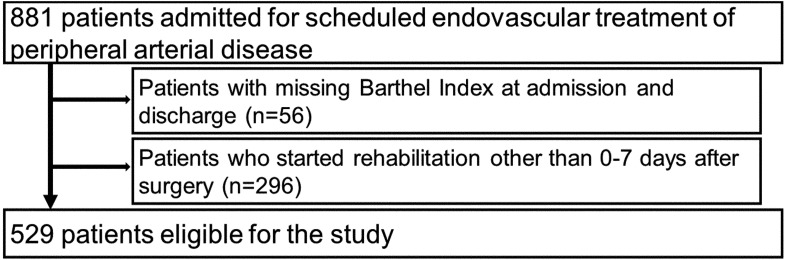
Methods: Using data from the JMDC hospital database, the study included 529 patients who were hospitalized for PAD and underwent endovascular treatment. Patients were classified into two independent variables: early rehabilitation group (rehabilitation started within 2 days postoperatively) and control group (rehabilitation started within 3-7 days postoperatively). The outcome measures were the occurrence of hospital-associated disability (HAD) and duration of hospitalization.
Results: Unadjusted data showed that the early rehabilitation group (n=469) had fewer HAD events (8.5% vs. 23.3%, P <0.001) and a shorter mean hospitalization duration (4.4 vs. 18.9 days, P <0.001) than the control group (n=60). The difference remained significant after adjustment by propensity score analysis.
Conclusions: In patients with PAD, early rehabilitation after endovascular treatment may be beneficial in preventing the development of HAD and reducing the duration of hospitalization.
目的:外周动脉疾病(PAD)的发病率呈上升趋势,血管内治疗是一种广为接受的外科干预方法。PAD 患者通常会出现日常生活活动能力(ADL)下降的情况。因此,我们进行了一项回顾性队列研究,以探讨血管内治疗后早期康复对 PAD 患者的影响:该研究利用 JMDC 医院数据库的数据,纳入了 529 名因 PAD 住院并接受血管内治疗的患者。患者被分为两个独立变量:早期康复组(术后2天内开始康复)和对照组(术后3-7天内开始康复)。结果指标为住院相关残疾(HAD)的发生率和住院时间:结果:未经调整的数据显示,早期康复组(469 人)发生的 HAD 事件较少(8.5% 对 23.3%,P 结论:对于 PAD 患者,早期康复可以减少 HAD 的发生:对于 PAD 患者,血管内治疗后的早期康复可能有利于预防 HAD 的发生并缩短住院时间。



 京公网安备 11010802042870号
京ICP备2023020795号-1
京公网安备 11010802042870号
京ICP备2023020795号-1

 分享
分享

 求助内容:
求助内容: 应助结果提醒方式:
 扫码关注我们
