Fredrik Ildstad, Torgeir Wethal, Hanne Ellekjær, Stian Lydersen, Tom Eirik Mollnes, Thor Ueland, Pål Aukrust, Bent Indredavik
{"title":"Five-Year Risk of Cardiovascular Events after Transient Ischemic Attack: Results from a Prospective Cohort","authors":"Fredrik Ildstad, Torgeir Wethal, Hanne Ellekjær, Stian Lydersen, Tom Eirik Mollnes, Thor Ueland, Pål Aukrust, Bent Indredavik","doi":"10.1155/2024/4982336","DOIUrl":null,"url":null,"abstract":"<div>\n <p><i>Objectives</i>. There are few contemporary, prospective studies reporting on the long-term risk of stroke and other cardiovascular (CV) events after transient ischemic attack (TIA). The primary aim was to examine the risk of new CV events within 5 years after TIA. The secondary aim was to identify baseline predictors of long-term CV events, including inflammatory biomarkers in a subgroup analysis. <i>Materials and Methods</i>. In a prospective, multicenter study, we enrolled 577 TIA patients between 2012 and 2014. The primary outcome was a composite of stroke, acute coronary syndrome, and CV death. We used data from the Norwegian Cardiovascular Disease Registry. In a subgroup of 112 patients, blood samples were analyzed for inflammatory biomarkers. <i>Results</i>. The primary outcome occurred in 108 patients (18.7%), of which 69 patients (12.0%) had a stroke. Sixty-one (56.5%) of the events occurred during year two through five. Increasing age (HR 1.05; 95% CI, 1.03-1.08), male sex (HR 1.82; 95% CI, 1.16-2.85), hypertension (HR 1.67; 95% CI, 1.04-2.67), and acute infarction on brain imaging (HR 1.84; 95% CI, 1.17-2.91) were significant predictors for the primary outcome. In the subgroup analysis, none of the blood inflammatory biomarkers were associated with CV events. <i>Conclusions</i>. The risk of CV events was highest during the first year after TIA, with a lower but sustained risk throughout the follow-up. This emphasizes the importance of both early initiation of and long-term continuation of secondary preventive treatment after TIA. Inflammatory biomarkers are probably not important as prognostic markers of cardiovascular disease in TIA patients.</p>\n </div>","PeriodicalId":6939,"journal":{"name":"Acta Neurologica Scandinavica","volume":"2024 1","pages":""},"PeriodicalIF":2.7000,"publicationDate":"2024-06-10","publicationTypes":"Journal Article","fieldsOfStudy":null,"isOpenAccess":false,"openAccessPdf":"https://onlinelibrary.wiley.com/doi/epdf/10.1155/2024/4982336","citationCount":"0","resultStr":null,"platform":"Semanticscholar","paperid":null,"PeriodicalName":"Acta Neurologica Scandinavica","FirstCategoryId":"3","ListUrlMain":"https://onlinelibrary.wiley.com/doi/10.1155/2024/4982336","RegionNum":3,"RegionCategory":"医学","ArticlePicture":[],"TitleCN":null,"AbstractTextCN":null,"PMCID":null,"EPubDate":"","PubModel":"","JCR":"Q2","JCRName":"CLINICAL NEUROLOGY","Score":null,"Total":0}
引用次数: 0
Abstract
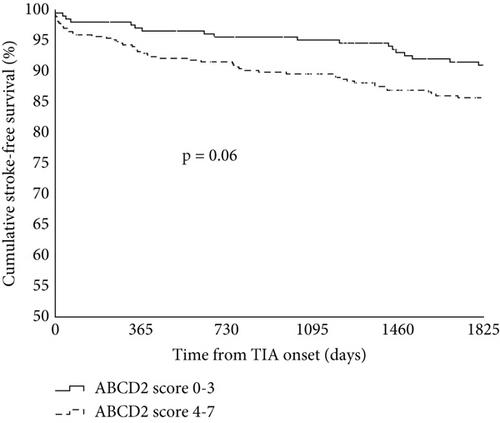
Objectives. There are few contemporary, prospective studies reporting on the long-term risk of stroke and other cardiovascular (CV) events after transient ischemic attack (TIA). The primary aim was to examine the risk of new CV events within 5 years after TIA. The secondary aim was to identify baseline predictors of long-term CV events, including inflammatory biomarkers in a subgroup analysis. Materials and Methods. In a prospective, multicenter study, we enrolled 577 TIA patients between 2012 and 2014. The primary outcome was a composite of stroke, acute coronary syndrome, and CV death. We used data from the Norwegian Cardiovascular Disease Registry. In a subgroup of 112 patients, blood samples were analyzed for inflammatory biomarkers. Results. The primary outcome occurred in 108 patients (18.7%), of which 69 patients (12.0%) had a stroke. Sixty-one (56.5%) of the events occurred during year two through five. Increasing age (HR 1.05; 95% CI, 1.03-1.08), male sex (HR 1.82; 95% CI, 1.16-2.85), hypertension (HR 1.67; 95% CI, 1.04-2.67), and acute infarction on brain imaging (HR 1.84; 95% CI, 1.17-2.91) were significant predictors for the primary outcome. In the subgroup analysis, none of the blood inflammatory biomarkers were associated with CV events. Conclusions. The risk of CV events was highest during the first year after TIA, with a lower but sustained risk throughout the follow-up. This emphasizes the importance of both early initiation of and long-term continuation of secondary preventive treatment after TIA. Inflammatory biomarkers are probably not important as prognostic markers of cardiovascular disease in TIA patients.
期刊介绍:
Acta Neurologica Scandinavica aims to publish manuscripts of a high scientific quality representing original clinical, diagnostic or experimental work in neuroscience. The journal''s scope is to act as an international forum for the dissemination of information advancing the science or practice of this subject area. Papers in English will be welcomed, especially those which bring new knowledge and observations from the application of therapies or techniques in the combating of a broad spectrum of neurological disease and neurodegenerative disorders. Relevant articles on the basic neurosciences will be published where they extend present understanding of such disorders. Priority will be given to review of topical subjects. Papers requiring rapid publication because of their significance and timeliness will be included as ''Clinical commentaries'' not exceeding two printed pages, as will ''Clinical commentaries'' of sufficient general interest. Debate within the speciality is encouraged in the form of ''Letters to the editor''. All submitted manuscripts falling within the overall scope of the journal will be assessed by suitably qualified referees.



 京公网安备 11010802042870号
京ICP备2023020795号-1
京公网安备 11010802042870号
京ICP备2023020795号-1

 分享
分享
 求助内容:
求助内容: 应助结果提醒方式:
 扫码关注我们
