Gastrointestinal: A case of ulcerative colitis complicated by Tolosa-hunt syndrome and pyoderma gangrenosum and featuring rare extraintestinal manifestations
M Katsurahara, M Nakamura, Y Hamada, K Tanaka, N Horiki, H Nakagawa
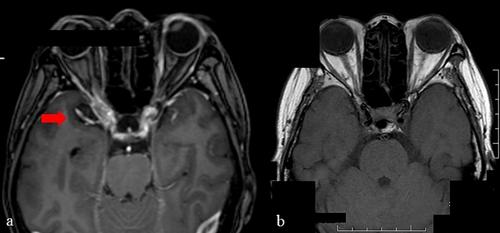
{"title":"Gastrointestinal: A case of ulcerative colitis complicated by Tolosa-hunt syndrome and pyoderma gangrenosum and featuring rare extraintestinal manifestations","authors":"M Katsurahara, M Nakamura, Y Hamada, K Tanaka, N Horiki, H Nakagawa","doi":"10.1111/jgh.16652","DOIUrl":null,"url":null,"abstract":"<p>A 68-year-old woman with no past history had been suffering from loose stools seven times a day with a small amount of blood for a year. She was admitted to our hospital because of impaired adduction and orbital pain on the right side. A head MRI revealed a contrast enhanced lesion through the right orbital apex and cavernous sinus (Fig. 1a). She was diagnosed to have Tolosa-Hunt syndrome (THS) based on the characteristic image. The ocular symptoms resolved with prednisolone 50 mg, and an MRI 2 months later showed that the lesion had disappeared (Fig. 1b). When prednisolone was reduced to 10 mg, a deep, fist-sized ulcer developed on her right leg, with red-purple edematous erythema (Fig. 2a). A skin biopsy revealed abscess formation in the deep dermis with neutrophil infiltration, leading to the diagnosis of pyoderma gangrenosum (PG). What could be the underlying cause in this case?</p><p>A whole body CT revealed the increased wall thickness of the entire colon. Although the frequency of diarrhea with no blood had decreased significantly, colonoscopy revealed diffusely rough and edematous mucosa with shallow ulcers from the sigmoid colon to the cecum (Fig. 2b,c), consistent with ulcerative colitis (UC). Considering the severity of PG, 5-aminosalicylic acid and increased prednisolone to 30 mg were administered, which resulted in remission of both the UC and PG.</p><p>Inflammatory bowel disease (IBD) causes various extraintestinal complications.<span><sup>1</sup></span> PG is histopathologically characterized by a proliferative, gangrenous ulcer with neutrophil infiltration, and a well-known complication of IBD, accounting for 1.8% of cases.<span><sup>2</sup></span> THS is considered to be an inflammatory granulomatous disease of unknown cause,<span><sup>3</sup></span> and to our knowledge, only one case of THS associated with IBD has been described in Crohn's disease.<span><sup>3</sup></span> We report for the first time a case of UC complicated by THS and PG.</p>","PeriodicalId":15877,"journal":{"name":"Journal of Gastroenterology and Hepatology","volume":"39 12","pages":"2473-2474"},"PeriodicalIF":3.4000,"publicationDate":"2024-06-13","publicationTypes":"Journal Article","fieldsOfStudy":null,"isOpenAccess":false,"openAccessPdf":"https://onlinelibrary.wiley.com/doi/epdf/10.1111/jgh.16652","citationCount":"0","resultStr":null,"platform":"Semanticscholar","paperid":null,"PeriodicalName":"Journal of Gastroenterology and Hepatology","FirstCategoryId":"3","ListUrlMain":"https://onlinelibrary.wiley.com/doi/10.1111/jgh.16652","RegionNum":3,"RegionCategory":"医学","ArticlePicture":[],"TitleCN":null,"AbstractTextCN":null,"PMCID":null,"EPubDate":"","PubModel":"","JCR":"Q2","JCRName":"GASTROENTEROLOGY & HEPATOLOGY","Score":null,"Total":0}
引用次数: 0
Abstract
A 68-year-old woman with no past history had been suffering from loose stools seven times a day with a small amount of blood for a year. She was admitted to our hospital because of impaired adduction and orbital pain on the right side. A head MRI revealed a contrast enhanced lesion through the right orbital apex and cavernous sinus (Fig. 1a). She was diagnosed to have Tolosa-Hunt syndrome (THS) based on the characteristic image. The ocular symptoms resolved with prednisolone 50 mg, and an MRI 2 months later showed that the lesion had disappeared (Fig. 1b). When prednisolone was reduced to 10 mg, a deep, fist-sized ulcer developed on her right leg, with red-purple edematous erythema (Fig. 2a). A skin biopsy revealed abscess formation in the deep dermis with neutrophil infiltration, leading to the diagnosis of pyoderma gangrenosum (PG). What could be the underlying cause in this case?
A whole body CT revealed the increased wall thickness of the entire colon. Although the frequency of diarrhea with no blood had decreased significantly, colonoscopy revealed diffusely rough and edematous mucosa with shallow ulcers from the sigmoid colon to the cecum (Fig. 2b,c), consistent with ulcerative colitis (UC). Considering the severity of PG, 5-aminosalicylic acid and increased prednisolone to 30 mg were administered, which resulted in remission of both the UC and PG.
Inflammatory bowel disease (IBD) causes various extraintestinal complications.1 PG is histopathologically characterized by a proliferative, gangrenous ulcer with neutrophil infiltration, and a well-known complication of IBD, accounting for 1.8% of cases.2 THS is considered to be an inflammatory granulomatous disease of unknown cause,3 and to our knowledge, only one case of THS associated with IBD has been described in Crohn's disease.3 We report for the first time a case of UC complicated by THS and PG.
期刊介绍:
Journal of Gastroenterology and Hepatology is produced 12 times per year and publishes peer-reviewed original papers, reviews and editorials concerned with clinical practice and research in the fields of hepatology, gastroenterology and endoscopy. Papers cover the medical, radiological, pathological, biochemical, physiological and historical aspects of the subject areas. All submitted papers are reviewed by at least two referees expert in the field of the submitted paper.



 京公网安备 11010802042870号
京ICP备2023020795号-1
京公网安备 11010802042870号
京ICP备2023020795号-1

 分享
分享
 求助内容:
求助内容: 应助结果提醒方式:
 扫码关注我们
