Yi Zhou , Yong-Qin He , Xia Nie , Lin Lu , Xian-Rong Song , Zhao-Zhao Zhou , Wan-Fa Tian , Qiang Xiao
{"title":"Ir/Co dual catalyzed hydroacylation of electron-deficient alkenes overcoming redox potential limitations†","authors":"Yi Zhou , Yong-Qin He , Xia Nie , Lin Lu , Xian-Rong Song , Zhao-Zhao Zhou , Wan-Fa Tian , Qiang Xiao","doi":"10.1039/d4qo00778f","DOIUrl":null,"url":null,"abstract":"<div><div>An unexpected Ir/Co dual catalytic hydroacylation of electron-deficient alkenes overcoming redox potential limitations is reported. In this protocol, Co(<span>i</span>) species are generated <em>via</em> photoreduction using Ir[dF(CF<sub>3</sub>)ppy]<sub>2</sub>dtbbpy, whose excited state has an oxidative potential (<em>E</em><sub>ox</sub> = −0.89 V <em>vs.</em> SCE) that is closer to or lower than the reduction potential of several effective salen-Co(<span>ii</span>) catalysts (<strong>Co-1–Co-5</strong>: <em>E</em><sup>Co( ii )/Co( i )</sup> = −0.80 to −1.36 V <em>vs</em>. SCE). The nucleophilic Co(<span>i</span>) species catalyzes the fragmentation of carboxylic anhydrides to release an acyl radical, which is subsequently captured by electron-deficient alkenes.</div></div>","PeriodicalId":94379,"journal":{"name":"Organic chemistry frontiers : an international journal of organic chemistry","volume":"11 15","pages":"Pages 4269-4274"},"PeriodicalIF":0.0000,"publicationDate":"2024-07-23","publicationTypes":"Journal Article","fieldsOfStudy":null,"isOpenAccess":false,"openAccessPdf":"","citationCount":"0","resultStr":null,"platform":"Semanticscholar","paperid":null,"PeriodicalName":"Organic chemistry frontiers : an international journal of organic chemistry","FirstCategoryId":"1085","ListUrlMain":"https://www.sciencedirect.com/org/science/article/pii/S2052412924004200","RegionNum":0,"RegionCategory":null,"ArticlePicture":[],"TitleCN":null,"AbstractTextCN":null,"PMCID":null,"EPubDate":"2024/6/14 0:00:00","PubModel":"Epub","JCR":"","JCRName":"","Score":null,"Total":0}
引用次数: 0
Abstract
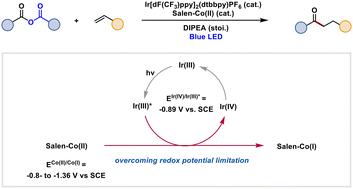
An unexpected Ir/Co dual catalytic hydroacylation of electron-deficient alkenes overcoming redox potential limitations is reported. In this protocol, Co(i) species are generated via photoreduction using Ir[dF(CF3)ppy]2dtbbpy, whose excited state has an oxidative potential (Eox = −0.89 V vs. SCE) that is closer to or lower than the reduction potential of several effective salen-Co(ii) catalysts (Co-1–Co-5: ECo( ii )/Co( i ) = −0.80 to −1.36 V vs. SCE). The nucleophilic Co(i) species catalyzes the fragmentation of carboxylic anhydrides to release an acyl radical, which is subsequently captured by electron-deficient alkenes.




 京公网安备 11010802042870号
京ICP备2023020795号-1
京公网安备 11010802042870号
京ICP备2023020795号-1

 分享
分享

 求助内容:
求助内容: 应助结果提醒方式:
 扫码关注我们
