Yashu Zhang , Khair Bux , Fedaa Attana , Dengguo Wei , Shozeb Haider , Gary N. Parkinson
{"title":"Structural descriptions of ligand interactions to RNA quadruplexes folded from the non-coding region of pseudorabies virus","authors":"Yashu Zhang , Khair Bux , Fedaa Attana , Dengguo Wei , Shozeb Haider , Gary N. Parkinson","doi":"10.1016/j.biochi.2024.06.003","DOIUrl":null,"url":null,"abstract":"<div><div>To rationalise the binding of specific ligands to RNA-quadruplex we investigated several naphthalene diimide ligands that interact with the non-coding region of Pseudorabies virus (PRV). Herein we report on the x-ray structure of the naphthalene diimide ND11 with an RNA G-quadruplex putative forming sequence from rPRV. Consistent with previously observed rPRV sequence it assembles into a bimolecular RNA G-quadruplex consisting of a pair of two tetrads stacked 3ʹ to 5ʹ. We observe that ND11 interacts by binding on both the externally available 5ʹ and 3ʹ quartets. The CUC (loop 1) is structurally altered to enhance the 5ʹ mode of interaction. These loop residues are shifted significantly to generate a new ligand binding pocket whereas the terminal A14 residue is lifted away from the RNA G-quadruplex tetrad plane to be restacked above the bound ND11 ligand NDI core. CD analysis of this family of NDI ligands shows consistency in the spectra between the different ligands in the presence of the rPRV RNA G-quadruplex motif, reflecting a common folded topology and mode of ligand interaction. FRET melt assay confirms the strong stabilising properties of the tetrasubstituted NDI compounds and the contributions length of the substituted groups have on melt temperatures.</div></div>","PeriodicalId":251,"journal":{"name":"Biochimie","volume":"227 ","pages":"Pages 28-36"},"PeriodicalIF":3.0000,"publicationDate":"2024-12-01","publicationTypes":"Journal Article","fieldsOfStudy":null,"isOpenAccess":false,"openAccessPdf":"","citationCount":"0","resultStr":null,"platform":"Semanticscholar","paperid":null,"PeriodicalName":"Biochimie","FirstCategoryId":"99","ListUrlMain":"https://www.sciencedirect.com/science/article/pii/S0300908424001391","RegionNum":3,"RegionCategory":"生物学","ArticlePicture":[],"TitleCN":null,"AbstractTextCN":null,"PMCID":null,"EPubDate":"2024/6/13 0:00:00","PubModel":"Epub","JCR":"Q2","JCRName":"BIOCHEMISTRY & MOLECULAR BIOLOGY","Score":null,"Total":0}
引用次数: 0
Abstract
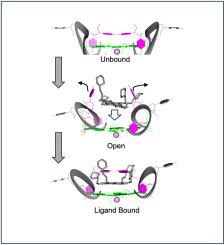
To rationalise the binding of specific ligands to RNA-quadruplex we investigated several naphthalene diimide ligands that interact with the non-coding region of Pseudorabies virus (PRV). Herein we report on the x-ray structure of the naphthalene diimide ND11 with an RNA G-quadruplex putative forming sequence from rPRV. Consistent with previously observed rPRV sequence it assembles into a bimolecular RNA G-quadruplex consisting of a pair of two tetrads stacked 3ʹ to 5ʹ. We observe that ND11 interacts by binding on both the externally available 5ʹ and 3ʹ quartets. The CUC (loop 1) is structurally altered to enhance the 5ʹ mode of interaction. These loop residues are shifted significantly to generate a new ligand binding pocket whereas the terminal A14 residue is lifted away from the RNA G-quadruplex tetrad plane to be restacked above the bound ND11 ligand NDI core. CD analysis of this family of NDI ligands shows consistency in the spectra between the different ligands in the presence of the rPRV RNA G-quadruplex motif, reflecting a common folded topology and mode of ligand interaction. FRET melt assay confirms the strong stabilising properties of the tetrasubstituted NDI compounds and the contributions length of the substituted groups have on melt temperatures.
期刊介绍:
Biochimie publishes original research articles, short communications, review articles, graphical reviews, mini-reviews, and hypotheses in the broad areas of biology, including biochemistry, enzymology, molecular and cell biology, metabolic regulation, genetics, immunology, microbiology, structural biology, genomics, proteomics, and molecular mechanisms of disease. Biochimie publishes exclusively in English.
Articles are subject to peer review, and must satisfy the requirements of originality, high scientific integrity and general interest to a broad range of readers. Submissions that are judged to be of sound scientific and technical quality but do not fully satisfy the requirements for publication in Biochimie may benefit from a transfer service to a more suitable journal within the same subject area.




 京公网安备 11010802042870号
京ICP备2023020795号-1
京公网安备 11010802042870号
京ICP备2023020795号-1

 分享
分享
 求助内容:
求助内容: 应助结果提醒方式:
 扫码关注我们
