{"title":"Site-specific DNA post-synthetic modification via fast photocatalytic allylation†","authors":"Ying Huang , Yixin Zhang , Chenchen Hu , Yiyun Chen","doi":"10.1039/d4qo00752b","DOIUrl":null,"url":null,"abstract":"<div><div>Expanding DNA functionality has significant implications in nucleic acid chemistry, biology, and beyond. Therefore, developing new chemical tools for site-specific post-synthetic modification of nucleic acids is urgently needed. Herein, we demonstrate the first site-specific DNA post-synthetic modification <em>via</em> visible-light-catalyzed decarboxylative allylation. Allyl sulfone groups were introduced into DNA, not only at the terminal sites <em>via</em> amide formation but also at internal and terminal positions during DNA solid-phase synthesis. This visible-light-catalyzed decarboxylative allylation proceeds rapidly on DNA bearing allyl sulfone groups under open-air conditions within minutes, exhibiting excellent chemoselectivity and compatibility with various functional groups while retaining DNA integrity. Specifically, introducing allyl sulfones into DNA <em>via</em> solid-phase synthesis enables site-specific modification on chemically synthesized single-stranded DNA (internal and terminal positions), hybridized double-stranded DNA, and enzymatically amplified long-chain DNA under visible light irradiation. The versatile reactivity of allyl sulfone scaffolds further enables diverse on-DNA photocatalytic transformations, promising to advance the chemical toolbox for DNA post-synthetic modification through diverse photochemical methods.</div></div>","PeriodicalId":94379,"journal":{"name":"Organic chemistry frontiers : an international journal of organic chemistry","volume":"11 16","pages":"Pages 4408-4415"},"PeriodicalIF":0.0000,"publicationDate":"2024-06-18","publicationTypes":"Journal Article","fieldsOfStudy":null,"isOpenAccess":false,"openAccessPdf":"","citationCount":"0","resultStr":null,"platform":"Semanticscholar","paperid":null,"PeriodicalName":"Organic chemistry frontiers : an international journal of organic chemistry","FirstCategoryId":"1085","ListUrlMain":"https://www.sciencedirect.com/org/science/article/pii/S2052412924004613","RegionNum":0,"RegionCategory":null,"ArticlePicture":[],"TitleCN":null,"AbstractTextCN":null,"PMCID":null,"EPubDate":"","PubModel":"","JCR":"","JCRName":"","Score":null,"Total":0}
引用次数: 0
Abstract
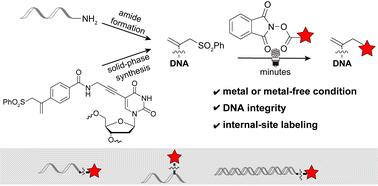
Expanding DNA functionality has significant implications in nucleic acid chemistry, biology, and beyond. Therefore, developing new chemical tools for site-specific post-synthetic modification of nucleic acids is urgently needed. Herein, we demonstrate the first site-specific DNA post-synthetic modification via visible-light-catalyzed decarboxylative allylation. Allyl sulfone groups were introduced into DNA, not only at the terminal sites via amide formation but also at internal and terminal positions during DNA solid-phase synthesis. This visible-light-catalyzed decarboxylative allylation proceeds rapidly on DNA bearing allyl sulfone groups under open-air conditions within minutes, exhibiting excellent chemoselectivity and compatibility with various functional groups while retaining DNA integrity. Specifically, introducing allyl sulfones into DNA via solid-phase synthesis enables site-specific modification on chemically synthesized single-stranded DNA (internal and terminal positions), hybridized double-stranded DNA, and enzymatically amplified long-chain DNA under visible light irradiation. The versatile reactivity of allyl sulfone scaffolds further enables diverse on-DNA photocatalytic transformations, promising to advance the chemical toolbox for DNA post-synthetic modification through diverse photochemical methods.
开发新的化学工具箱用于位点特异性核酸合成后修饰是一项巨大的挑战,也是精确扩展 DNA 功能的迫切需要,对核酸化学、生物学及其他领域具有重要的研究意义。在此,我们首次展示了在可见光下通过快速光催化烯丙基化作用对 DNA 进行位点特异性合成后修饰的方法。烯丙基砜基团不仅通过传统的酰胺化反应被引入寡核苷酸的末端位点,还通过 DNA 固相合成被引入内部和末端位点。这种可见光诱导的光催化脱羧烯丙基化反应在露天条件下几分钟内就能在带有烯丙基砜基团的寡核苷酸上迅速进行,在保留 DNA 完整性的同时,还表现出极佳的化学选择性和与各种官能团的兼容性。具体来说,通过 DNA 固相合成将烯丙基砜引入寡核苷酸,可在可见光下对化学合成的单链 DNA 的内部和末端位置、杂交的双链 DNA 以及酶扩增的长链 DNA 进行特定位点的 DNA 修饰。烯丙基砜支架的多功能反应性进一步实现了多种 DNA 上的光催化转化,有望通过多种光化学方法推进 DNA 后合成修饰的化学工具箱。



 京公网安备 11010802042870号
京ICP备2023020795号-1
京公网安备 11010802042870号
京ICP备2023020795号-1

 分享
分享

 求助内容:
求助内容: 应助结果提醒方式:
 扫码关注我们
