Di Jin, Wenbo Liu, Linnan Jia, Yuning Zhang, Junkai Hu, H. El Dirani, Sébastien Kerdiles, C. Sciancalepore, Pierre Demongodin, C. Grillet, C. Monat, Duan Huang, Jiayang Wu, Baohua Jia, David J. Moss
{"title":"Thickness‐ and Wavelength‐Dependent Nonlinear Optical Absorption in 2D Layered MXene Films","authors":"Di Jin, Wenbo Liu, Linnan Jia, Yuning Zhang, Junkai Hu, H. El Dirani, Sébastien Kerdiles, C. Sciancalepore, Pierre Demongodin, C. Grillet, C. Monat, Duan Huang, Jiayang Wu, Baohua Jia, David J. Moss","doi":"10.1002/smsc.202400179","DOIUrl":null,"url":null,"abstract":"As a rapidly expanding family of 2D materials, MXenes have recently gained considerable attention. Herein, by developing a coating method that enables transfer‐free and layer‐by‐layer film coating, the nonlinear optical absorption (NOA) of Ti3C2Tx MXene films is investigated. Using the Z‐scan technique, the NOA of the MXene films is characterized at ≈800 nm. The results show that there is a strong and layer‐dependent NOA behavior, transitioning from reverse saturable absorption (RSA) to saturable absorption (SA) as the layer number increases from 5 to 30. Notably, the nonlinear absorption coefficient β changes significantly from ≈7.13 × 102 cm GW−1 to ≈−2.69 × 102 cm GW−1 within this range. The power‐dependent NOA of the MXene films is also characterized, and a decreasing trend in β is observed for increasing laser intensity. Finally, the NOA of 2D MXene films at ≈1550 nm is characterized by integrating them onto silicon nitride waveguides, where an SA behavior is observed for the films including 5 and 10 layers of MXene, in contrast to the RSA observed at ≈800 nm. These results reveal intriguing nonlinear optical properties of 2D MXene films, highlighting their versatility and potential for implementing high‐performance nonlinear photonic devices.","PeriodicalId":11,"journal":{"name":"ACS Chemical Biology","volume":"42 8","pages":""},"PeriodicalIF":3.8000,"publicationDate":"2024-06-13","publicationTypes":"Journal Article","fieldsOfStudy":null,"isOpenAccess":false,"openAccessPdf":"","citationCount":"0","resultStr":null,"platform":"Semanticscholar","paperid":null,"PeriodicalName":"ACS Chemical Biology","FirstCategoryId":"1085","ListUrlMain":"https://doi.org/10.1002/smsc.202400179","RegionNum":2,"RegionCategory":"生物学","ArticlePicture":[],"TitleCN":null,"AbstractTextCN":null,"PMCID":null,"EPubDate":"","PubModel":"","JCR":"Q2","JCRName":"BIOCHEMISTRY & MOLECULAR BIOLOGY","Score":null,"Total":0}
引用次数: 0
Abstract
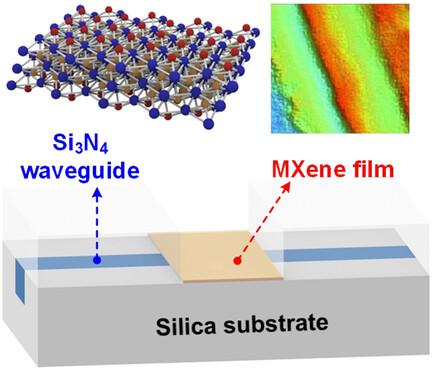
As a rapidly expanding family of 2D materials, MXenes have recently gained considerable attention. Herein, by developing a coating method that enables transfer‐free and layer‐by‐layer film coating, the nonlinear optical absorption (NOA) of Ti3C2Tx MXene films is investigated. Using the Z‐scan technique, the NOA of the MXene films is characterized at ≈800 nm. The results show that there is a strong and layer‐dependent NOA behavior, transitioning from reverse saturable absorption (RSA) to saturable absorption (SA) as the layer number increases from 5 to 30. Notably, the nonlinear absorption coefficient β changes significantly from ≈7.13 × 102 cm GW−1 to ≈−2.69 × 102 cm GW−1 within this range. The power‐dependent NOA of the MXene films is also characterized, and a decreasing trend in β is observed for increasing laser intensity. Finally, the NOA of 2D MXene films at ≈1550 nm is characterized by integrating them onto silicon nitride waveguides, where an SA behavior is observed for the films including 5 and 10 layers of MXene, in contrast to the RSA observed at ≈800 nm. These results reveal intriguing nonlinear optical properties of 2D MXene films, highlighting their versatility and potential for implementing high‐performance nonlinear photonic devices.
期刊介绍:
ACS Chemical Biology provides an international forum for the rapid communication of research that broadly embraces the interface between chemistry and biology.
The journal also serves as a forum to facilitate the communication between biologists and chemists that will translate into new research opportunities and discoveries. Results will be published in which molecular reasoning has been used to probe questions through in vitro investigations, cell biological methods, or organismic studies.
We welcome mechanistic studies on proteins, nucleic acids, sugars, lipids, and nonbiological polymers. The journal serves a large scientific community, exploring cellular function from both chemical and biological perspectives. It is understood that submitted work is based upon original results and has not been published previously.



 京公网安备 11010802042870号
京ICP备2023020795号-1
京公网安备 11010802042870号
京ICP备2023020795号-1

 分享
分享
 求助内容:
求助内容: 应助结果提醒方式:
 扫码关注我们
