Rania H. Taha, Tarek H. Taha, Mohamed Elnouby, E. A. El Desouky, Abdulrahman M. Alhudhaibi, Mahmoud Moustafa, Mervat A. Elsherif, Mohamed Yahia, M. A. Abu-Saied
{"title":"Environmentally green film blends: polyvinyl alcohol (PVA)/cellulose acetate (CA)/potato peel starch as an alternative to petroleum plastics","authors":"Rania H. Taha, Tarek H. Taha, Mohamed Elnouby, E. A. El Desouky, Abdulrahman M. Alhudhaibi, Mahmoud Moustafa, Mervat A. Elsherif, Mohamed Yahia, M. A. Abu-Saied","doi":"10.1007/s10570-024-05984-9","DOIUrl":null,"url":null,"abstract":"<div><p>In recent decades, synthetic plastics have posed a significant environmental threat due to their non-biodegradability. Research is being carried out to find alternative biodegradable sources similar to petroleum plastics but with a lower environmental impact than petroleum plastics. Solution casting was utilized to fabricate the blended films of poly(vinyl alcohol) (PVA)/cellulose acetate(CA)/starch with varying ratios with subsequent testing of their biodegradability using amylase and cellulase enzymes. Before and after enzymatic biodegradability testing, SEM, FTIR, tensile strength, elongation percentage, and swelling of (PVA/CA):(Starch) blended films were investigated. The optimized mechanical properties tensile strength appear at the ratio of (PVA/CA):(Starch) 1:1 was 37.17 ± 1.04 MPa. Using both amylase and cellulase enzymes at the same blend of the polymer best biodegradability that resulted in releasing 131.5 mg/dl of glucose units. The results suggest that (PVA/CA):(Starch) films blended in a ratio of 1:1 can replace petroleum-based plastics and become a green alternative.</p><h3>Graphical Abstract</h3><div><figure><div><div><picture><source><img></source></picture></div></div></figure></div></div>","PeriodicalId":511,"journal":{"name":"Cellulose","volume":"31 10","pages":"6155 - 6172"},"PeriodicalIF":4.8000,"publicationDate":"2024-06-13","publicationTypes":"Journal Article","fieldsOfStudy":null,"isOpenAccess":false,"openAccessPdf":"","citationCount":"0","resultStr":null,"platform":"Semanticscholar","paperid":null,"PeriodicalName":"Cellulose","FirstCategoryId":"88","ListUrlMain":"https://link.springer.com/article/10.1007/s10570-024-05984-9","RegionNum":2,"RegionCategory":"工程技术","ArticlePicture":[],"TitleCN":null,"AbstractTextCN":null,"PMCID":null,"EPubDate":"","PubModel":"","JCR":"Q1","JCRName":"MATERIALS SCIENCE, PAPER & WOOD","Score":null,"Total":0}
引用次数: 0
Abstract
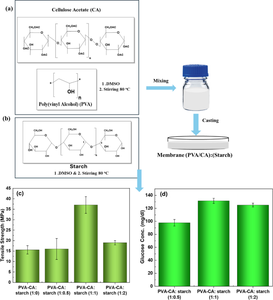
In recent decades, synthetic plastics have posed a significant environmental threat due to their non-biodegradability. Research is being carried out to find alternative biodegradable sources similar to petroleum plastics but with a lower environmental impact than petroleum plastics. Solution casting was utilized to fabricate the blended films of poly(vinyl alcohol) (PVA)/cellulose acetate(CA)/starch with varying ratios with subsequent testing of their biodegradability using amylase and cellulase enzymes. Before and after enzymatic biodegradability testing, SEM, FTIR, tensile strength, elongation percentage, and swelling of (PVA/CA):(Starch) blended films were investigated. The optimized mechanical properties tensile strength appear at the ratio of (PVA/CA):(Starch) 1:1 was 37.17 ± 1.04 MPa. Using both amylase and cellulase enzymes at the same blend of the polymer best biodegradability that resulted in releasing 131.5 mg/dl of glucose units. The results suggest that (PVA/CA):(Starch) films blended in a ratio of 1:1 can replace petroleum-based plastics and become a green alternative.
期刊介绍:
Cellulose is an international journal devoted to the dissemination of research and scientific and technological progress in the field of cellulose and related naturally occurring polymers. The journal is concerned with the pure and applied science of cellulose and related materials, and also with the development of relevant new technologies. This includes the chemistry, biochemistry, physics and materials science of cellulose and its sources, including wood and other biomass resources, and their derivatives. Coverage extends to the conversion of these polymers and resources into manufactured goods, such as pulp, paper, textiles, and manufactured as well natural fibers, and to the chemistry of materials used in their processing. Cellulose publishes review articles, research papers, and technical notes.



 京公网安备 11010802042870号
京ICP备2023020795号-1
京公网安备 11010802042870号
京ICP备2023020795号-1

 分享
分享
 求助内容:
求助内容: 应助结果提醒方式:
 扫码关注我们
