Tiantian Yang, Dan Luo, Lingcheng Wang, Yuanqiang Liu, Changtong Mei
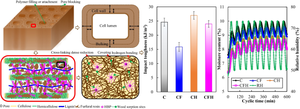
{"title":"Improving fast-growing poplar wood with furfuryl alcohol and a hyperbranched polymer","authors":"Tiantian Yang, Dan Luo, Lingcheng Wang, Yuanqiang Liu, Changtong Mei","doi":"10.1007/s10570-024-05992-9","DOIUrl":null,"url":null,"abstract":"<div><p>To address drawbacks of significant toughness decrease of furfurylated wood and comprehensively improve properties of low-quality wood, this study synthesized hyperbranched poly(ester-amide) (HBP) as toughening agent and used synergies of furfuryl alcohol (FA) and HBP for poplar wood modification. The SEM–EDX and FTIR analysis showed that FA and HBP penetrated into wood and in situ polymerized in cell walls and cell lumina, leading to about 25% mass gain and 7% volumetric changes. After compound modification, wood exhibited enhanced hydrophobicity and dimensional stability, suggested by the maximum decrease of over 30% moisture content and volumetric change. This was mainly because polymers blocked water exchanging paths, reduced water accommodation, covered sorption sites and bulked cell walls. The flexural strength and surface hardness of modified wood were notably improved. The impact toughness increased by about 50% compared with that of furfurylated wood, which was mainly ascribed to (1) HBP with a three-dimensional globular structure had micro-phase separation with FA resin during polymerization. The HBP with high flexibility and mobility, acting as the second phase particles, increased the free volume for macromolecular movement. (2) The flexible group-ester group and tertiary amide group of HBP contributed to more absorption of energy and interruption of crack development under impact. Besides, the cracks would be blunted and dissipate impact energy by producing extensive shear deformation. (3) The HBP interrupted the cross-linking of furfural resin and reduced brittle furfural resin network dense. This study provided new references for improving toughness of resin-modified wood and upgrading low-quality wood products for wide application.</p><h3>Graphical abstract</h3>\n<div><figure><div><div><picture><source><img></source></picture></div></div></figure></div></div>","PeriodicalId":511,"journal":{"name":"Cellulose","volume":"31 10","pages":"6485 - 6499"},"PeriodicalIF":4.8000,"publicationDate":"2024-06-13","publicationTypes":"Journal Article","fieldsOfStudy":null,"isOpenAccess":false,"openAccessPdf":"","citationCount":"0","resultStr":null,"platform":"Semanticscholar","paperid":null,"PeriodicalName":"Cellulose","FirstCategoryId":"88","ListUrlMain":"https://link.springer.com/article/10.1007/s10570-024-05992-9","RegionNum":2,"RegionCategory":"工程技术","ArticlePicture":[],"TitleCN":null,"AbstractTextCN":null,"PMCID":null,"EPubDate":"","PubModel":"","JCR":"Q1","JCRName":"MATERIALS SCIENCE, PAPER & WOOD","Score":null,"Total":0}
引用次数: 0
Abstract
To address drawbacks of significant toughness decrease of furfurylated wood and comprehensively improve properties of low-quality wood, this study synthesized hyperbranched poly(ester-amide) (HBP) as toughening agent and used synergies of furfuryl alcohol (FA) and HBP for poplar wood modification. The SEM–EDX and FTIR analysis showed that FA and HBP penetrated into wood and in situ polymerized in cell walls and cell lumina, leading to about 25% mass gain and 7% volumetric changes. After compound modification, wood exhibited enhanced hydrophobicity and dimensional stability, suggested by the maximum decrease of over 30% moisture content and volumetric change. This was mainly because polymers blocked water exchanging paths, reduced water accommodation, covered sorption sites and bulked cell walls. The flexural strength and surface hardness of modified wood were notably improved. The impact toughness increased by about 50% compared with that of furfurylated wood, which was mainly ascribed to (1) HBP with a three-dimensional globular structure had micro-phase separation with FA resin during polymerization. The HBP with high flexibility and mobility, acting as the second phase particles, increased the free volume for macromolecular movement. (2) The flexible group-ester group and tertiary amide group of HBP contributed to more absorption of energy and interruption of crack development under impact. Besides, the cracks would be blunted and dissipate impact energy by producing extensive shear deformation. (3) The HBP interrupted the cross-linking of furfural resin and reduced brittle furfural resin network dense. This study provided new references for improving toughness of resin-modified wood and upgrading low-quality wood products for wide application.
期刊介绍:
Cellulose is an international journal devoted to the dissemination of research and scientific and technological progress in the field of cellulose and related naturally occurring polymers. The journal is concerned with the pure and applied science of cellulose and related materials, and also with the development of relevant new technologies. This includes the chemistry, biochemistry, physics and materials science of cellulose and its sources, including wood and other biomass resources, and their derivatives. Coverage extends to the conversion of these polymers and resources into manufactured goods, such as pulp, paper, textiles, and manufactured as well natural fibers, and to the chemistry of materials used in their processing. Cellulose publishes review articles, research papers, and technical notes.



 京公网安备 11010802042870号
京ICP备2023020795号-1
京公网安备 11010802042870号
京ICP备2023020795号-1

 分享
分享
 求助内容:
求助内容: 应助结果提醒方式:
 扫码关注我们
