{"title":"Research funding in different SCI disciplines: A comparison analysis based on Web of Science","authors":"Wencan Tian, Ruonan Cai, Zhichao Fang, Qianqian Xie, Zhigang Hu, Xianwen Wang","doi":"10.1162/qss_a_00315","DOIUrl":null,"url":null,"abstract":"\n To provide valuable insights for shaping future funding policies, in this study, we offer a comprehensive panorama of the research funding across 171 SCI disciplines in the past decade (2011–2020), based on more than 13 million scientific literature records from the Web of Science. The relationship between funding and research impact was also explored. To this end, we employ two indicators, i.e., the universality and multiplicity of funding, to indicate the funding level and six indicators to gauge the impact advantages of funding. Our findings reveal an upward trend in both the universality (increasing from 66.30% to 74.26%) and multiplicity (increasing from 2.82 to 3.26) of funding over the past decade. The allocation of funding varies across disciplines, with life sciences and earth sciences receiving the highest percentage of funding (78.31%) and medicine having the highest multiplicity of funding (3.07). Engineering and computer science have seen relatively rapid growth in terms of universality and multiplicity of funding. Funded articles have a greater impact than unfunded ones. And this impact strengthens as the number of funding grants increases. Through regression analysis, the citation advantage of funding was also proven at the article level, although the usage advantage is not significant.\n \n \n https://www.webofscience.com/api/gateway/wos/peer-review/10.1162/qss_a_00315\n","PeriodicalId":4,"journal":{"name":"ACS Applied Energy Materials","volume":"105 21","pages":""},"PeriodicalIF":5.5000,"publicationDate":"2024-06-10","publicationTypes":"Journal Article","fieldsOfStudy":null,"isOpenAccess":false,"openAccessPdf":"","citationCount":"0","resultStr":null,"platform":"Semanticscholar","paperid":null,"PeriodicalName":"ACS Applied Energy Materials","FirstCategoryId":"1085","ListUrlMain":"https://doi.org/10.1162/qss_a_00315","RegionNum":3,"RegionCategory":"材料科学","ArticlePicture":[],"TitleCN":null,"AbstractTextCN":null,"PMCID":null,"EPubDate":"","PubModel":"","JCR":"Q2","JCRName":"CHEMISTRY, PHYSICAL","Score":null,"Total":0}
引用次数: 0
Abstract
To provide valuable insights for shaping future funding policies, in this study, we offer a comprehensive panorama of the research funding across 171 SCI disciplines in the past decade (2011–2020), based on more than 13 million scientific literature records from the Web of Science. The relationship between funding and research impact was also explored. To this end, we employ two indicators, i.e., the universality and multiplicity of funding, to indicate the funding level and six indicators to gauge the impact advantages of funding. Our findings reveal an upward trend in both the universality (increasing from 66.30% to 74.26%) and multiplicity (increasing from 2.82 to 3.26) of funding over the past decade. The allocation of funding varies across disciplines, with life sciences and earth sciences receiving the highest percentage of funding (78.31%) and medicine having the highest multiplicity of funding (3.07). Engineering and computer science have seen relatively rapid growth in terms of universality and multiplicity of funding. Funded articles have a greater impact than unfunded ones. And this impact strengthens as the number of funding grants increases. Through regression analysis, the citation advantage of funding was also proven at the article level, although the usage advantage is not significant.
https://www.webofscience.com/api/gateway/wos/peer-review/10.1162/qss_a_00315
期刊介绍:
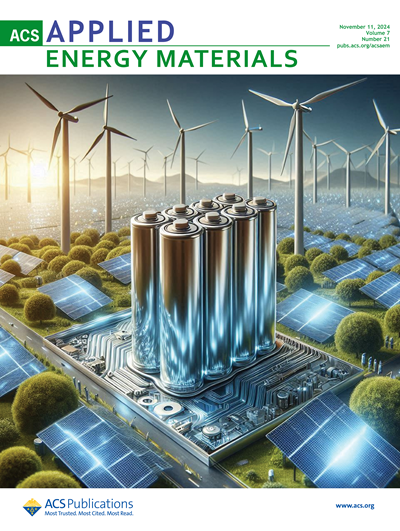
ACS Applied Energy Materials is an interdisciplinary journal publishing original research covering all aspects of materials, engineering, chemistry, physics and biology relevant to energy conversion and storage. The journal is devoted to reports of new and original experimental and theoretical research of an applied nature that integrate knowledge in the areas of materials, engineering, physics, bioscience, and chemistry into important energy applications.



 京公网安备 11010802042870号
京ICP备2023020795号-1
京公网安备 11010802042870号
京ICP备2023020795号-1

 分享
分享
 求助内容:
求助内容: 应助结果提醒方式:
 扫码关注我们
