Sanjita Wasti, Frederic Vautard, Caitlyn Clarkson, Samarthya Bhagia, Harry M. Meyer III, Anne Gosnell, Halil Tekinalp, Soydan Ozcan, Uday Vaidya
{"title":"Effects of mercerization and fiber sizing of coir fiber for utilization in polypropylene composites","authors":"Sanjita Wasti, Frederic Vautard, Caitlyn Clarkson, Samarthya Bhagia, Harry M. Meyer III, Anne Gosnell, Halil Tekinalp, Soydan Ozcan, Uday Vaidya","doi":"10.1007/s10570-024-05997-4","DOIUrl":null,"url":null,"abstract":"<div><p>The use of natural fibers as an alternative to synthetic fibers for reinforcing composites is increasing. However, the poor interfacial adhesion between natural fibers and polymer matrices limits their applications. Several approaches have been considered to improve fiber-matrix adhesion via chemical and/or physical treatment. However, the effectiveness of these treatments varies based on the type of fiber, its source, and its composition. Thus, it is imperative to understand the effectiveness of treatment conditions. In this study, we investigated the influence of alkali treatment and fiber sizing on the chemical, thermal, morphological, and mechanical properties of coir fibers and the interface between coir fiber and polypropylene matrix. It was found that using a 5 wt% sodium hydroxide solution for 6 h at room temperature was the optimal treatment condition that led to an improvement in tensile strength by 58%, tensile modulus by 71%, and elongation at break by 37% compared to untreated fibers, and an increment in interfacial shear strength (IFSS) between coir fibers and polypropylene matrix by 32%. The alkali treatment removed the fiber surface impurities, made the fiber surface rough, and enhanced the fiber crystallinity. Sizing of the alkali-treated fiber led to an improvement in IFSS by 87% with no modification of the fiber’s mechanical properties.</p></div>","PeriodicalId":511,"journal":{"name":"Cellulose","volume":"31 10","pages":"6317 - 6334"},"PeriodicalIF":4.8000,"publicationDate":"2024-06-10","publicationTypes":"Journal Article","fieldsOfStudy":null,"isOpenAccess":false,"openAccessPdf":"","citationCount":"0","resultStr":null,"platform":"Semanticscholar","paperid":null,"PeriodicalName":"Cellulose","FirstCategoryId":"88","ListUrlMain":"https://link.springer.com/article/10.1007/s10570-024-05997-4","RegionNum":2,"RegionCategory":"工程技术","ArticlePicture":[],"TitleCN":null,"AbstractTextCN":null,"PMCID":null,"EPubDate":"","PubModel":"","JCR":"Q1","JCRName":"MATERIALS SCIENCE, PAPER & WOOD","Score":null,"Total":0}
引用次数: 0
Abstract
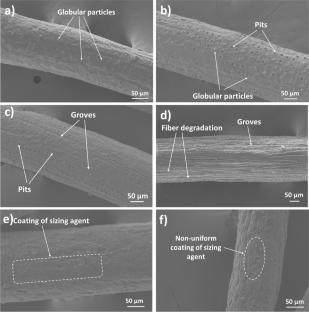
The use of natural fibers as an alternative to synthetic fibers for reinforcing composites is increasing. However, the poor interfacial adhesion between natural fibers and polymer matrices limits their applications. Several approaches have been considered to improve fiber-matrix adhesion via chemical and/or physical treatment. However, the effectiveness of these treatments varies based on the type of fiber, its source, and its composition. Thus, it is imperative to understand the effectiveness of treatment conditions. In this study, we investigated the influence of alkali treatment and fiber sizing on the chemical, thermal, morphological, and mechanical properties of coir fibers and the interface between coir fiber and polypropylene matrix. It was found that using a 5 wt% sodium hydroxide solution for 6 h at room temperature was the optimal treatment condition that led to an improvement in tensile strength by 58%, tensile modulus by 71%, and elongation at break by 37% compared to untreated fibers, and an increment in interfacial shear strength (IFSS) between coir fibers and polypropylene matrix by 32%. The alkali treatment removed the fiber surface impurities, made the fiber surface rough, and enhanced the fiber crystallinity. Sizing of the alkali-treated fiber led to an improvement in IFSS by 87% with no modification of the fiber’s mechanical properties.
期刊介绍:
Cellulose is an international journal devoted to the dissemination of research and scientific and technological progress in the field of cellulose and related naturally occurring polymers. The journal is concerned with the pure and applied science of cellulose and related materials, and also with the development of relevant new technologies. This includes the chemistry, biochemistry, physics and materials science of cellulose and its sources, including wood and other biomass resources, and their derivatives. Coverage extends to the conversion of these polymers and resources into manufactured goods, such as pulp, paper, textiles, and manufactured as well natural fibers, and to the chemistry of materials used in their processing. Cellulose publishes review articles, research papers, and technical notes.



 京公网安备 11010802042870号
京ICP备2023020795号-1
京公网安备 11010802042870号
京ICP备2023020795号-1

 分享
分享
 求助内容:
求助内容: 应助结果提醒方式:
 扫码关注我们
