Chengli Ding, Canming Hu, Xupeng Yang, Xiongfei An, Xiaojiao Chen
{"title":"Preparation and adsorption properties of cotton linters and coal-gangue-based cellulose/SiO2 composite aerogels","authors":"Chengli Ding, Canming Hu, Xupeng Yang, Xiongfei An, Xiaojiao Chen","doi":"10.1007/s10570-024-05958-x","DOIUrl":null,"url":null,"abstract":"<div><p>High-value comprehensive utilization of coal gangue solid waste, reducing synthesis cost and environmental hazards has become an important research direction for green development. In this study, acid–alkali treated coal gangue was used as the silica source, and abundant cotton short staple in Xinjiang was used as the raw material of aerogel. Cellulose/SiO<sub>2</sub> composite aerogels were prepared by sol–gel method using N–N methylenebisacrylamide (MBA) as cross-linking agent and hydrochloric acid (HCl) as catalyst. The samples were characterized and analyzed by XRD, SEM, FT-IR, XPS, EDS, BET, and mechanical property tests. The results show that the composites exhibit low density and high porosity. The density ranges from 0.118–0.290 g/cm<sup>−3</sup> with a high porosity of 92.5%. SEM and BET results showed that the composites showed a three-dimensional mesh structure, and the specific surface area was as high as 325.742 m<sup>2</sup>/g, with a pore size of 21.997 nm, which is a mesoporous material. The adsorption performance of the composite aerogel was tested by simulating wastewater with the dye methylene blue (MB), which showed that the adsorption amount of MB was 82.3 mg/g, and the adsorption amount showed a tendency of increasing and then decreasing with the increase of SiO<sub>2</sub>, and adsorption kinetics, adsorption isotherm and adsorption thermodynamic models were established to investigate the adsorption mechanism. The results showed that the adsorption process was more in line with the proposed secondary kinetics and Langmuir isothermal adsorption, which indicated that the adsorption process was a synergistic action of chemical adsorption and physical adsorption, and it was a monomolecular layer adsorption; thermodynamically, the adsorption process belonged to the spontaneous exothermic reaction. In addition, we explored the cyclic regeneration performance of the material, and after 5 cycles of adsorption experiments, the decrease rate was 3.9%, presenting good cyclic regeneration. Therefore, the results of this study provide new ideas and methods in solving the problem of environmental pollution caused by excessive accumulation of coal gangue, as well as providing a good new application prospect for composite aerogel and a theoretical basis for the development of low-cost new advanced materials.</p></div>","PeriodicalId":511,"journal":{"name":"Cellulose","volume":"31 10","pages":"6335 - 6354"},"PeriodicalIF":4.8000,"publicationDate":"2024-06-08","publicationTypes":"Journal Article","fieldsOfStudy":null,"isOpenAccess":false,"openAccessPdf":"","citationCount":"0","resultStr":null,"platform":"Semanticscholar","paperid":null,"PeriodicalName":"Cellulose","FirstCategoryId":"88","ListUrlMain":"https://link.springer.com/article/10.1007/s10570-024-05958-x","RegionNum":2,"RegionCategory":"工程技术","ArticlePicture":[],"TitleCN":null,"AbstractTextCN":null,"PMCID":null,"EPubDate":"","PubModel":"","JCR":"Q1","JCRName":"MATERIALS SCIENCE, PAPER & WOOD","Score":null,"Total":0}
引用次数: 0
Abstract
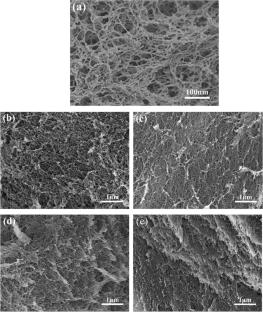
High-value comprehensive utilization of coal gangue solid waste, reducing synthesis cost and environmental hazards has become an important research direction for green development. In this study, acid–alkali treated coal gangue was used as the silica source, and abundant cotton short staple in Xinjiang was used as the raw material of aerogel. Cellulose/SiO2 composite aerogels were prepared by sol–gel method using N–N methylenebisacrylamide (MBA) as cross-linking agent and hydrochloric acid (HCl) as catalyst. The samples were characterized and analyzed by XRD, SEM, FT-IR, XPS, EDS, BET, and mechanical property tests. The results show that the composites exhibit low density and high porosity. The density ranges from 0.118–0.290 g/cm−3 with a high porosity of 92.5%. SEM and BET results showed that the composites showed a three-dimensional mesh structure, and the specific surface area was as high as 325.742 m2/g, with a pore size of 21.997 nm, which is a mesoporous material. The adsorption performance of the composite aerogel was tested by simulating wastewater with the dye methylene blue (MB), which showed that the adsorption amount of MB was 82.3 mg/g, and the adsorption amount showed a tendency of increasing and then decreasing with the increase of SiO2, and adsorption kinetics, adsorption isotherm and adsorption thermodynamic models were established to investigate the adsorption mechanism. The results showed that the adsorption process was more in line with the proposed secondary kinetics and Langmuir isothermal adsorption, which indicated that the adsorption process was a synergistic action of chemical adsorption and physical adsorption, and it was a monomolecular layer adsorption; thermodynamically, the adsorption process belonged to the spontaneous exothermic reaction. In addition, we explored the cyclic regeneration performance of the material, and after 5 cycles of adsorption experiments, the decrease rate was 3.9%, presenting good cyclic regeneration. Therefore, the results of this study provide new ideas and methods in solving the problem of environmental pollution caused by excessive accumulation of coal gangue, as well as providing a good new application prospect for composite aerogel and a theoretical basis for the development of low-cost new advanced materials.
期刊介绍:
Cellulose is an international journal devoted to the dissemination of research and scientific and technological progress in the field of cellulose and related naturally occurring polymers. The journal is concerned with the pure and applied science of cellulose and related materials, and also with the development of relevant new technologies. This includes the chemistry, biochemistry, physics and materials science of cellulose and its sources, including wood and other biomass resources, and their derivatives. Coverage extends to the conversion of these polymers and resources into manufactured goods, such as pulp, paper, textiles, and manufactured as well natural fibers, and to the chemistry of materials used in their processing. Cellulose publishes review articles, research papers, and technical notes.




 京公网安备 11010802042870号
京ICP备2023020795号-1
京公网安备 11010802042870号
京ICP备2023020795号-1

 分享
分享
 求助内容:
求助内容: 应助结果提醒方式:
 扫码关注我们
