Cattle intensification based on silvopastoral systems with Leucaena leucocephala (Lam.) de Wit as a strategy to increase production and mitigate greenhouse gas emissions in the Caribbean region of Colombia
Julián E. Rivera, Gonzalo O. Villegas, Laura P. Serna, Julián Chará
{"title":"Cattle intensification based on silvopastoral systems with Leucaena leucocephala (Lam.) de Wit as a strategy to increase production and mitigate greenhouse gas emissions in the Caribbean region of Colombia","authors":"Julián E. Rivera, Gonzalo O. Villegas, Laura P. Serna, Julián Chará","doi":"10.1007/s10457-024-01000-y","DOIUrl":null,"url":null,"abstract":"<div><p>Different cattle production interventions have been proposed to reduce greenhouse gas (GHG) emissions and increase animal productivity, but few studies have identified their real potential under grazing conditions and at the whole system level. The aim of this study was to determine the effect of silvopastoral systems (SPS) with <i>Leucaena leucocephala</i> on total GHG emissions, emission intensity, GHG balance and cattle productivity in a series of production scenarios in northern Colombia. A life cycle analysis (LCA) approach was used to evaluate one baseline system (BL) based on pastures and four SPS intervention scenarios. For this analysis, the emissions from enteric fermentation and manure were determined in situ. Methane emissions from enteric fermentation were 9.7% lower in the SPS with leucaena than in BL systems (<i>p</i> = 0.0369). Emission factors for manure were higher in the BL systems (<i>p</i> < 0.05) as were emission intensities to produce one kg of fat and protein corrected milk (FPCM) and one kg of live weight gain (LWG). For animal production and GHG balance, it was found that the inclusion of leucaena increased animal production up to four times compared to the BL system and mitigated GHG emissions per hectare up to 86% due to carbon sequestration. In conclusion, leucaena SPSs are an alternative to mitigate climate change under grazing conditions, as they reduce GHG emissions and increase animal productivity.</p></div>","PeriodicalId":7610,"journal":{"name":"Agroforestry Systems","volume":"98 7","pages":"2125 - 2139"},"PeriodicalIF":2.2000,"publicationDate":"2024-06-08","publicationTypes":"Journal Article","fieldsOfStudy":null,"isOpenAccess":false,"openAccessPdf":"","citationCount":"0","resultStr":null,"platform":"Semanticscholar","paperid":null,"PeriodicalName":"Agroforestry Systems","FirstCategoryId":"97","ListUrlMain":"https://link.springer.com/article/10.1007/s10457-024-01000-y","RegionNum":3,"RegionCategory":"农林科学","ArticlePicture":[],"TitleCN":null,"AbstractTextCN":null,"PMCID":null,"EPubDate":"","PubModel":"","JCR":"Q2","JCRName":"AGRONOMY","Score":null,"Total":0}
引用次数: 0
Abstract
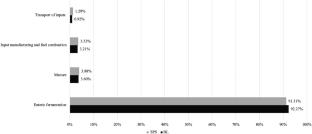
Different cattle production interventions have been proposed to reduce greenhouse gas (GHG) emissions and increase animal productivity, but few studies have identified their real potential under grazing conditions and at the whole system level. The aim of this study was to determine the effect of silvopastoral systems (SPS) with Leucaena leucocephala on total GHG emissions, emission intensity, GHG balance and cattle productivity in a series of production scenarios in northern Colombia. A life cycle analysis (LCA) approach was used to evaluate one baseline system (BL) based on pastures and four SPS intervention scenarios. For this analysis, the emissions from enteric fermentation and manure were determined in situ. Methane emissions from enteric fermentation were 9.7% lower in the SPS with leucaena than in BL systems (p = 0.0369). Emission factors for manure were higher in the BL systems (p < 0.05) as were emission intensities to produce one kg of fat and protein corrected milk (FPCM) and one kg of live weight gain (LWG). For animal production and GHG balance, it was found that the inclusion of leucaena increased animal production up to four times compared to the BL system and mitigated GHG emissions per hectare up to 86% due to carbon sequestration. In conclusion, leucaena SPSs are an alternative to mitigate climate change under grazing conditions, as they reduce GHG emissions and increase animal productivity.
期刊介绍:
Agroforestry Systems is an international scientific journal that publishes results of novel, high impact original research, critical reviews and short communications on any aspect of agroforestry. The journal particularly encourages contributions that demonstrate the role of agroforestry in providing commodity as well non-commodity benefits such as ecosystem services. Papers dealing with both biophysical and socioeconomic aspects are welcome. These include results of investigations of a fundamental or applied nature dealing with integrated systems involving trees and crops and/or livestock. Manuscripts that are purely descriptive in nature or confirmatory in nature of well-established findings, and with limited international scope are discouraged. To be acceptable for publication, the information presented must be relevant to a context wider than the specific location where the study was undertaken, and provide new insight or make a significant contribution to the agroforestry knowledge base



 京公网安备 11010802042870号
京ICP备2023020795号-1
京公网安备 11010802042870号
京ICP备2023020795号-1

 分享
分享
 求助内容:
求助内容: 应助结果提醒方式:
 扫码关注我们
