{"title":"Applications of in-situ spectroscopic techniques towards CO2 electroreduction","authors":"Haoyu Zhang, Chaoyue Gu, Minghui Fan, Zhi Zhao, Xiangdong Kong, Zhigang Geng","doi":"10.1007/s11426-024-2113-7","DOIUrl":null,"url":null,"abstract":"<div><p><i>In-situ</i> experimental techniques have been widely applied to uncover the dynamic evolutions of both the structure of catalysts and the interfacial property of catalysis, thus serving as the most important means to gain molecular-level insights into the reaction mechanisms. In this mini review, we summarized recent progress in the applications of the interface-sensitive <i>in-situ</i> Raman and <i>in-situ</i> infrared (IR) spectroscopy towards CO<sub>2</sub> electroreduction. Specifically, we concentrated on two aspects to clarify the role of both <i>in-situ</i> Raman and <i>in-situ</i> IR in revealing reaction mechanisms of CO<sub>2</sub> electroreduction. The first one was the <i>in-situ</i> spectroscopy for detecting the active structures. The other one was the <i>in-situ</i> spectroscopy for capturing the reaction intermediates. As powerful guidance for the rational design of catalysts, the reaction mechanism was discussed in the specific examples. Finally, we try to predict the trends for the future development of <i>in-situ</i> spectroscopic techniques towards heterogeneous catalysis.</p><div><figure><div><div><picture><source><img></source></picture></div></div></figure></div></div>","PeriodicalId":772,"journal":{"name":"Science China Chemistry","volume":"67 12","pages":"3925 - 3933"},"PeriodicalIF":9.7000,"publicationDate":"2024-06-06","publicationTypes":"Journal Article","fieldsOfStudy":null,"isOpenAccess":false,"openAccessPdf":"","citationCount":"0","resultStr":null,"platform":"Semanticscholar","paperid":null,"PeriodicalName":"Science China Chemistry","FirstCategoryId":"1","ListUrlMain":"https://link.springer.com/article/10.1007/s11426-024-2113-7","RegionNum":1,"RegionCategory":"化学","ArticlePicture":[],"TitleCN":null,"AbstractTextCN":null,"PMCID":null,"EPubDate":"","PubModel":"","JCR":"Q1","JCRName":"CHEMISTRY, MULTIDISCIPLINARY","Score":null,"Total":0}
引用次数: 0
Abstract
In-situ experimental techniques have been widely applied to uncover the dynamic evolutions of both the structure of catalysts and the interfacial property of catalysis, thus serving as the most important means to gain molecular-level insights into the reaction mechanisms. In this mini review, we summarized recent progress in the applications of the interface-sensitive in-situ Raman and in-situ infrared (IR) spectroscopy towards CO2 electroreduction. Specifically, we concentrated on two aspects to clarify the role of both in-situ Raman and in-situ IR in revealing reaction mechanisms of CO2 electroreduction. The first one was the in-situ spectroscopy for detecting the active structures. The other one was the in-situ spectroscopy for capturing the reaction intermediates. As powerful guidance for the rational design of catalysts, the reaction mechanism was discussed in the specific examples. Finally, we try to predict the trends for the future development of in-situ spectroscopic techniques towards heterogeneous catalysis.
期刊介绍:
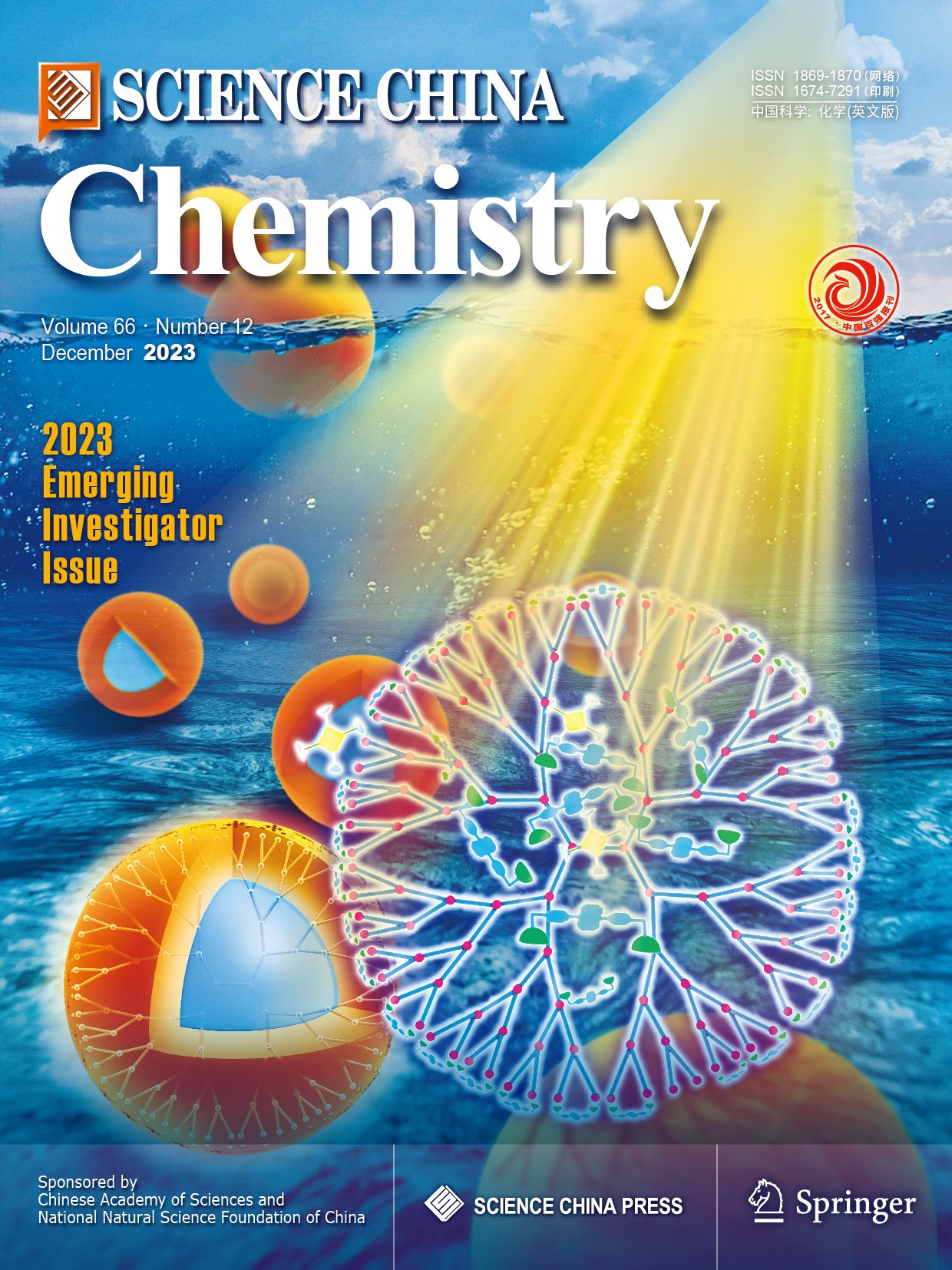
Science China Chemistry, co-sponsored by the Chinese Academy of Sciences and the National Natural Science Foundation of China and published by Science China Press, publishes high-quality original research in both basic and applied chemistry. Indexed by Science Citation Index, it is a premier academic journal in the field.
Categories of articles include:
Highlights. Brief summaries and scholarly comments on recent research achievements in any field of chemistry.
Perspectives. Concise reports on thelatest chemistry trends of interest to scientists worldwide, including discussions of research breakthroughs and interpretations of important science and funding policies.
Reviews. In-depth summaries of representative results and achievements of the past 5–10 years in selected topics based on or closely related to the research expertise of the authors, providing a thorough assessment of the significance, current status, and future research directions of the field.



 京公网安备 11010802042870号
京ICP备2023020795号-1
京公网安备 11010802042870号
京ICP备2023020795号-1

 分享
分享
 求助内容:
求助内容: 应助结果提醒方式:
 扫码关注我们
